Department of Neuroscience, Physiology and Pharmacology, University College London, Gower Street, London, WC1E 6BT, UK.
Department of Pharmacology, Emory University School of Medicine, Rollins Research Center, 1510 Clifton Road, Atlanta, GA, 30322, USA.
J Physiol. 2018 Sep;596(17):4057-4089. doi: 10.1113/JP276093. Epub 2018 Aug 1.
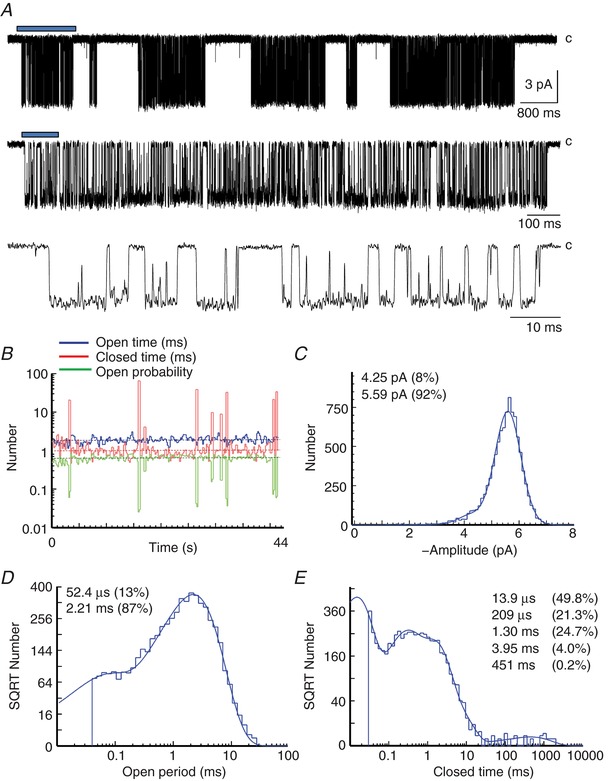
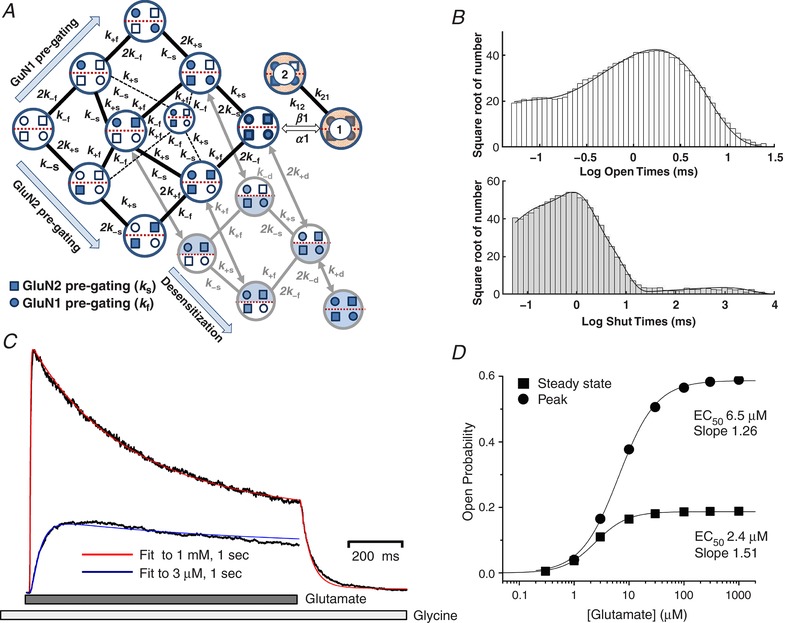
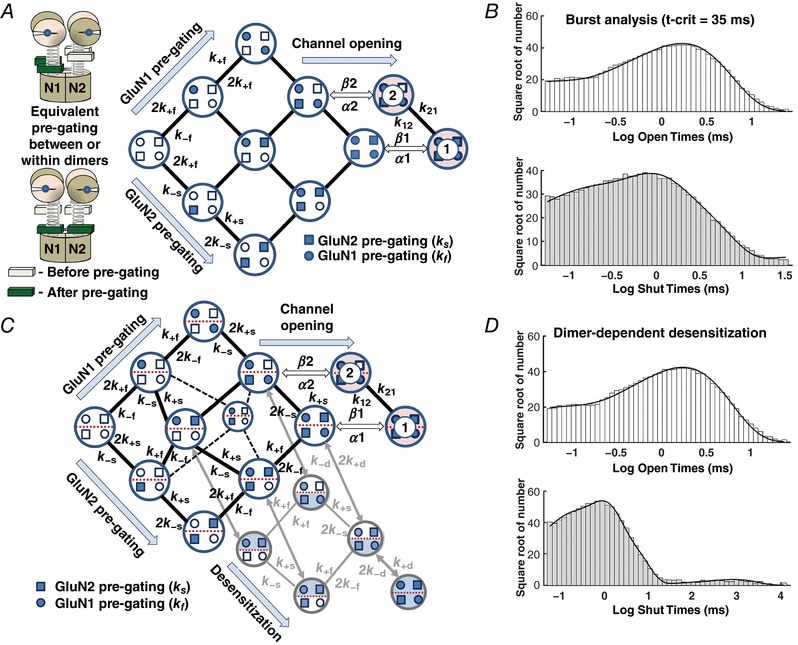
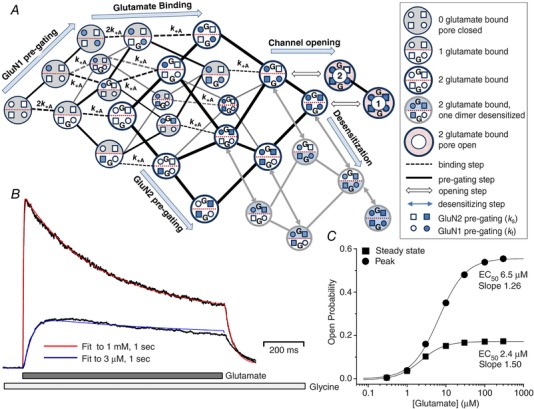
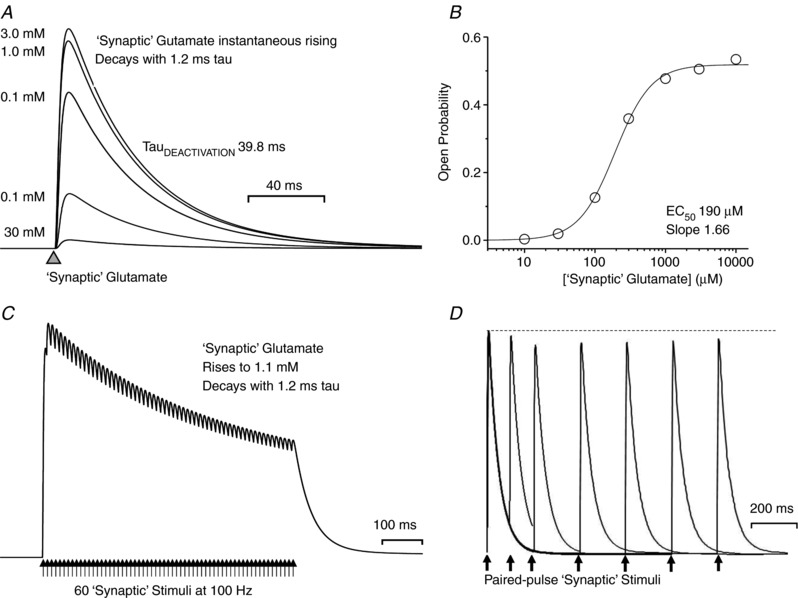
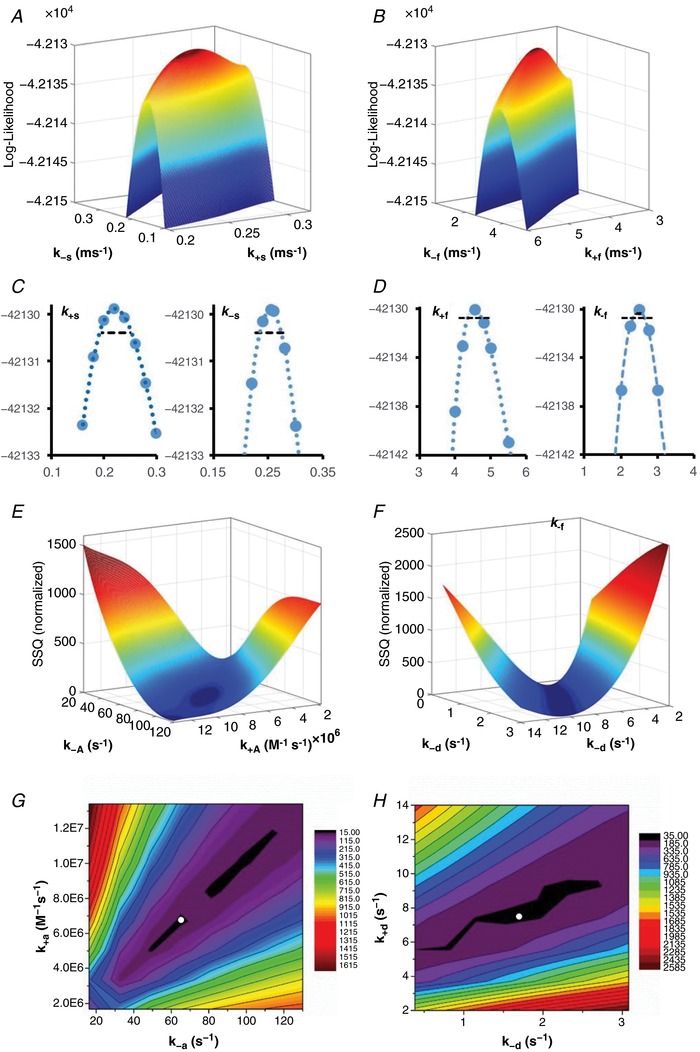
The kinetics of NMDA receptor (NMDAR) signalling are a critical aspect of the physiology of excitatory synaptic transmission in the brain. Here we develop a mechanistic description of NMDAR function based on the receptor tetrameric structure and the principle that each agonist-bound subunit must undergo some rate-limiting conformational change after agonist binding, prior to channel opening. By fitting this mechanism to single channel data using a new MATLAB-based software implementation of maximum likelihood fitting with correction for limited time resolution, rate constants were derived for this mechanism that reflect distinct structural changes and predict the properties of macroscopic and synaptic NMDAR currents. The principles applied here to develop a mechanistic description of the heterotetrameric NMDAR, and the software used in this analysis, can be equally applied to other heterotetrameric glutamate receptors, providing a unifying mechanistic framework to understanding the physiology of glutamate receptor signalling in the brain.
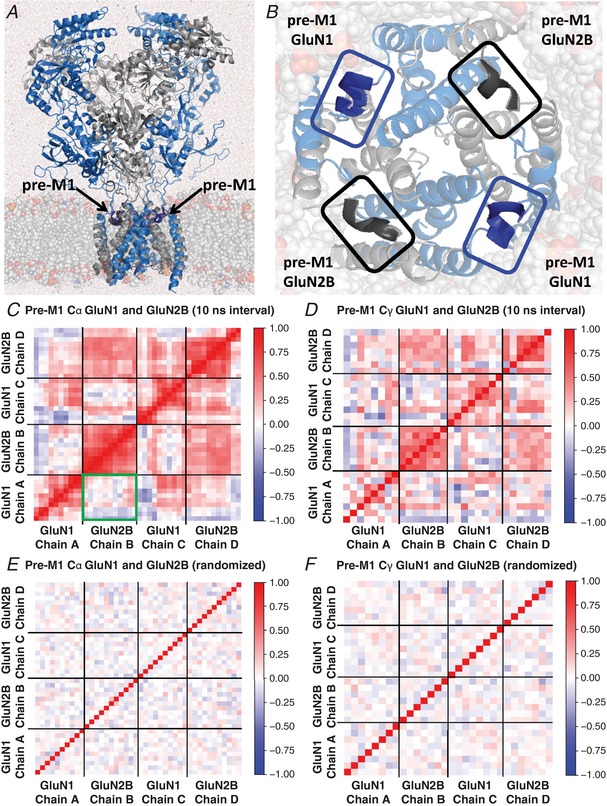
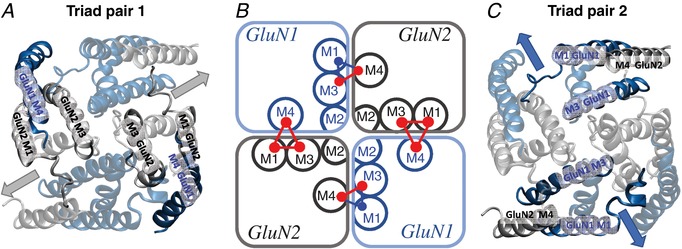
NMDA receptors (NMDARs) are tetrameric complexes comprising two glycine-binding GluN1 and two glutamate-binding GluN2 subunits. Four GluN2 subunits encoded by different genes can produce up to 10 different di- and triheteromeric receptors. In addition, some neurological patients contain a de novo mutation or inherited rare variant in only one subunit. There is currently no mechanistic framework to describe tetrameric receptor function that can be extended to receptors with two different GluN1 or GluN2 subunits. Here we use the structural features of glutamate receptors to develop a mechanism describing both single channel and macroscopic NMDAR currents. We propose that each agonist-bound subunit undergoes some rate-limiting conformational change after agonist binding, prior to channel opening. We hypothesize that this conformational change occurs within a triad of interactions between a short helix preceding the M1 transmembrane helix, the highly conserved M3 motif encoded by the residues SYTANLAAF, and the linker preceding the M4 transmembrane helix of the adjacent subunit. Molecular dynamics simulations suggest that pre-M1 helix motion is uncorrelated between subunits, which we interpret to suggest independent subunit-specific conformational changes may influence these pre-gating steps. According to this interpretation, these conformational changes are the main determinants of the key kinetic properties of NMDA receptor activation following agonist binding, and so these steps sculpt their physiological role. We show that this structurally derived tetrameric model describes both single channel and macroscopic data, giving a new approach to interpreting functional properties of synaptic NMDARs that provides a logical framework to understanding receptors with non-identical subunits.
N-甲基-D-天冬氨酸受体(NMDAR)信号转导动力学是大脑中兴奋性突触传递生理学的一个关键方面。在这里,我们基于受体四聚体结构和这样一个原理,即每个与激动剂结合的亚基在通道打开之前,必须在与激动剂结合后经历一些限速构象变化,来构建 NMDAR 功能的机制描述。通过使用基于 MATLAB 的新软件实现最大似然拟合,并对有限的时间分辨率进行修正,将该机制拟合到单通道数据中,从而得出反映不同结构变化的该机制的速率常数,并预测宏观和突触 NMDAR 电流的特性。此处应用的原理用于开发异四聚体 NMDAR 的机制描述,以及在此分析中使用的软件,可以同样应用于其他异四聚体谷氨酸受体,为理解大脑中谷氨酸受体信号转导的生理学提供一个统一的机制框架。
N-甲基-D-天冬氨酸受体(NMDAR)是由两个甘氨酸结合的 GluN1 和两个谷氨酸结合的 GluN2 亚基组成的四聚体复合物。由不同基因编码的四个 GluN2 亚基可以产生多达 10 种不同的二聚体和三聚体受体。此外,一些神经患者仅在一个亚基中存在新的基因突变或遗传罕见变体。目前还没有能够扩展到具有两个不同 GluN1 或 GluN2 亚基的受体的描述四聚体受体功能的机制框架。在这里,我们使用谷氨酸受体的结构特征来开发一种描述单个通道和宏观 NMDAR 电流的机制。我们提出,每个与激动剂结合的亚基在与激动剂结合后、通道打开之前,都会经历一些限速构象变化。我们假设这种构象变化发生在由 M1 跨膜螺旋之前的短螺旋、由 SYTANLAAF 编码的高度保守的 M3 基序和相邻亚基的 M4 跨膜螺旋之前的连接子之间的三联体相互作用内。分子动力学模拟表明,前 M1 螺旋运动在亚基之间是不相关的,我们将其解释为表明独立的亚基特异性构象变化可能影响这些前门控步骤。根据这种解释,这些构象变化是 NMDA 受体激动剂结合后激活的关键动力学特性的主要决定因素,因此这些步骤塑造了它们的生理作用。我们表明,这种基于结构的四聚体模型描述了单个通道和宏观数据,为解释突触 NMDAR 的功能特性提供了一种新方法,为理解具有非同源亚基的受体提供了一个逻辑框架。