University of Pennsylvania School of Medicine, Philadelphia, Pennsylvania, USA.
Emerg Infect Dis. 2011 Jun;17(6):1037-43. doi: 10.3201/eid/1706.100358.
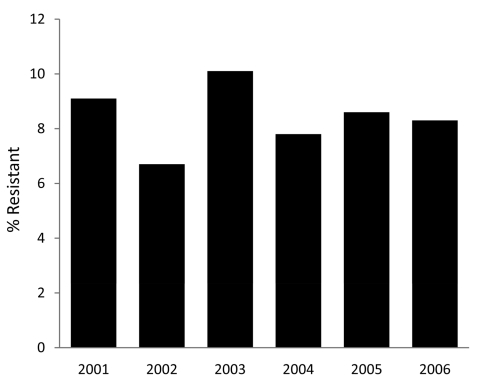
Resistance to extended-spectrum cephalosporins complicates treatment of Pseudomonas aeruginosa infections. To elucidate risk factors for cefepime-resistant P. aeruginosa and determine its association with patient death, we conducted a case-control study in Philadelphia, Pennsylvania. Among 2,529 patients hospitalized during 2001-2006, a total of 213 (8.4%) had cefepime-resistant P. aeruginosa infection. Independent risk factors were prior use of an extended-spectrum cephalosphorin (p<0.001), prior use of an extended-spectrum penicillin (p = 0.005), prior use of a quinolone (p<0.001), and transfer from an outside facility (p = 0.01). Among those hospitalized at least 30 days, mortality rates were higher for those with cefepime-resistant than with cefepime-susceptible P. aeruginosa infection (20.2% vs. 13.2%, p = 0.007). Cefepime-resistant P. aeruginosa was an independent risk factor for death only for patients for whom it could be isolated from blood (p = 0.001). Strategies to counter its emergence should focus on optimizing use of antipseudomonal drugs.
对扩展谱头孢菌素的耐药性使铜绿假单胞菌感染的治疗复杂化。为了阐明对头孢吡肟耐药的铜绿假单胞菌的危险因素,并确定其与患者死亡的关系,我们在宾夕法尼亚州费城进行了一项病例对照研究。在 2001 年至 2006 年期间住院的 2529 名患者中,共有 213 名(8.4%)患有头孢吡肟耐药的铜绿假单胞菌感染。独立的危险因素是先前使用了扩展谱头孢菌素(p<0.001)、先前使用了扩展谱青霉素(p=0.005)、先前使用了喹诺酮类药物(p<0.001)以及从外部医疗机构转入(p=0.01)。在至少住院 30 天的患者中,头孢吡肟耐药的铜绿假单胞菌感染患者的死亡率高于头孢吡肟敏感的铜绿假单胞菌感染患者(20.2% vs. 13.2%,p=0.007)。只有当可以从血液中分离出头孢吡肟耐药的铜绿假单胞菌时,头孢吡肟耐药的铜绿假单胞菌才是死亡的独立危险因素(p=0.001)。对抗其出现的策略应侧重于优化使用抗假单胞菌药物。