Department of Building and Construction, City University of Hong Kong, Tat Chee Avenue, Kowloon Tong, Hong Kong.
J Hazard Mater. 2011 Sep 15;192(3):1299-306. doi: 10.1016/j.jhazmat.2011.06.040. Epub 2011 Jul 12.
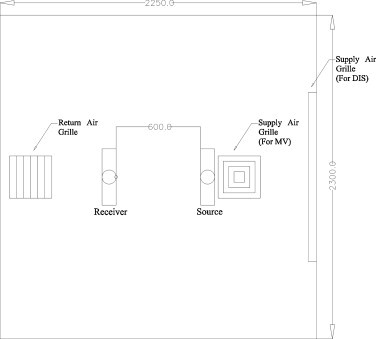
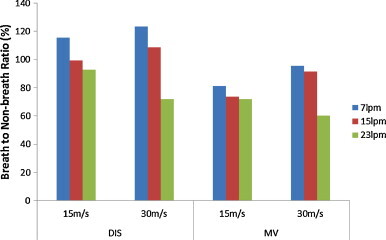
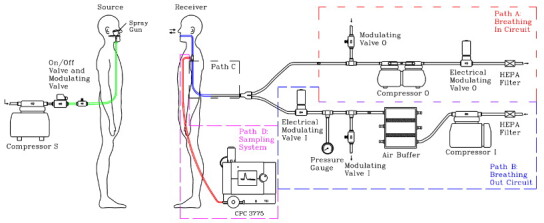
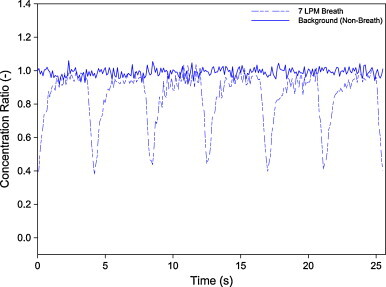
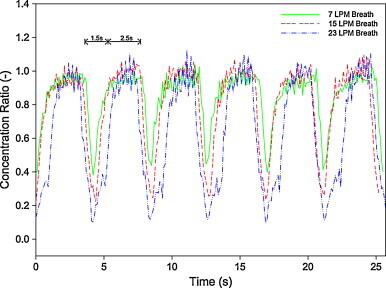
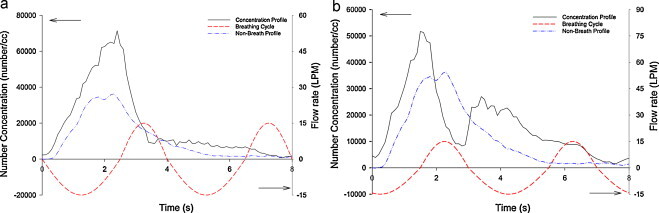
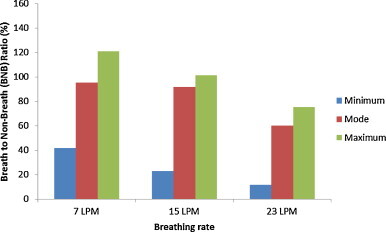
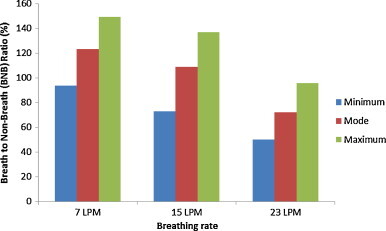
Estimating inhalation dose accurately under realistic conditions can enhance the accuracy of risk assessment. Conventional methods to quantify aerosol concentration that susceptible victims in contaminated environments are exposed to use real time particle counters to measure concentrations in environments without occupancy. Breathing-induced airflow interacts and influences concentration around nostrils or mouth and alter the ultimate exposure. This subject has not yet been systematically studied, particularly under transient emission. In this work, an experimental facility comprising two manikins was designed and fabricated. One of them mimicked realistic breathing, acting as a susceptible victim. Both steady and episodic emissions were generated in an air-conditioned environmental chamber in which two different ventilation schemes were tested. The scaled-dose of the victim under different expiratory velocities and pulmonary ventilation was measured. Inferring from results obtained from comprehensive tests, it can be concluded that breathing has very significant influence on the ultimate dose compared with that without breathing. Majority of results show that breathing reduces inhalation quantity and the reduction magnitude increases with breathing rate. This is attributed to the fact that the exhalation process plays a more significant role in reducing the dose level than the enhanced effect during inhalation period. The higher the breathing rate, the sharper the decline of the resultant concentration would be leading to lower dose. Nevertheless, under low pulmonary ventilation, results show that breathing increases dose marginally. Results also reveals that ventilation scheme also affects the exposure.
准确估算实际条件下的吸入剂量可以提高风险评估的准确性。传统的量化气溶胶浓度的方法是在无人居住的环境中使用实时粒子计数器来测量环境中的浓度,以确定易受感染的受害者在污染环境中所接触的浓度。呼吸引起的气流会相互作用并影响鼻孔或口腔周围的浓度,并改变最终的暴露量。这个问题尚未得到系统研究,特别是在瞬时排放的情况下。在这项工作中,设计并制造了一个由两个模拟人组成的实验设备。其中一个模拟真实呼吸,充当易受感染的受害者。在一个装有空调的环境室中产生了稳定和间歇排放,测试了两种不同的通风方案。测量了在不同呼气速度和肺通气下受害者的比例剂量。从全面测试获得的结果推断,与不呼吸相比,呼吸对最终剂量有非常显著的影响。大多数结果表明,呼吸会减少吸入量,且随着呼吸率的增加,减少的幅度也会增加。这是因为呼气过程在降低剂量水平方面比吸气期间的增强效果更为重要。呼吸率越高,最终浓度的下降幅度就越大,导致剂量越低。然而,在低肺通气下,结果表明呼吸会使剂量略有增加。结果还表明,通风方案也会影响暴露。