Research Center for Molecular and Developmental Biology, Key Laboratory of Photosynthesis and Environmental Molecular Physiology, Institute of Botany, The Chinese Academy of Sciences, Beijing, China.
PLoS One. 2011;6(7):e21945. doi: 10.1371/journal.pone.0021945. Epub 2011 Jul 6.
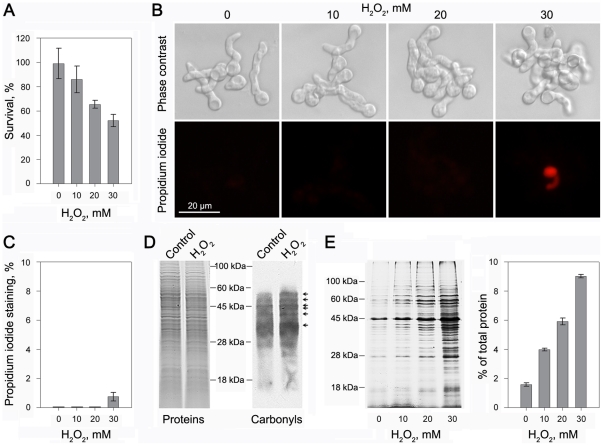
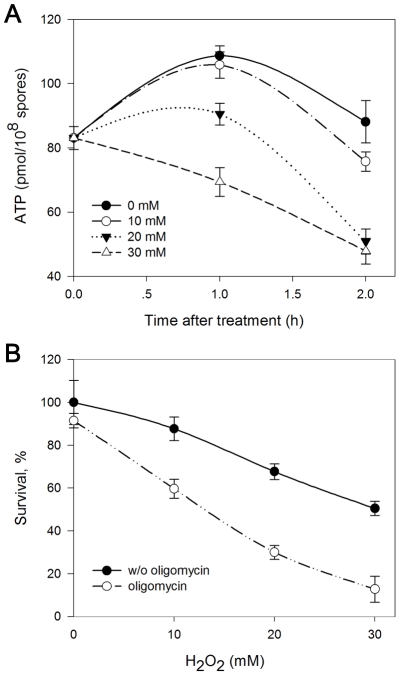
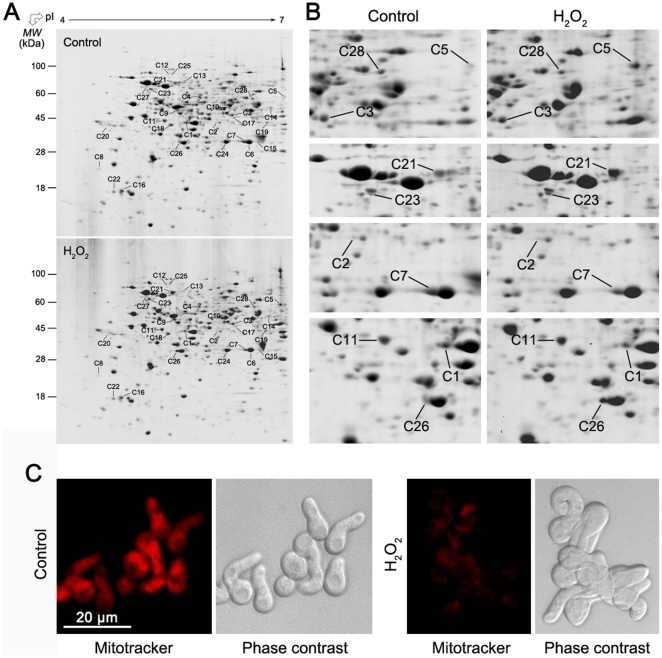
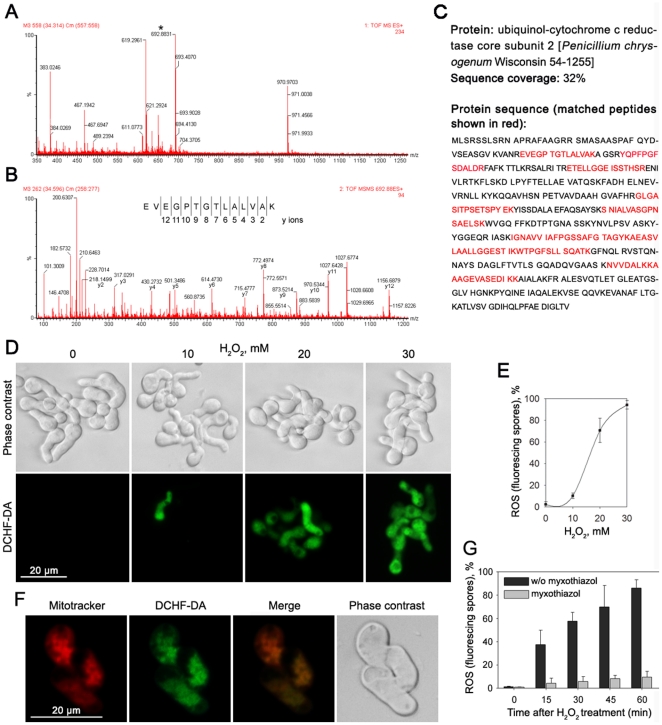
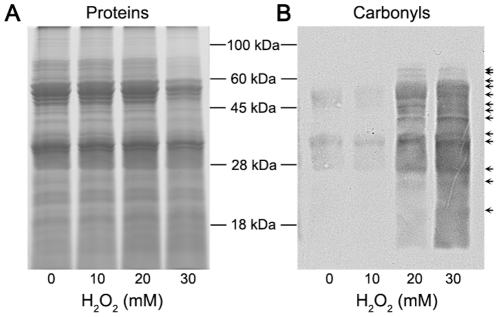
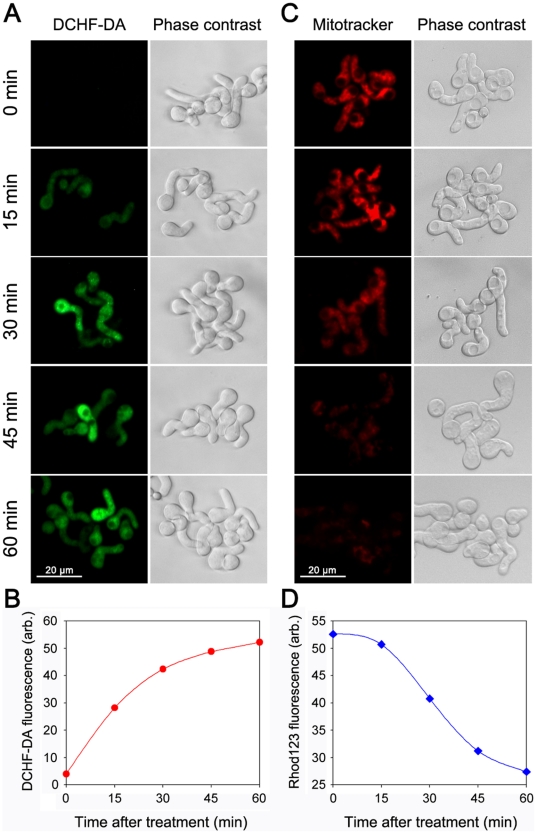
How the host cells of plants and animals protect themselves against fungal invasion is a biologically interesting and economically important problem. Here we investigate the mechanistic process that leads to death of Penicillium expansum, a widespread phytopathogenic fungus, by identifying the cellular compounds affected by hydrogen peroxide (H(2)O(2)) that is frequently produced as a response of the host cells. We show that plasma membrane damage was not the main reason for H(2)O(2)-induced death of the fungal pathogen. Proteomic analysis of the changes of total cellular proteins in P. expansum showed that a large proportion of the differentially expressed proteins appeared to be of mitochondrial origin, implying that mitochondria may be involved in this process. We then performed mitochondrial sub-proteomic analysis to seek the H(2)O(2)-sensitive proteins in P. expansum. A set of mitochondrial proteins were identified, including respiratory chain complexes I and III, F(1)F(0) ATP synthase, and mitochondrial phosphate carrier protein. The functions of several proteins were further investigated to determine their effects on the H(2)O(2)-induced fungal death. Through fluorescent co-localization and the use of specific inhibitor, we provide evidence that complex III of the mitochondrial respiratory chain contributes to ROS generation in fungal mitochondria under H(2)O(2) stress. The undesirable accumulation of ROS caused oxidative damage of mitochondrial proteins and led to the collapse of mitochondrial membrane potential. Meanwhile, we demonstrate that ATP synthase is involved in the response of fungal pathogen to oxidative stress, because inhibition of ATP synthase by oligomycin decreases survival. Our data suggest that mitochondrial impairment due to functional alteration of oxidative stress-sensitive proteins is associated with fungal death caused by H(2)O(2).
动植物细胞如何保护自己免受真菌入侵是一个具有生物学意义和经济重要性的问题。在这里,我们通过鉴定宿主细胞产生的过氧化氢 (H(2)O(2)) 影响的细胞化合物来研究导致广泛植物病原菌扩展青霉 (Penicillium expansum) 死亡的机制过程。我们表明,质膜损伤不是 H(2)O(2)诱导真菌病原体死亡的主要原因。对扩展青霉总细胞蛋白变化的蛋白质组学分析表明,大量差异表达的蛋白质似乎来自线粒体,这意味着线粒体可能参与了这一过程。然后,我们进行了线粒体亚蛋白质组分析,以寻找扩展青霉中对 H(2)O(2)敏感的蛋白质。鉴定了一组线粒体蛋白,包括呼吸链复合物 I 和 III、F(1)F(0)ATP 合酶和线粒体磷酸盐载体蛋白。进一步研究了几种蛋白质的功能,以确定它们对 H(2)O(2)诱导的真菌死亡的影响。通过荧光共定位和使用特定抑制剂,我们提供了证据表明,在线粒体呼吸链复合物 III 下,H(2)O(2)应激会导致真菌线粒体中 ROS 的产生。ROS 的不期望积累导致线粒体蛋白的氧化损伤,并导致线粒体膜电位崩溃。同时,我们证明 ATP 合酶参与真菌病原体对氧化应激的反应,因为寡霉素抑制 ATP 合酶会降低存活率。我们的数据表明,由于氧化应激敏感蛋白功能改变导致的线粒体损伤与 H(2)O(2)引起的真菌死亡有关。