Sisk Matthew L, Shea John J
Interdepartmental Doctoral Program in Anthropological Sciences, Stony Brook University, Stony Brook, NY 11794-4364, USA.
Int J Evol Biol. 2011;2011:968012. doi: 10.4061/2011/968012. Epub 2011 Mar 30.
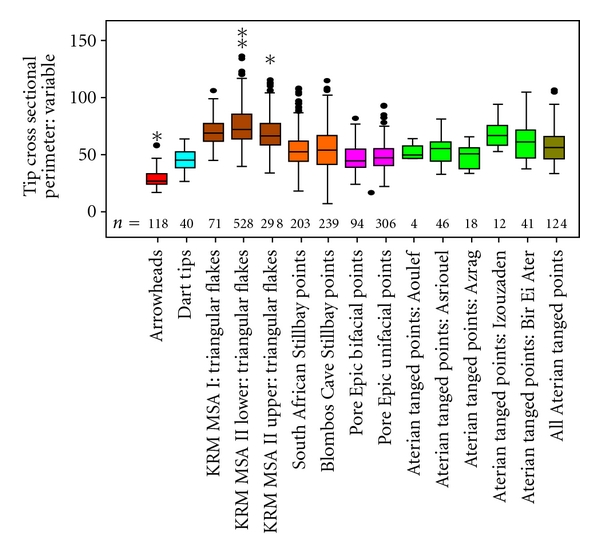
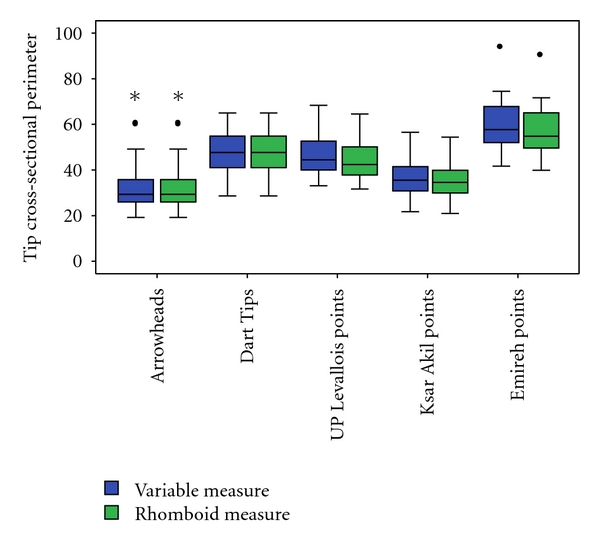
Despite a body of literature focusing on the functionality of modern and stylistically distinct projectile points, comparatively little attention has been paid to quantifying the functionality of the early stages of projectile use. Previous work identified a simple ballistics measure, the Tip Cross-Sectional Area, as a way of determining if a given class of stone points could have served as effective projectile armatures. Here we use this in combination with an alternate measure, the Tip Cross-Sectional Perimeter, a more accurate proxy of the force needed to penetrate a target to a lethal depth. The current study discusses this measure and uses it to analyze a collection of measurements from African Middle Stone Age pointed stone artifacts. Several point types that were rejected in previous studies are statistically indistinguishable from ethnographic projectile points using this new measure. The ramifications of this finding for a Middle Stone Age origin of complex projectile technology is discussed.
尽管有大量文献关注现代风格独特的投射尖状器的功能,但相对而言,对投射器使用早期阶段功能的量化研究较少。先前的研究确定了一种简单的弹道测量方法,即尖端横截面积,以此来判断某类石制尖状器是否可作为有效的投射器电枢。在此,我们将其与另一种测量方法——尖端横截面周长相结合,后者是将目标穿透至致死深度所需力的更精确指标。本研究讨论了这一测量方法,并运用它来分析一组来自非洲中石器时代尖状石制器物的测量数据。使用这一新方法,先前研究中被排除的几种尖状器类型在统计学上与民族志投射器尖状器并无差异。本文讨论了这一发现对复杂投射技术起源于中石器时代的影响。