Mincione Gabriella, Di Marcantonio Maria Carmela, Tarantelli Chiara, D'Inzeo Sonia, Nicolussi Arianna, Nardi Francesco, Donini Caterina Francesca, Coppa Anna
Department of Oncology and Experimental Medicine, University "G. d'Annunzio" Chieti-Pescara, 66013 Chieti, Italy.
J Thyroid Res. 2011;2011:431718. doi: 10.4061/2011/431718. Epub 2011 Jun 13.
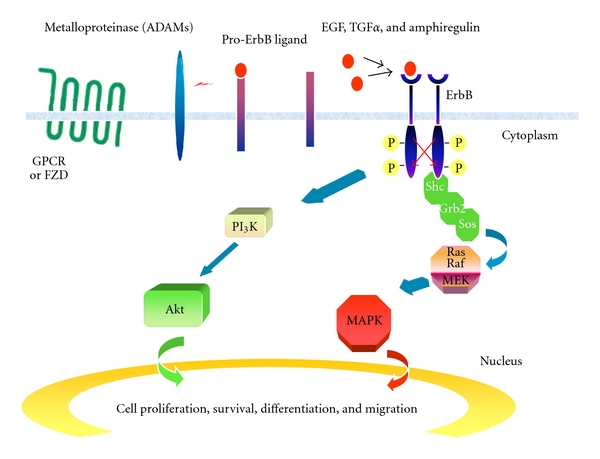
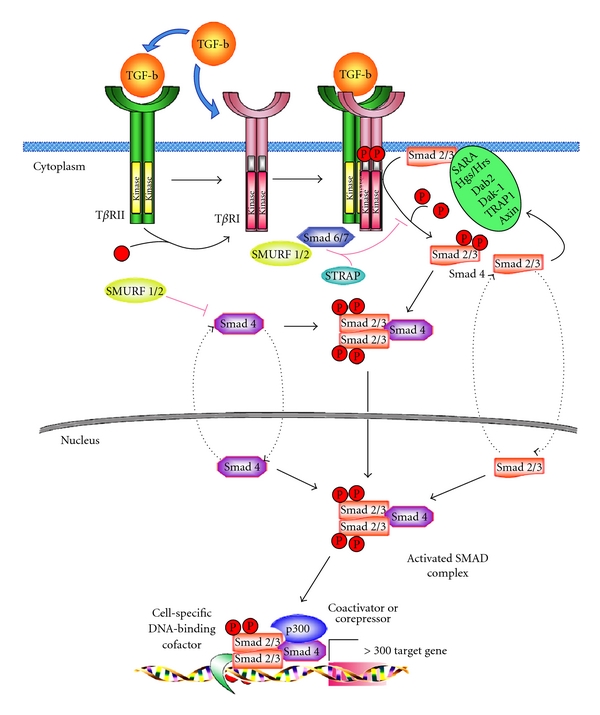
Normal epithelial thyroid cells in culture are inhibited by TGF-β1. Instead, transformed thyroid cell lines are frequently resistant to its growth inhibitory effect. Loss of TGF-β responsiveness could be due to a reduced expression of TGF-β receptors, as shown in transformed rat thyroid cell lines and in human thyroid tumors, or to alterations of other genes controlling TGF-β signal transduction pathway. However, in thyroid neoplasia, a complex pattern of alterations occurring during transformation and progression has been identified. Functionally, TGF-β1 acts as a tumor suppressor in the early stage of transformation or as a tumor promoter in advanced cancer. This peculiar pleiotropic behaviour of TGF-β may result from cross-talk with signalling pathways mediated by other growth factors, among which EGF-like ligands play an important role. This paper reports evidences on TGF-β1 and EGF systems in thyroid tumors and on the cross-talk between these growth factors in thyroid cancer.
培养中的正常甲状腺上皮细胞会受到转化生长因子-β1(TGF-β1)的抑制。相反,转化的甲状腺细胞系通常对其生长抑制作用具有抗性。TGF-β反应性的丧失可能是由于TGF-β受体表达降低,如在转化的大鼠甲状腺细胞系和人类甲状腺肿瘤中所示,或者是由于控制TGF-β信号转导途径的其他基因发生改变。然而,在甲状腺肿瘤形成过程中,已经确定了在转化和进展过程中发生的复杂改变模式。在功能上,TGF-β1在转化早期充当肿瘤抑制因子,而在晚期癌症中则充当肿瘤促进因子。TGF-β这种特殊的多效性行为可能源于与其他生长因子介导的信号通路的相互作用,其中表皮生长因子(EGF)样配体起着重要作用。本文报道了关于甲状腺肿瘤中TGF-β1和EGF系统以及这些生长因子在甲状腺癌中的相互作用的证据。