Murdoch University, Praxis fuer Chiropraktik Wolfsburg, Wolfsburg, Germany.
BMC Musculoskelet Disord. 2011 Jul 15;12:162. doi: 10.1186/1471-2474-12-162.
Increased center of pressure excursions are well documented in patients suffering from non-specific low back pain, whereby the altered postural sway includes both higher mean sway velocities and larger sway area. No investigation has been conducted to evaluate a relationship between pain intensity and postural sway in adults (aged 50 or less) with non-specific low back pain.
Seventy-seven patients with non-specific low back pain and a matching number of healthy controls were enrolled. Center of pressure parameters were measured by three static bipedal standing tasks of 90 sec duration with eyes closed in narrow stance on a firm surface. The perceived pain intensity was assessed by a numeric rating scale (NRS-11), an equal number of patients (n = 11) was enrolled per pain score.
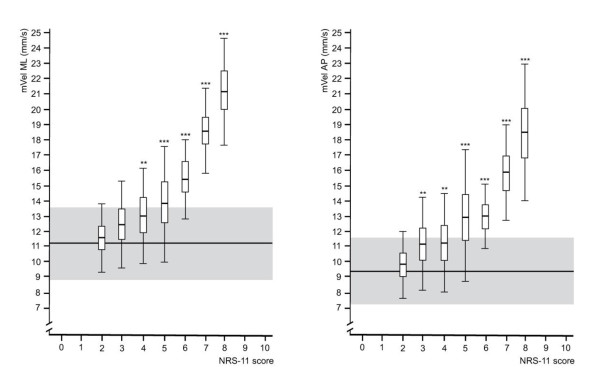
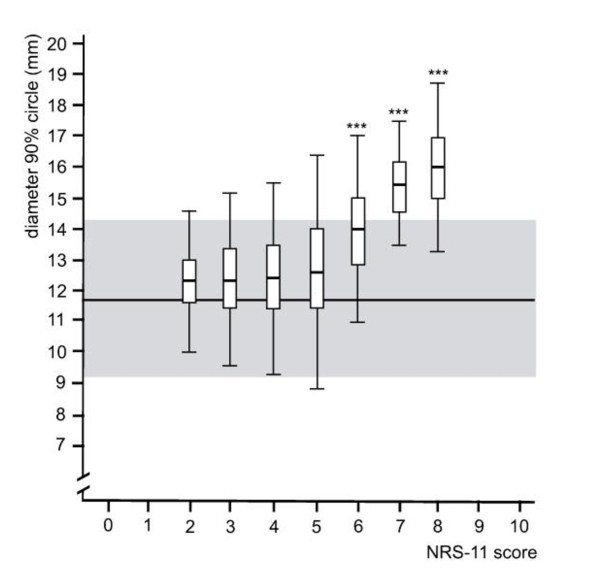
Generally, our results confirmed increased postural instability in pain sufferers compared to healthy controls. In addition, regression analysis revealed a significant and linear increase in postural sway with higher pain ratings for all included COP parameters. Statistically significant changes in mean sway velocity in antero-posterior and medio-lateral direction and sway area were reached with an incremental change in NRS scores of two to three points.
COP mean velocity and sway area are closely related to self-reported pain scores. This relationship may be of clinical use as an objective monitoring tool for patients under treatment or rehabilitation.
患有非特异性下腰痛的患者的压力中心位移明显增加,其姿势摆动改变包括更高的平均摆动速度和更大的摆动面积。尚未有研究评估过患有非特异性下腰痛的 50 岁及以下成年人的疼痛强度与姿势摆动之间的关系。
招募了 77 名患有非特异性下腰痛的患者和与之匹配数量的健康对照组。使用闭眼、窄距、在坚硬表面上进行的 90 秒时长的三个静态双足站立任务来测量压力中心参数。使用数字评分量表(NRS-11)评估感知疼痛强度,根据疼痛评分,每个疼痛评分组都招募了相同数量的患者(n = 11)。
一般来说,与健康对照组相比,我们的结果证实疼痛患者的姿势稳定性增加。此外,回归分析显示,对于所有包含的 COP 参数,随着疼痛评分的升高,姿势摆动明显呈线性增加。随着 NRS 评分增加两到三分,前后向和左右向的平均摆动速度以及摆动面积的统计显著变化。
COP 的平均速度和摆动面积与自我报告的疼痛评分密切相关。这种关系可能在临床治疗或康复中作为一种客观的监测工具对患者有用。