Department of Anesthesiology, College of Medicine, Mayo Clinic, Rochester, MN 55905, United States.
Respir Physiol Neurobiol. 2011 Oct 15;179(1):57-63. doi: 10.1016/j.resp.2011.06.028. Epub 2011 Jul 6.
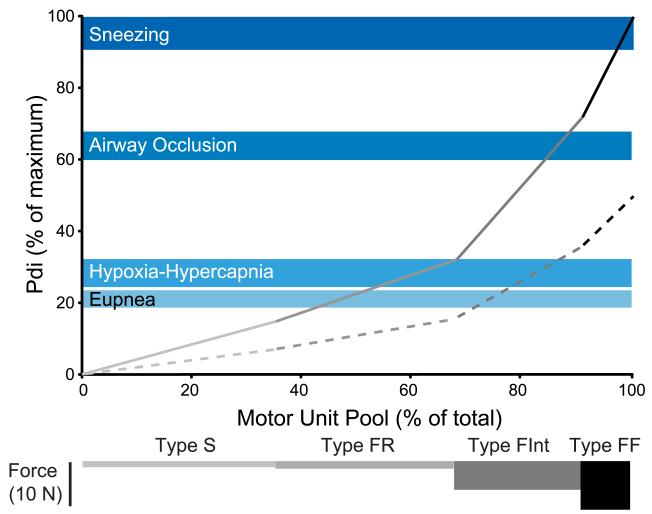
Phrenic motoneurons are located in the cervical spinal cord and innervate the diaphragm muscle, the main inspiratory muscle in mammals. Similar to other skeletal muscles, phrenic motoneurons and diaphragm muscle fibers form motor units which are the final element of neuromotor control. In addition to their role in sustaining ventilation, phrenic motor units are active in other non-ventilatory behaviors important for airway clearance such as coughing or sneezing. Diaphragm muscle fibers comprise all fiber types and are commonly classified based on expression of contractile proteins including myosin heavy chain isoforms. Although there are differences in contractile and fatigue properties across motor units, there is a matching of properties for the motor neuron and muscle fibers within a motor unit. Motor units are generally recruited in order such that fatigue-resistant motor units are recruited earlier and more often than more fatigable motor units. Thus, in sustaining ventilation, fatigue-resistant motor units are likely required. Based on a series of studies in cats, hamsters and rats, an orderly model of motor unit recruitment was proposed that takes into consideration the maximum forces generated by single type-identified diaphragm muscle fibers as well as the proportion of the different motor unit types. Using this model, eupnea can be accomplished by activation of only slow-twitch diaphragm motor units and only a subset of fast-twitch, fatigue-resistant units. Activation of fast-twitch fatigable motor units only becomes necessary when accomplishing tasks that require greater force generation by the diaphragm muscle, e.g., sneezing and coughing.
膈神经运动神经元位于颈段脊髓,支配哺乳动物的主要吸气肌——膈肌。与其他骨骼肌一样,膈神经运动神经元和膈肌纤维形成运动单位,是运动神经控制的最终元件。除了在维持通气中的作用外,膈运动单位还活跃于其他非通气行为中,如咳嗽或打喷嚏,这些行为对气道清除很重要。膈肌纤维包含所有纤维类型,通常根据收缩蛋白(包括肌球蛋白重链同工型)的表达进行分类。尽管运动单位之间存在收缩和疲劳特性的差异,但在一个运动单位内,运动神经元和肌肉纤维的特性是匹配的。运动单位通常按顺序募集,因此抗疲劳的运动单位比更易疲劳的运动单位更早、更频繁地募集。因此,在维持通气时,可能需要抗疲劳的运动单位。基于一系列在猫、仓鼠和大鼠中进行的研究,提出了一个有序的运动单位募集模型,该模型考虑了单个鉴定的膈肌纤维产生的最大力以及不同运动单位类型的比例。使用该模型,仅通过激活慢收缩型膈肌运动单位和仅一部分快收缩型、抗疲劳型运动单位,就可以完成正常呼吸。只有当需要膈肌产生更大的力来完成任务时,如打喷嚏和咳嗽,才需要激活快收缩型易疲劳运动单位。