Division of Psychiatry, School of Community Health Sciences, University of Nottingham, UK.
Neuroimage. 2012 Jan 2;59(1):261-70. doi: 10.1016/j.neuroimage.2011.06.094. Epub 2011 Jul 8.
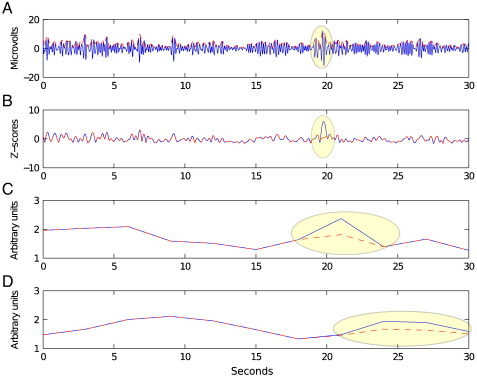
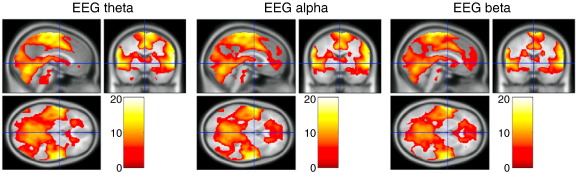
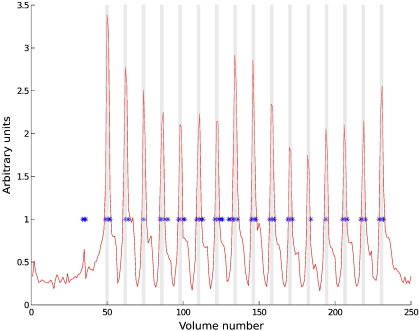
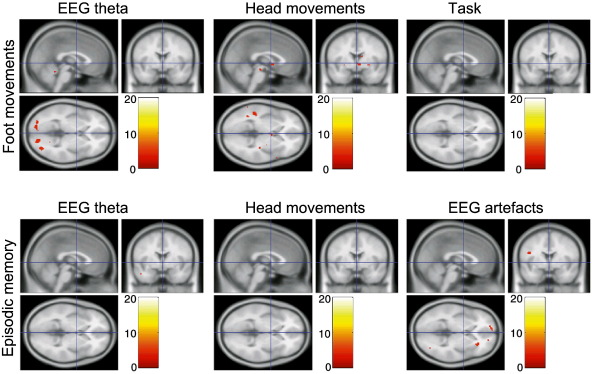
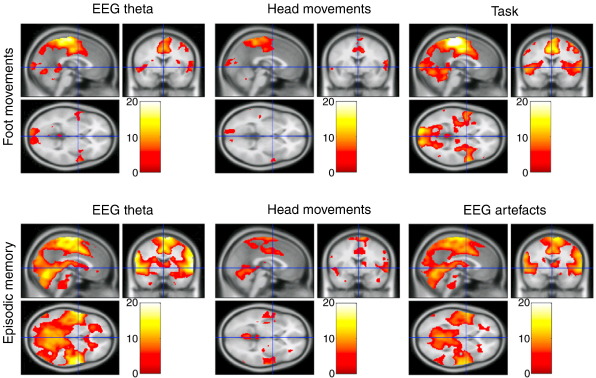
The simultaneous acquisition and subsequent analysis of EEG and fMRI data is challenging owing to increased noise levels in the EEG data. A common method to integrate data from these two modalities is to use aspects of the EEG data, such as the amplitudes of event-related potentials (ERP) or oscillatory EEG activity, to predict fluctuations in the fMRI data. However, this relies on the acquisition of high quality datasets to ensure that only the correlates of neuronal activity are being studied. In this study, we investigate the effects of head-motion-related artefacts in the EEG signal on the predicted T2*-weighted signal variation. We apply our analyses to two independent datasets: 1) four participants were asked to move their feet in the scanner to generate small head movements, and 2) four participants performed an episodic memory task. We created T2*-weighted signal predictors from indicators of abrupt head motion using derivatives of the realignment parameters, from visually detected artefacts in the EEG as well as from three EEG frequency bands (theta, alpha and beta). In both datasets, we found little correlation between the T2*-weighted signal and EEG predictors that were not convolved with the canonical haemodynamic response function (cHRF). However, all convolved EEG predictors strongly correlated with the T2*-weighted signal variation in various regions including the bilateral superior temporal cortex, supplementary motor area, medial parietal cortex and cerebellum. The finding that movement onset spikes in the EEG predict T2*-weighted signal intensity only when the time course of movements is convolved with the cHRF, suggests that the correlated signal might reflect a BOLD response to neural activity associated with head movement. Furthermore, the observation that broad-spectral EEG spikes tend to occur at the same time as abrupt head movements, together with the finding that abrupt movements and EEG spikes show similar correlations with the T2*-weighted signal, indicates that the EEG spikes are produced by abrupt movement and that continuous regressors of EEG oscillations contain motion-related noise even after stringent correction of the EEG data. If not properly removed, these artefacts complicate the use of EEG data as a predictor of T2*-weighted signal variation.
由于 EEG 数据中的噪声水平增加,同时获取和随后分析 EEG 和 fMRI 数据具有挑战性。将这两种模式的数据整合的一种常见方法是使用 EEG 数据的某些方面,例如事件相关电位(ERP)或振荡 EEG 活动的幅度,来预测 fMRI 数据的波动。然而,这依赖于获取高质量数据集来确保仅研究神经元活动的相关物。在这项研究中,我们研究了 EEG 信号中与头部运动相关的伪影对预测 T2*-加权信号变化的影响。我们将我们的分析应用于两个独立的数据集:1)四名参与者被要求在扫描仪中移动脚以产生小的头部运动,2)四名参与者执行情节记忆任务。我们使用重新定位参数的导数、脑电图中视觉检测到的伪影以及三个 EEG 频带(theta、alpha 和 beta),从突然的头部运动的指标中创建 T2*-加权信号预测器。在两个数据集,我们发现 T2*-加权信号与未卷积标准血流响应函数(cHRF)的 EEG 预测器之间相关性很小。然而,所有卷积 EEG 预测器都与双侧颞上皮质、辅助运动区、内侧顶叶皮质和小脑等不同区域的 T2*-加权信号变化强烈相关。脑电图中的运动起始尖峰仅在运动时间过程与 cHRF 卷积时才预测 T2*-加权信号强度的发现表明,相关信号可能反映与头部运动相关的神经活动的 BOLD 反应。此外,观察到宽频谱 EEG 尖峰倾向于与突然的头部运动同时发生,以及突然的运动和 EEG 尖峰与 T2*-加权信号显示相似的相关性的发现表明 EEG 尖峰是由突然的运动产生的,即使在 EEG 数据的严格校正后,连续 EEG 振荡的回归器也包含运动相关的噪声。如果不适当去除,这些伪影会使 EEG 数据作为 T2*-加权信号变化的预测因子的使用变得复杂。