Department of Physics, The Ohio State University, 191 West Woodruff Avenue, Columbus, Ohio 43210-1117, USA.
Nucleic Acids Res. 2011 Oct;39(19):8306-13. doi: 10.1093/nar/gkr422. Epub 2011 Jul 14.
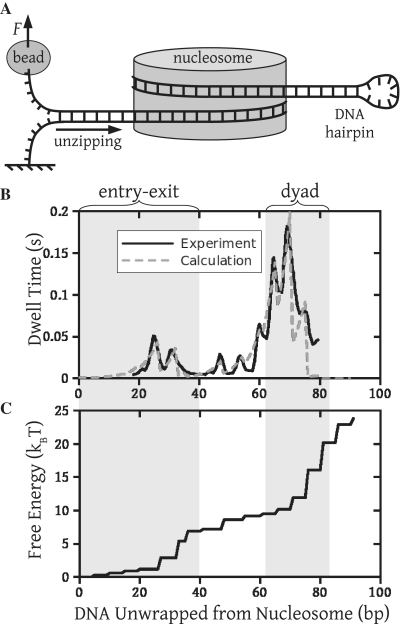
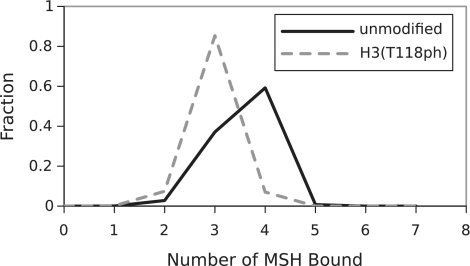
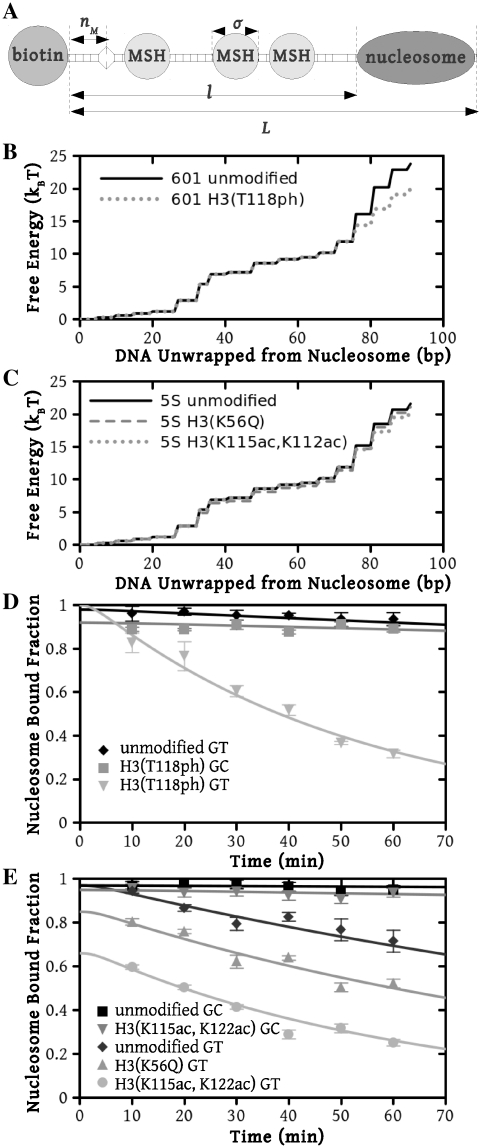
The expression, replication and repair of eukaryotic genomes require the fundamental organizing unit of chromatin, the nucleosome, to be unwrapped and disassembled. We have developed a quantitative model of nucleosome dynamics which provides a fundamental understanding of these DNA processes. We calibrated this model using results from high precision single molecule nucleosome unzipping experiments, and then tested its predictions for experiments in which nucleosomes are disassembled by the DNA mismatch recognition complex hMSH2-hMSH6. We found that this calibrated model quantitatively describes hMSH2-hMSH6 induced disassembly rates of nucleosomes with two separate DNA sequences and four distinct histone modification states. In addition, this model provides mechanistic insight into nucleosome disassembly by hMSH2-hMSH6 and the influence of histone modifications on this disassembly reaction. This model's precise agreement with current experiments suggests that it can be applied more generally to provide important mechanistic understanding of the numerous nucleosome alterations that occur during DNA processing.
真核基因组的表达、复制和修复需要染色质的基本组织单元核小体解缠绕和拆卸。我们开发了一种核小体动力学的定量模型,为这些 DNA 过程提供了基本的理解。我们使用高精度单分子核小体解拉链实验的结果对该模型进行了校准,然后针对由 DNA 错配识别复合物 hMSH2-hMSH6 拆卸核小体的实验对其预测进行了测试。我们发现,该校准模型定量描述了 hMSH2-hMSH6 对具有两个独立 DNA 序列和四个不同组蛋白修饰状态的核小体的解组装速率。此外,该模型为 hMSH2-hMSH6 诱导的核小体解组装以及组蛋白修饰对该解组装反应的影响提供了机制见解。该模型与当前实验的精确一致性表明,它可以更广泛地应用于提供对 DNA 处理过程中发生的众多核小体改变的重要机制理解。