Borkowski Jakub, Palmer Stephen C F, Borowski Zbigniew
Acta Theriol (Warsz). 2011 Jul;56(3):239-253. doi: 10.1007/s13364-010-0023-8. Epub 2011 Jan 29.
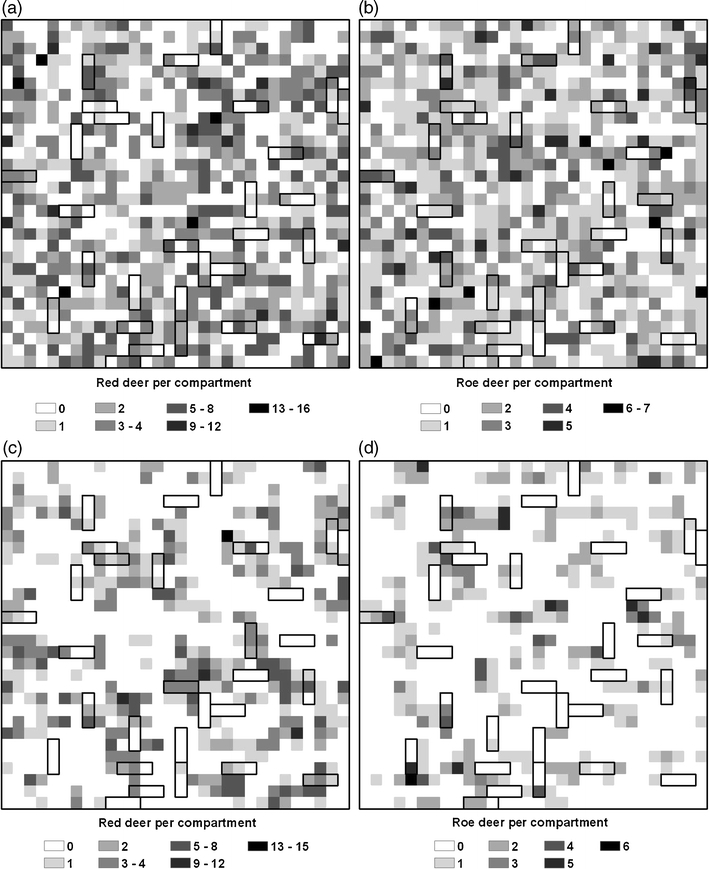
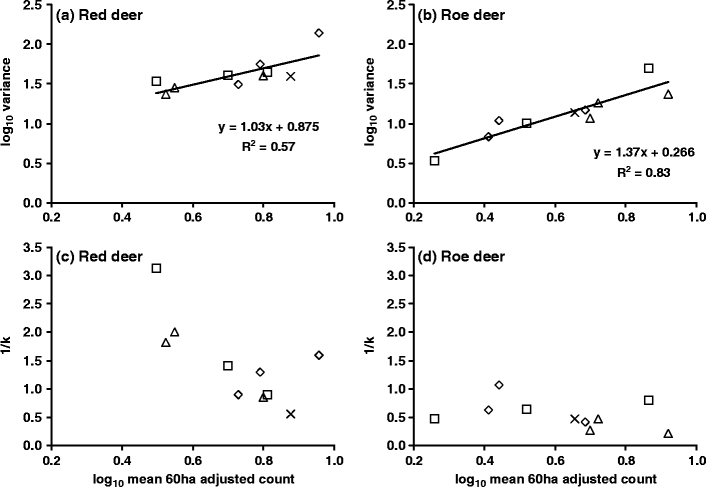
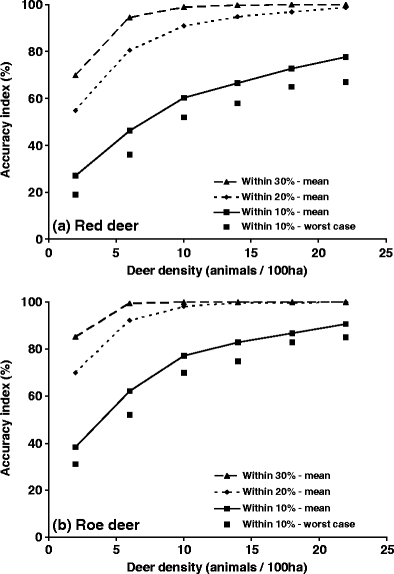
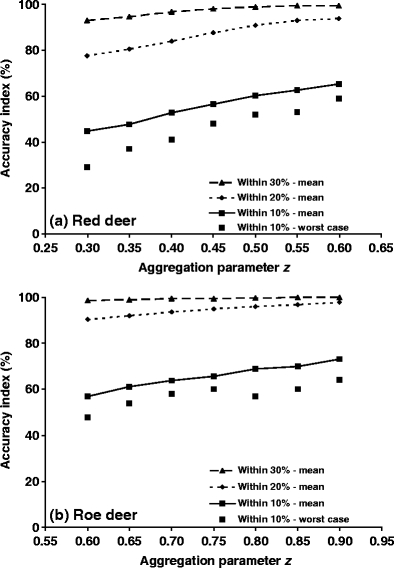
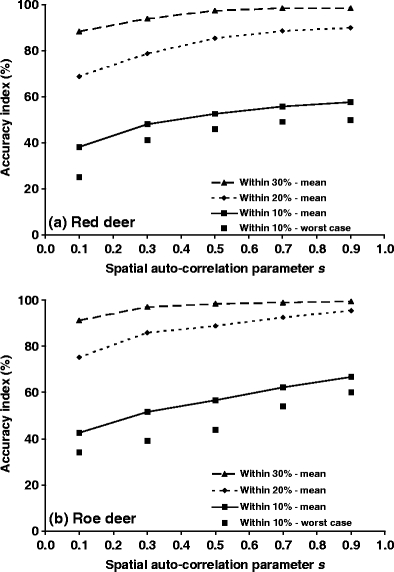
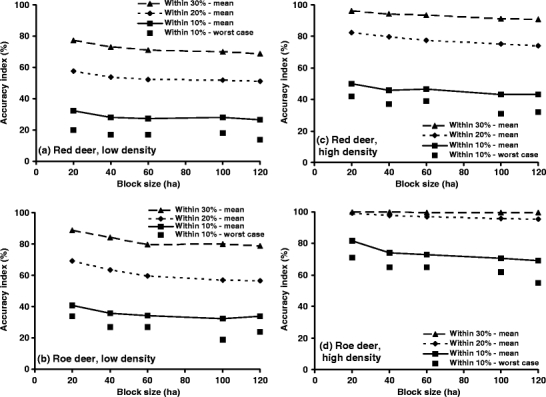
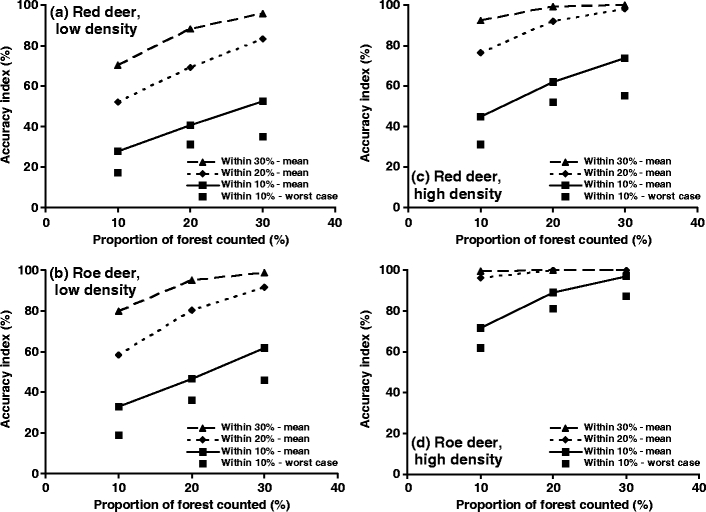
Although drive counts are frequently used to estimate the size of deer populations in forests, little is known about how counting methods or the density and social organization of the deer species concerned influence the accuracy of the estimates obtained, and hence their suitability for informing management decisions. As these issues cannot readily be examined for real populations, we conducted a series of 'virtual experiments' in a computer simulation model to evaluate the effects of block size, proportion of forest counted, deer density, social aggregation and spatial auto-correlation on the accuracy of drive counts. Simulated populations of red and roe deer were generated on the basis of drive count data obtained from Polish commercial forests. For both deer species, count accuracy increased with increasing density, and decreased as the degree of aggregation, either demographic or spatial, within the population increased. However, the effect of density on accuracy was substantially greater than the effect of aggregation. Although improvements in accuracy could be made by reducing the size of counting blocks for low-density, aggregated populations, these were limited. Increasing the proportion of the forest counted led to greater improvements in accuracy, but the gains were limited compared with the increase in effort required. If it is necessary to estimate the deer population with a high degree of accuracy (e.g. within 10% of the true value), drive counts are likely to be inadequate whatever the deer density. However, if a lower level of accuracy (within 20% or more) is acceptable, our study suggests that at higher deer densities (more than ca. five to seven deer/100 ha) drive counts can provide reliable information on population size.
虽然驱赶计数法经常被用于估算森林中鹿群的数量,但对于计数方法、相关鹿种的密度和社会组织如何影响所获得估算值的准确性,以及因此影响其用于指导管理决策的适用性,人们却知之甚少。由于这些问题无法轻易地在真实种群中进行研究,我们在一个计算机模拟模型中进行了一系列“虚拟实验”,以评估样区大小、计数的森林比例、鹿的密度、社会聚集度和空间自相关性对驱赶计数准确性的影响。根据从波兰商业森林获得的驱赶计数数据生成了赤鹿和狍的模拟种群。对于这两种鹿来说,计数准确性都随着密度的增加而提高,随着种群内无论是种群统计学上的还是空间上的聚集度增加而降低。然而,密度对准确性的影响远大于聚集度的影响。虽然对于低密度、聚集的种群,通过减小计数样区的大小可以提高准确性,但这些改进是有限的。增加计数的森林比例会带来更大的准确性提高,但与所需努力的增加相比,收益是有限的。如果有必要以高精度(例如在真实值的10%以内)估算鹿的种群数量,无论鹿的密度如何,驱赶计数法可能都不够。然而,如果可以接受较低的准确性水平(在20%或更高以内),我们的研究表明,在较高的鹿密度(超过约每100公顷五到七只鹿)下,驱赶计数法可以提供有关种群大小的可靠信息。