Sand Håkan, Eklund Ann, Zimmermann Barbara, Wikenros Camilla, Wabakken Petter
Grimsö Wildlife Research Station, Department of Ecology, Swedish University of Agricultural Sciences, Riddarhyttan, Sweden.
Faculty of Applied Ecology and Agricultural Sciences, Hedmark University of Applied Sciences, Evenstad, Koppang, Norway.
PLoS One. 2016 Dec 28;11(12):e0168062. doi: 10.1371/journal.pone.0168062. eCollection 2016.
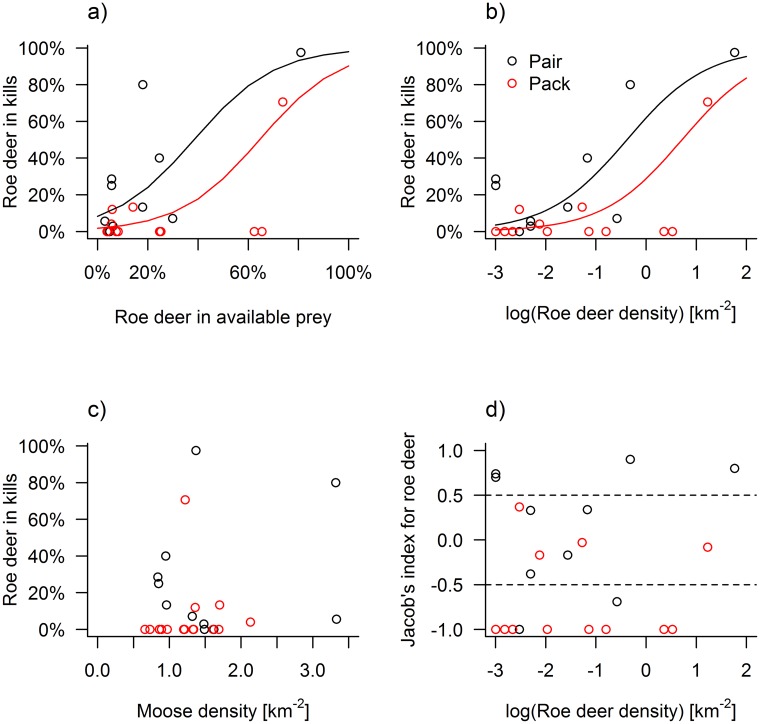
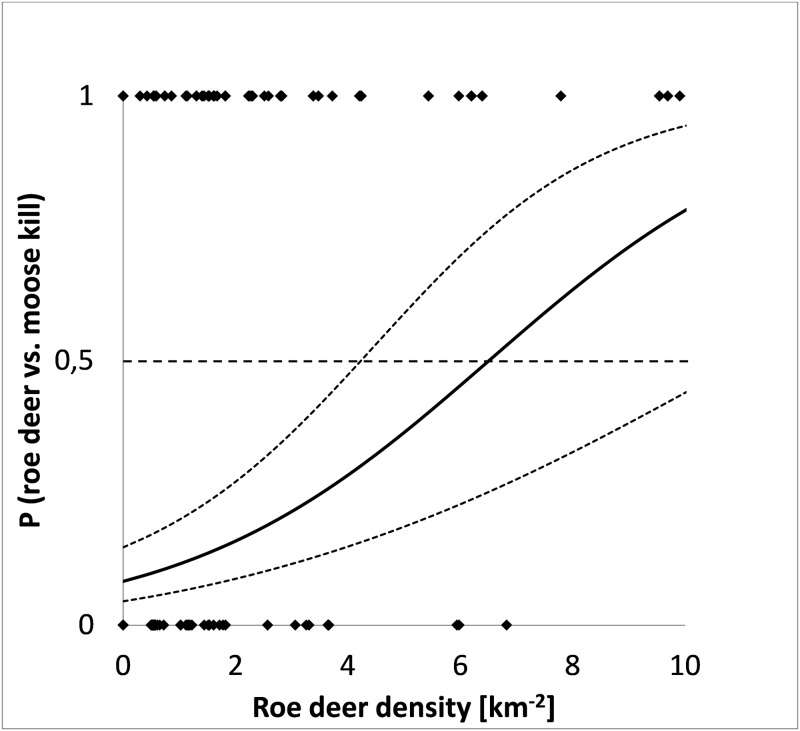
Research on large predator-prey interactions are often limited to the predators' primary prey, with the potential for prey switching in systems with multiple ungulate species rarely investigated. We evaluated wolf (Canis lupus) prey selection at two different spatial scales, i.e., inter- and intra-territorial, using data from 409 ungulate wolf-kills in an expanding wolf population in Scandinavia. This expansion includes a change from a one-prey into a two-prey system with variable densities of one large-sized ungulate; moose (Alces alces) and one small-sized ungulate; roe deer (Capreolus capreolus). Among wolf territories, the proportion of roe deer in wolf kills was related to both pack size and roe deer density, but not to moose density. Pairs of wolves killed a higher proportion of roe deer than did packs, and wolves switched to kill more roe deer as their density increased above a 1:1 ratio in relation to the availability of the two species. At the intra-territorial level, wolves again responded to changes in roe deer density in their prey selection whereas we found no effect of snow depth, time during winter, or other predator-related factors on the wolves' choice to kill moose or roe deer. Moose population density was only weakly related to intra-territorial prey selection. Our results show that the functional response of wolves on moose, the species hitherto considered as the main prey, was strongly dependent on the density of a smaller, alternative, ungulate prey. The impact of wolf predation on the prey species community is therefore likely to change with the composition of the multi-prey species community along with the geographical expansion of the wolf population.
对大型捕食者与猎物相互作用的研究通常局限于捕食者的主要猎物,而在具有多种有蹄类动物的系统中,猎物转换的可能性很少被研究。我们利用斯堪的纳维亚半岛一个不断扩张的狼群中409起有蹄类动物被狼捕杀的数据,在两个不同的空间尺度上,即领地间和领地内,评估了狼(Canis lupus)的猎物选择。这种扩张包括从单一猎物系统转变为两种猎物系统,其中一种大型有蹄类动物驼鹿(Alces alces)和一种小型有蹄类动物狍(Capreolus capreolus)的密度各不相同。在狼群领地中,狍在狼捕杀猎物中所占的比例与狼群规模和狍的密度都有关,但与驼鹿密度无关。成对的狼捕杀狍的比例高于狼群,并且当狍的密度相对于这两个物种的可获得性增加到超过1:1的比例时,狼会转而捕杀更多的狍。在领地内层面,狼在猎物选择上再次对狍密度的变化做出反应,而我们发现雪深、冬季时间或其他与捕食者相关的因素对狼选择捕杀驼鹿或狍没有影响。驼鹿种群密度与领地内猎物选择的相关性较弱。我们的结果表明,狼对驼鹿(迄今被视为主要猎物的物种)的功能反应强烈依赖于一种较小的替代有蹄类猎物的密度。因此,随着多猎物物种群落的组成以及狼群地理范围的扩大,狼捕食对猎物物种群落的影响可能会发生变化。