Department of Forest Zoology and Forest Conservation incl. Wildlife Biology and Game Management, Büsgen-Institute, Georg-August-University Göttingen, Büsgenweg 3, Göttingen, Germany.
Exp Appl Acarol. 2010 Sep;52(1):73-84. doi: 10.1007/s10493-010-9341-4. Epub 2010 Mar 4.
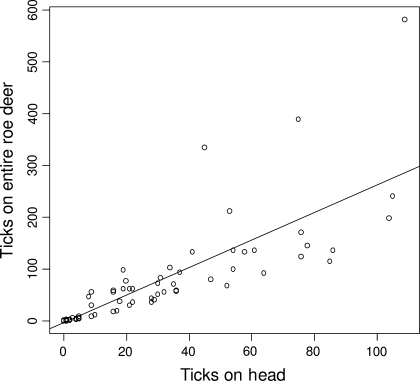
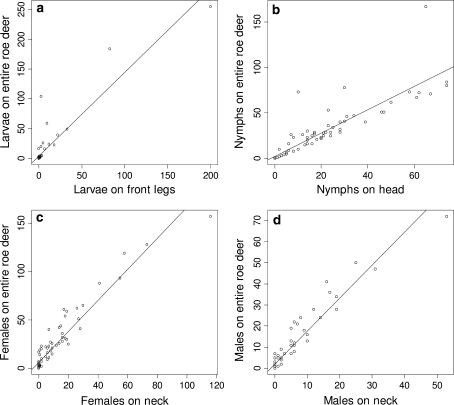
Despite the importance of roe deer as a host for Ixodes ticks in central Europe, estimates of total tick burden on roe deer are not available to date. We aimed at providing (1) estimates of life stage and sex specific (larvae, nymphs, males and females, hereafter referred to as tick life stages) total Ixodes burden and (2) equations which can be used to predict the total life stage burden by counting the life stage on a selected body area. Within a period of 1(1/2) years, we conducted whole body counts of ticks from 80 hunter-killed roe deer originating from a beech dominated forest area in central Germany. Averaged over the entire study period (winter 2007-summer 2009), the mean tick burden per roe deer was 64.5 (SE +/- 10.6). Nymphs were the most numerous tick life stage per roe deer (23.9 +/- 3.2), followed by females (21.4 +/- 3.5), larvae (10.8 +/- 4.2) and males (8.4 +/- 1.5). The individual tick burden was highly aggregated (k = 0.46); levels of aggregation were highest in larvae (k = 0.08), followed by males (k = 0.40), females (k = 0.49) and nymphs (k = 0.71). To predict total life stage specific burdens based on counts on selected body parts, we provide linear equations. For estimating larvae abundance on the entire roe deer, counts can be restricted to the front legs. Tick counts restricted to the head are sufficient to estimate total nymph burden and counts on the neck are appropriate for estimating adult ticks (females and males). In order to estimate the combined tick burden, tick counts on the head can be used for extrapolation. The presented linear models are highly significant and explain 84.1, 77.3, 90.5, 91.3, and 65.3% (adjusted R (2)) of the observed variance, respectively. Thus, these models offer a robust basis for rapid tick abundance assessment. This can be useful for studies aiming at estimating effects of abiotic and biotic factors on tick abundance, modelling tick population dynamics, modelling tick-borne pathogen transmission dynamics or assessing the efficacy of acaricides.
尽管獐鹿作为中欧地区的硬蜱宿主非常重要,但迄今为止,尚无关于獐鹿硬蜱总负荷的估计。我们旨在提供(1)各生命阶段和性别特异性(幼虫、若虫、雄性和雌性,以下简称蜱生命阶段)总蜱负荷的估计值,以及(2)可以通过计算选定身体区域的生命阶段来预测总生命阶段负担的方程。在 1(1/2)年的时间内,我们对来自德国中部一个山毛榉主导森林地区的 80 只被猎人杀死的獐鹿进行了全身蜱计数。在整个研究期间(2007 年冬季至 2009 年夏季),平均每只獐鹿的蜱负荷为 64.5(SE +/- 10.6)。每只獐鹿数量最多的蜱生命阶段是若虫(23.9 +/- 3.2),其次是雌性(21.4 +/- 3.5)、幼虫(10.8 +/- 4.2)和雄性(8.4 +/- 1.5)。个体蜱的负担高度聚集(k = 0.46);聚集程度最高的是幼虫(k = 0.08),其次是雄性(k = 0.40)、雌性(k = 0.49)和若虫(k = 0.71)。为了根据选定身体部位的计数预测特定生命阶段的总负担,我们提供了线性方程。要估计整个獐鹿幼虫的数量,可以将计数限制在前腿上。仅计数头部就足以估计总若虫负担,而计数颈部则适合估计成年蜱(雌性和雄性)。为了估计总蜱负担,可以对头部的蜱计数进行外推。所提出的线性模型高度显著,分别解释了观察方差的 84.1%、77.3%、90.5%、91.3%和 65.3%(调整后的 R (2))。因此,这些模型为快速蜱丰度评估提供了可靠的基础。这对于旨在估计生物和非生物因素对蜱丰度的影响、模拟蜱种群动态、模拟蜱传病原体传播动态或评估杀螨剂效果的研究非常有用。