Department of Biochemistry and Molecular Biology, University of Georgia, Athens, Georgia, United States of America.
PLoS One. 2011;6(7):e21730. doi: 10.1371/journal.pone.0021730. Epub 2011 Jul 12.
MicroRNAs have been widely-studied with regard to their aberrant expression and high correlation with tumorigenesis and progression in various solid tumors. With the major goal of assessing gonadotropin (luteinizing hormone, LH) contributions to LH receptor (LHR)-positive ovarian cancer cells, we have conducted a genome-wide transcriptomic analysis on human epithelial ovarian cancer cells to identify the microRNA-associated cellular response to LH-mediated activation of LHR.
Human ovarian cancer cells (SKOV3) were chosen as negative control (LHR-) and stably transfected to express functional LHR (LHR+), followed by incubation with LH (0-20 h). At different times of LH-mediated activation of LHR the cancer cells were analyzed by a high-density Ovarian Cancer Disease-Specific-Array (DSA, ALMAC™), which profiled ∼ 100,000 transcripts with ∼ 400 non-coding microRNAs.
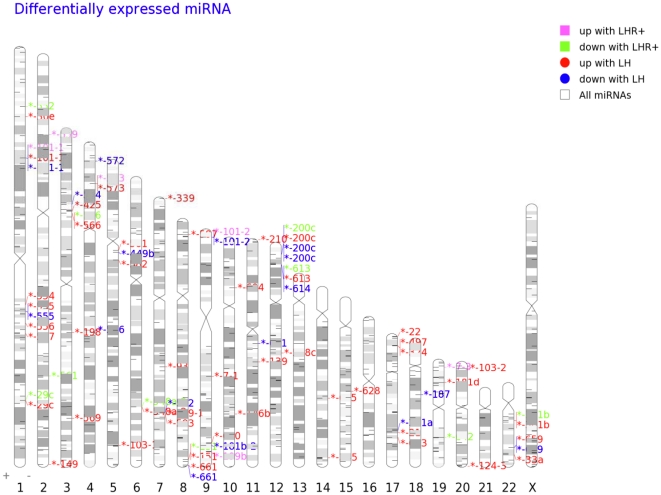
In total, 65 microRNAs were identified to exhibit differential expression in either LHR expressing SKOV3 cells or LH-treated cells, a few of which have been found in the genomic fragile regions that are associated with abnormal deletion or amplification in cancer, such as miR-21, miR-101-1, miR-210 and miR-301a. By incorporating the dramatic expression changes observed in mRNAs, strong microRNA/mRNA regulatory pairs were predicted through statistical analyses coupled with collective computational prediction. The role of each microRNA was then determined through a functional analysis based on the highly-confident microRNA/mRNA pairs.
The overall impact on the transcriptome-level expression indicates that LH may regulate apoptosis and cell growth of LHR+ SKOV3 cells, particularly by reducing cancer cell proliferation, with some microRNAs involved in regulatory roles.
微小 RNA 的异常表达与多种实体瘤的发生和进展高度相关,因此它们受到了广泛的研究。我们的主要目标是评估促性腺激素(黄体生成素,LH)对 LH 受体(LHR)阳性卵巢癌细胞的作用,为此我们对人上皮性卵巢癌细胞进行了全基因组转录组分析,以确定 LH 介导的 LHR 激活对 LHR 阳性卵巢癌细胞的细胞反应相关的 microRNA。
选择人卵巢癌细胞(SKOV3)作为阴性对照(LHR-),并稳定转染以表达功能性 LHR(LHR+),然后用 LH(0-20 小时)孵育。在 LH 介导的 LHR 激活不同时间,用高密度卵巢癌疾病特异性阵列(DSA,ALMAC)分析癌细胞,该阵列对大约 100000 个转录物和大约 400 个非编码 microRNA 进行了分析。
总共鉴定出 65 个 microRNA 在表达 LHR 的 SKOV3 细胞或 LH 处理的细胞中表现出差异表达,其中一些 microRNA 位于与癌症中异常缺失或扩增相关的基因组脆性区域,如 miR-21、miR-101-1、miR-210 和 miR-301a。通过整合 mRNA 中观察到的显著表达变化,通过统计学分析结合集体计算预测,预测了强 microRNA/mRNA 调控对。然后通过基于高度置信 microRNA/mRNA 对的功能分析来确定每个 microRNA 的作用。
对转录组水平表达的总体影响表明,LH 可能调节 LHR+SKOV3 细胞的凋亡和细胞生长,特别是通过减少癌细胞增殖,一些 microRNA 参与了调节作用。