Department of Ecology and Animal Biology, EUET, Forestry, Vigo University, 36005 Pontevedra, Spain.
BMC Evol Biol. 2011 Jul 18;11:210. doi: 10.1186/1471-2148-11-210.
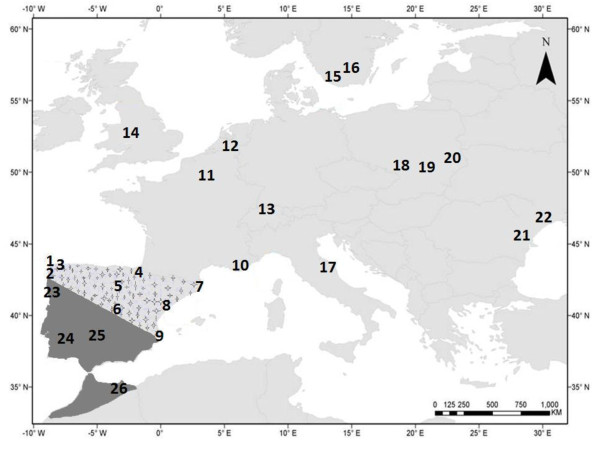
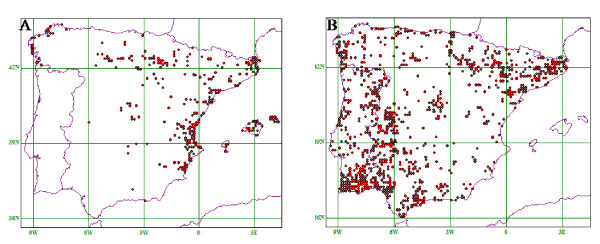
Studying contemporary hybridization increases our understanding of introgression, adaptation and, ultimately, speciation. The sister species Ischnura elegans and I. graellsii (Odonata: Coenagrionidae) are ecologically, morphologically and genetically similar and hybridize. Recently, I. elegans has colonized northern Spain, creating a broad sympatric region with I. graellsii. Here, we review the distribution of both species in Iberia and evaluate the degree of introgression of I. graellsii into I. elegans using six microsatellite markers (442 individuals from 26 populations) and five mitochondrial genes in sympatric and allopatric localities. Furthermore, we quantify the effect of hybridization on the frequencies of the genetically controlled colour polymorphism in females of both species.
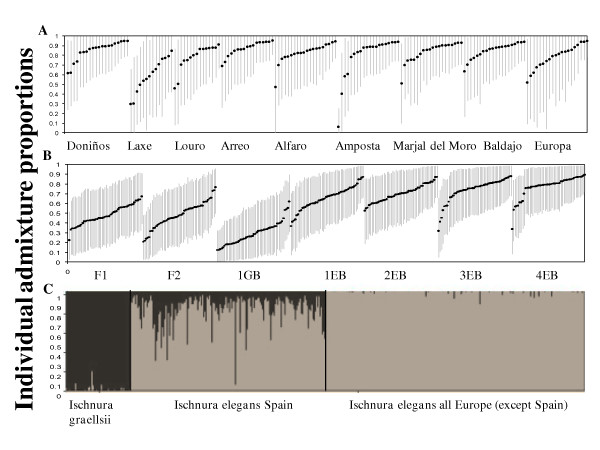
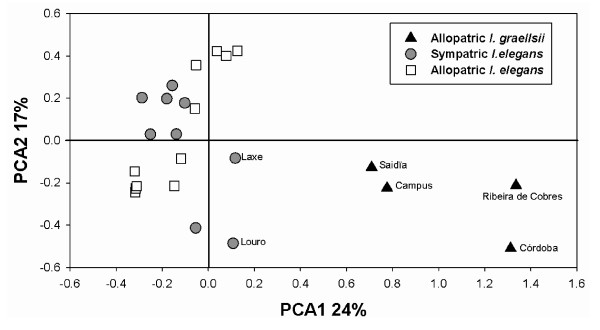
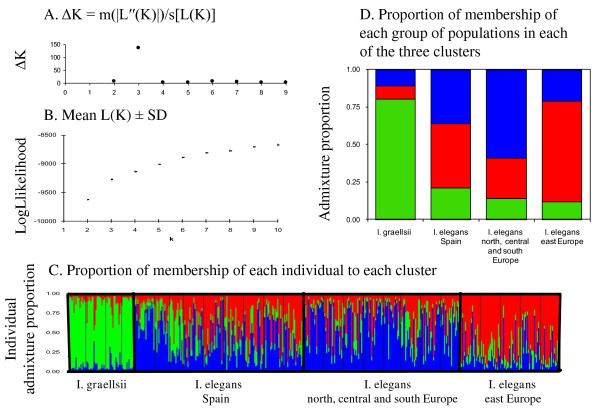
In a principal component analysis of the microsatellite data, the first two principal components summarised almost half (41%) of the total genetic variation. The first axis revealed a clear separation of I. graellsii and I. elegans populations, while the second axis separated I. elegans populations. Admixture analyses showed extensive hybridization and introgression in I. elegans populations, consistent with I. elegans backcrosses and occasional F1-hybrids, suggesting hybridization is on-going. More specifically, approximately 58% of the 166 Spanish I. elegans individuals were assigned to the I. elegans backcross category, whereas not a single of those individuals was assigned to the backcross with I. graellsii. The mitochondrial genes held little genetic variation, and the most common haplotype was shared by the two species.
The results suggest rapid species turnover in sympatric regions in favour of I. elegans, corroborating previous findings that I. graellsii suffers a mating disadvantage in sympatry with I. elegans. Examination of morph frequency dynamics indicates that hybridization is likely to have important implications for the maintenance of multiple female morphs, in particular during the initial period of hybridization.
研究当代杂交增加了我们对渐渗、适应以及最终物种形成的理解。姐妹种 Ischnura elegans 和 I. graellsii(蜻蜓目:Coenagrionidae)在生态、形态和遗传上相似,并且发生杂交。最近,I. elegans 已经在西班牙北部殖民,与 I. graellsii 形成了一个广泛的同域区。在这里,我们回顾了这两个物种在伊比利亚半岛的分布,并使用六个微卫星标记(来自 26 个种群的 442 个个体)和五个线粒体基因评估了 I. graellsii 对 I. elegans 的渐渗程度,这些基因在同域和异域种群中使用。此外,我们量化了杂交对两种物种雌性遗传控制颜色多态性频率的影响。
在微卫星数据的主成分分析中,前两个主成分总结了近一半(41%)的总遗传变异。第一个轴清晰地分离了 I. graellsii 和 I. elegans 种群,而第二个轴则分离了 I. elegans 种群。混合分析表明,I. elegans 种群中存在广泛的杂交和渐渗,这与 I. elegans 的回交和偶尔的 F1 杂种一致,表明杂交仍在进行。更具体地说,在 166 个西班牙 I. elegans 个体中,约有 58%被归为 I. elegans 回交类,而没有一个个体被归为与 I. graellsii 的回交类。线粒体基因遗传变异很小,最常见的单倍型由两个物种共享。
结果表明,在同域地区,物种快速更替有利于 I. elegans,这与之前的发现一致,即 I. graellsii 在与 I. elegans 同域时存在交配劣势。形态频率动态的检验表明,杂交可能对维持多种雌性形态具有重要意义,特别是在杂交的初始阶段。