Institute of Physiological Chemistry, University Medical Center of the Johannes Gutenberg University, Mainz, Germany.
J Psychopharmacol. 2012 Jan;26(1):23-39. doi: 10.1177/0269881111408958. Epub 2011 Jul 18.
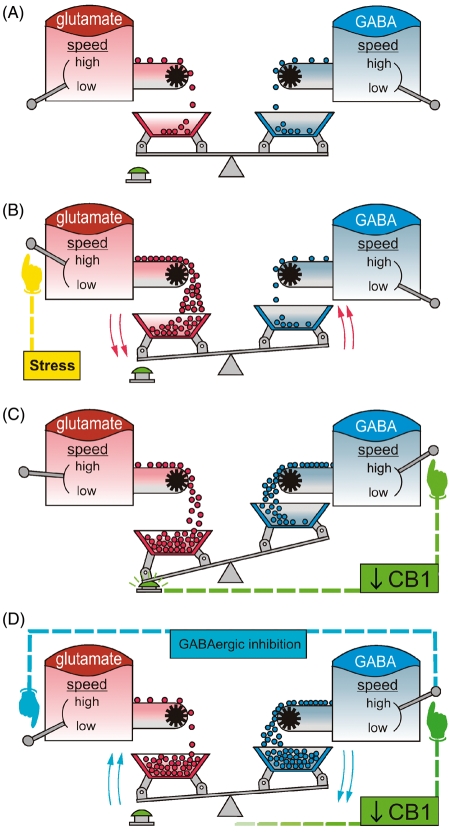
Evidence for the involvement of the endocannabinoid system (ECS) in anxiety and fear has been accumulated, providing leads for novel therapeutic approaches. In anxiety, a bidirectional influence of the ECS has been reported, whereby anxiolytic and anxiogenic responses have been obtained after both increases and decreases of the endocannabinoid tone. The recently developed genetic tools have revealed different but complementary roles for the cannabinoid type 1 (CB1) receptor on GABAergic and glutamatergic neuronal populations. This dual functionality, together with the plasticity of CB1 receptor expression, particularly on GABAergic neurons, as induced by stressful and rewarding experiences, gives the ECS a unique regulatory capacity for maintaining emotional homeostasis. However, the promiscuity of the endogenous ligands of the CB1 receptor complicates the interpretation of experimental data concerning ECS and anxiety. In fear memory paradigms, the ECS is mostly involved in the two opposing processes of reconsolidation and extinction of the fear memory. Whereas ECS activation deteriorates reconsolidation, proper extinction depends on intact CB1 receptor signalling. Thus, both for anxiety and fear memory processing, endocannabinoid signalling may ensure an appropriate reaction to stressful events. Therefore, the ECS can be considered as a regulatory buffer system for emotional responses.
内源性大麻素系统(ECS)在焦虑和恐惧中的作用的证据已经积累起来,为新的治疗方法提供了线索。在焦虑中,ECS 存在双向影响,即增加和减少内源性大麻素的作用后,均可获得抗焦虑和致焦虑反应。最近开发的遗传工具揭示了大麻素 1 型(CB1)受体在 GABA 能和谷氨酸能神经元群体中的不同但互补的作用。这种双重功能,以及 CB1 受体表达的可塑性,特别是在应激和奖励经验诱导下 GABA 能神经元上的可塑性,使 ECS 具有维持情绪平衡的独特调节能力。然而,CB1 受体的内源性配体的混杂性使有关 ECS 和焦虑的实验数据的解释复杂化。在恐惧记忆范式中,ECS 主要参与恐惧记忆的重新巩固和消退这两个相反的过程。尽管 ECS 的激活会损害重新巩固,但适当的消退取决于完整的 CB1 受体信号。因此,无论是焦虑还是恐惧记忆处理,内源性大麻素信号都可以确保对应激事件的适当反应。因此,ECS 可以被视为情绪反应的调节缓冲系统。