Mousavinasab Sayed Mostafa, Meyers Ian
Associate Professor, Department of Restorative Dentistry, Torabinejad Research Dental Center, School of Dentistry, Isfahan University of Medical Sciences and Health Services, Isfahan, Iran.
Eur J Dent. 2011 Jul;5(3):299-304.
To compare curing performance of a second generation LED curing light with a high power tungsten quartz halogen (QTH).
A hybrid composite resin (Filtek Z 250, 3M, USA) was used as test material and cured using a second generation LED light (Translux Power Blue™, Heraus Kulzer ,Germany) or a very high power QTH light unit (EMS, Switzerland). A two split aluminum mold was used to prepare ten samples with LED light source cured for forty seconds and ten samples prepared using high power QTH light unit, cured for four or six seconds recommended exposure time. Hardness, depth of cure (DOC) and thermal rise during exposure time by these light sources were measured. The data submitted to analysis of variance (ANOVA), Tukey's and student's t tests at 5% significance level.
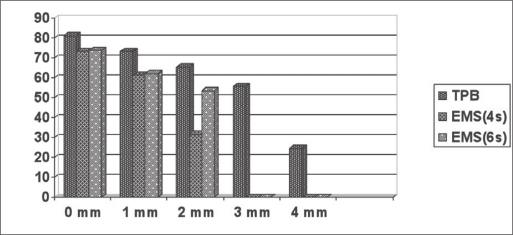
Significant differences were found in hardness, DOC of samples cured by above mentioned light sources and also in thermal rises during exposure time. The curing performance of the tested QTH was not as well as the LED light. TPB light source produced the maximum hardness (81.25, 73.29, 65.49,55.83 and 24.53 for 0 mm, 1 mm, 2 mm, 3 mm and 4 mm intervals) and DOC (2.64 mm) values with forty seconds irradiation time and the high power (QTH) the least hardness (73.27, 61.51 and 31.59 for 0 mm, 1 mm and 2 mm, respectively) and DOC (2 mm) values with four seconds irradiation time. Thermal rises during 4 s and 6 s curing time using high power QTH and tested LED were 1.88°C, 3°C and 1.87°C, respectively.
The used high power LED light produced greater hardness and depth of cure during forty seconds exposure time compared to high power QTH light with four or six seconds curing time. Thermal rise during 6 s curing time with QTH was greater compared to thermal changes occurred during 40 s curing time with tested LED light source. There was no difference seen in thermal changes caused by LED light with 40 s and QTH light with 4 s exposure time.
比较第二代发光二极管(LED)固化灯与高功率钨石英卤素灯(QTH)的固化性能。
使用一种混合复合树脂(美国3M公司的Filtek Z 250)作为测试材料,分别用第二代LED灯(德国贺利氏古莎公司的Translux Power Blue™)或高功率QTH灯(瑞士EMS公司)进行固化。使用一个双分型铝模具制备10个样本,用LED光源固化40秒,以及10个样本用高功率QTH灯按照推荐的4秒或6秒曝光时间进行固化。测量这些光源在曝光时间内的硬度、固化深度(DOC)和温度上升。数据采用方差分析(ANOVA)、Tukey检验和学生t检验,显著性水平为5%。
在上述光源固化的样本的硬度、DOC以及曝光时间内的温度上升方面发现了显著差异。测试的QTH的固化性能不如LED灯。TPB光源在40秒照射时间下产生的硬度最高(0毫米、1毫米、2毫米、3毫米和4毫米间隔处分别为81.25、73.29、65.49、55.83和24.53)和DOC值(2.64毫米),而高功率(QTH)在4秒照射时间下产生的硬度最低(0毫米、1毫米和2毫米处分别为73.27、61.51和31.59)和DOC值(2毫米)。使用高功率QTH和测试的LED在4秒和6秒固化时间内的温度上升分别为1.88°C、3°C和1.87°C。
与固化时间为4秒或6秒的高功率QTH灯相比,使用的高功率LED灯在40秒曝光时间内产生了更高的硬度和固化深度。QTH在6秒固化时间内的温度上升比测试的LED光源在40秒固化时间内发生的热变化更大。LED灯在40秒和QTH灯在4秒曝光时间下引起的热变化没有差异。