Center for Molecular Biology of Oral Diseases, College of Dentistry, University of Illinois at Chicago, Chicago, IL 60612, USA.
Biochem J. 2011 Nov 15;440(1):23-31. doi: 10.1042/BJ20111006.
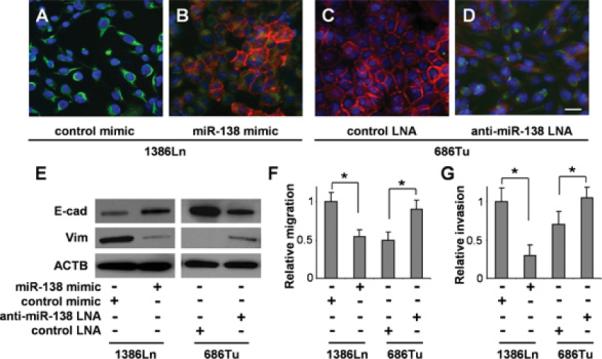
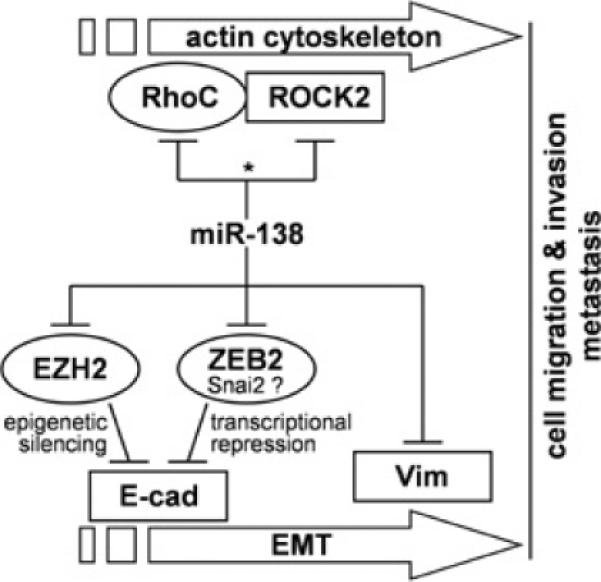
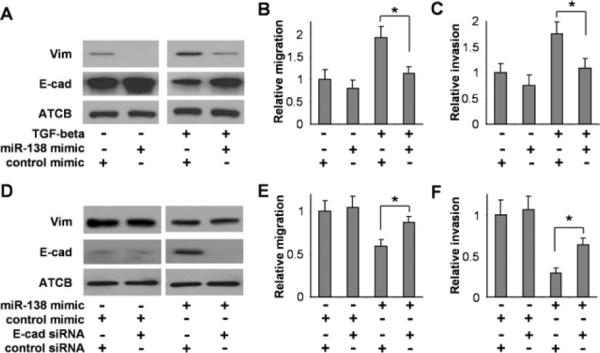
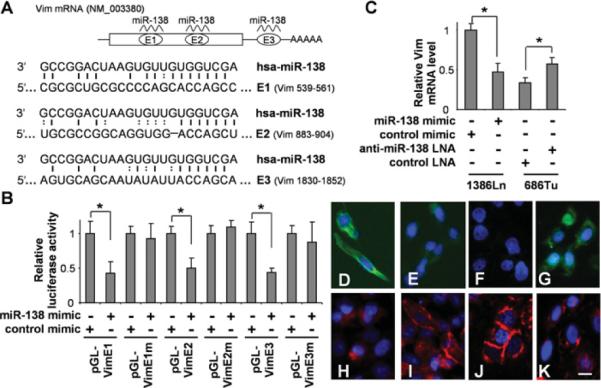
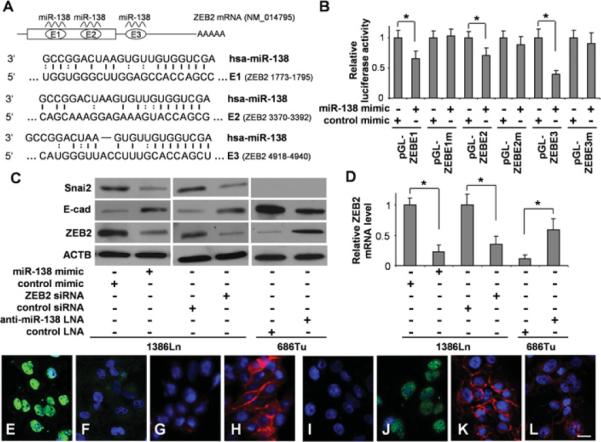
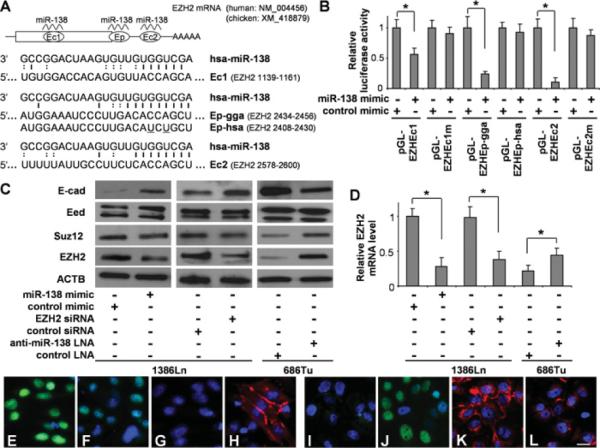
Down-regulation of miR-138 (microRNA-138) has been frequently observed in various cancers, including HNSCC (head and neck squamous cell carcinoma). Our previous studies suggest that down-regulation of miR-138 is associated with mesenchymal-like cell morphology and enhanced cell migration and invasion. In the present study, we demonstrated that these miR-138-induced changes were accompanied by marked reduction in E-cad (E-cadherin) expression and enhanced Vim (vimentin) expression, characteristics of EMT (epithelial-mesenchymal transition). On the basis of a combined experimental and bioinformatics analysis, we identified a number of miR-138 target genes that are associated with EMT, including VIM, ZEB2 (zinc finger E-box-binding homeobox 2) and EZH2 (enhancer of zeste homologue 2). Direct targeting of miR-138 to specific sequences located in the mRNAs of the VIM, ZEB2 and EZH2 genes was confirmed using luciferase reporter gene assays. Our functional analyses (knock-in and knock-down) demonstrated that miR-138 regulates the EMT via three distinct pathways: (i) direct targeting of VIM mRNA and controlling the expression of VIM at a post-transcriptional level, (ii) targeting the transcriptional repressors (ZEB2) which in turn regulating the transcription activity of the E-cad gene, and (iii) targeting the epigenetic regulator EZH2 which in turn modulates its gene silencing effects on the downstream genes including E-cad. These results, together with our previously observed miR-138 effects on cell migration and invasion through targeting RhoC (Rho-related GTP-binding protein C) and ROCK2 (Rho-associated, coiled-coil-containing protein kinase 2) concurrently, suggest that miR-138 is a multi-functional molecular regulator and plays major roles in EMT and in HNSCC progression.
miR-138(microRNA-138)的下调在各种癌症中经常观察到,包括头颈部鳞状细胞癌(HNSCC)。我们之前的研究表明,miR-138 的下调与间充质样细胞形态和增强的细胞迁移和侵袭有关。在本研究中,我们证明了这些 miR-138 诱导的变化伴随着 E-cad(E-钙黏蛋白)表达的显著减少和 Vim(波形蛋白)表达的增强,这是 EMT(上皮-间质转化)的特征。基于综合实验和生物信息学分析,我们确定了许多与 EMT 相关的 miR-138 靶基因,包括 VIM、ZEB2(锌指 E 盒结合同源框 2)和 EZH2(增强子的锌指同源物 2)。使用荧光素酶报告基因检测证实了 miR-138 直接靶向位于 VIM、ZEB2 和 EZH2 基因 mRNA 中特定序列的靶基因。我们的功能分析(敲入和敲低)表明,miR-138 通过三种不同的途径调节 EMT:(i)直接靶向 VIM mRNA,并在转录后水平控制 VIM 的表达,(ii)靶向转录抑制剂(ZEB2),进而调节 E-cad 基因的转录活性,以及(iii)靶向表观遗传调节剂 EZH2,进而调节其对下游基因(包括 E-cad)的基因沉默效应。这些结果,加上我们之前观察到的 miR-138 通过靶向 RhoC(Rho 相关 GTP 结合蛋白 C)和 ROCK2(Rho 相关卷曲螺旋蛋白激酶 2)对细胞迁移和侵袭的影响,表明 miR-138 是一种多功能分子调节剂,在 EMT 和 HNSCC 进展中发挥重要作用。