Mucosal Protection Laboratory, Thomas C Jenkins Department of Biophysics, Johns Hopkins University, 3400 North Charles Street, Baltimore, MD 21218, USA.
BMC Infect Dis. 2011 Jul 19;11:200. doi: 10.1186/1471-2334-11-200.
Hydrogen peroxide (H2O2) produced by vaginal lactobacilli is generally believed to protect against bacteria associated with bacterial vaginosis (BV), and strains of lactobacilli that can produce H2O2 are being developed as vaginal probiotics. However, evidence that led to this belief was based in part on non-physiological conditions, antioxidant-free aerobic conditions selected to maximize both production and microbicidal activity of H2O2. Here we used conditions more like those in vivo to compare the effects of physiologically plausible concentrations of H2O2 and lactic acid on a broad range of BV-associated bacteria and vaginal lactobacilli.
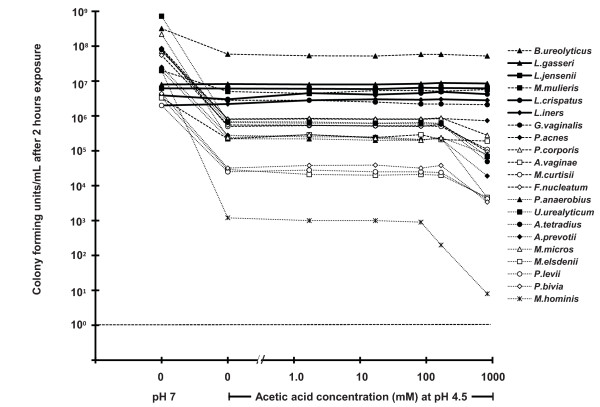
Anaerobic cultures of seventeen species of BV-associated bacteria and four species of vaginal lactobacilli were exposed to H2O2, lactic acid, or acetic acid at pH 7.0 and pH 4.5. After two hours, the remaining viable bacteria were enumerated by growth on agar media plates. The effect of vaginal fluid (VF) on the microbicidal activities of H2O2 and lactic acid was also measured.
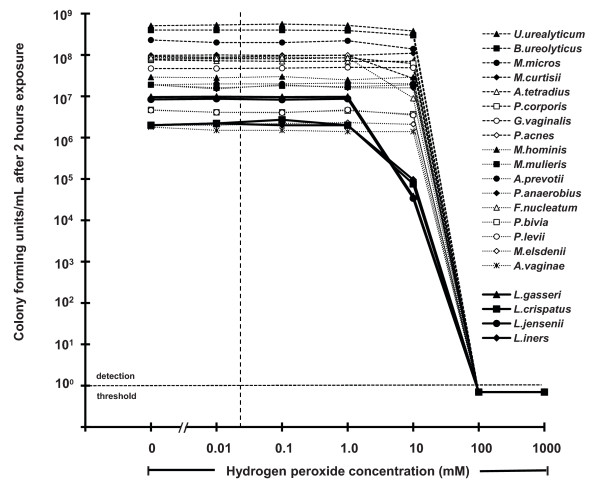
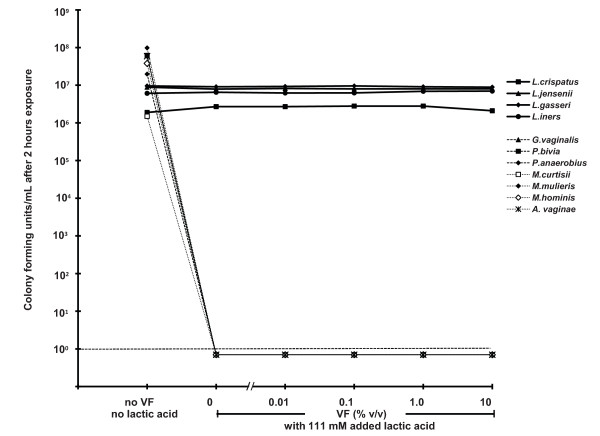
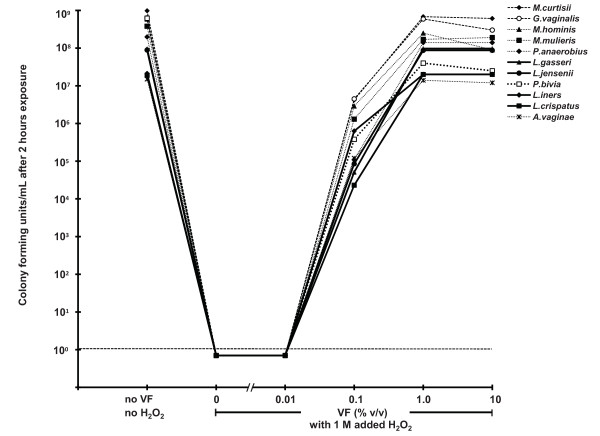
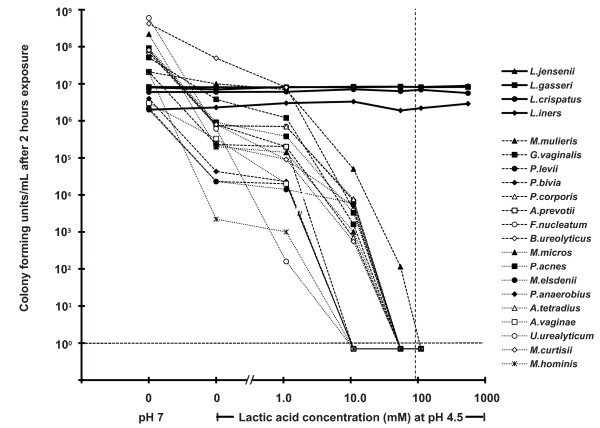
Physiological concentrations of H2O2 (< 100 μM) failed to inactivate any of the BV-associated bacteria tested, even in the presence of human myeloperoxidase (MPO) that increases the microbicidal activity of H2O2. At 10 mM, H2O2 inactivated all four species of vaginal lactobacilli but only one of seventeen species of BV-associated bacteria. Moreover, the addition of just 1% vaginal fluid (VF) blocked the microbicidal activity of 1 M H2O2. In contrast, lactic acid at physiological concentrations (55-111 mM) and pH (4.5) inactivated all the BV-associated bacteria tested, and had no detectable effect on the vaginal lactobacilli. Also, the addition of 10% VF did not block the microbicidal activity of lactic acid.
Under optimal, anaerobic growth conditions, physiological concentrations of lactic acid inactivated BV-associated bacteria without affecting vaginal lactobacilli, whereas physiological concentrations of H2O2 produced no detectable inactivation of either BV-associated bacteria or vaginal lactobacilli. Moreover, at very high concentrations, H2O2 was more toxic to vaginal lactobacilli than to BV-associated bacteria. On the basis of these in vitro observations, we conclude that lactic acid, not H2O2, is likely to suppress BV-associated bacteria in vivo.
阴道乳杆菌产生的过氧化氢(H2O2)通常被认为可以预防与细菌性阴道病(BV)相关的细菌,并且能够产生 H2O2 的乳杆菌菌株被开发为阴道益生菌。然而,导致这种信念的证据部分基于非生理条件,即在无氧条件下选择抗氧化剂,以最大限度地提高 H2O2 的产生和杀菌活性。在这里,我们使用更类似于体内的条件来比较生理上合理浓度的 H2O2 和乳酸对广泛的 BV 相关细菌和阴道乳杆菌的影响。
将十七种 BV 相关细菌和四种阴道乳杆菌的厌氧培养物暴露于 H2O2、乳酸或乙酸,pH 值分别为 7.0 和 4.5。两小时后,通过琼脂培养基平板上的生长来计数剩余的活菌。还测量了阴道液 (VF) 对 H2O2 和乳酸杀菌活性的影响。
生理浓度的 H2O2(<100μM)未能使任何测试的 BV 相关细菌失活,即使存在增加 H2O2 杀菌活性的人髓过氧化物酶 (MPO) 也是如此。在 10mM 时,H2O2 使所有四种阴道乳杆菌失活,但仅使十七种 BV 相关细菌中的一种失活。此外,只需添加 1%的阴道液 (VF) 就可以阻断 1M H2O2 的杀菌活性。相比之下,生理浓度(55-111mM)和 pH(4.5)的乳酸使所有测试的 BV 相关细菌失活,并且对阴道乳杆菌没有检测到影响。此外,添加 10%VF 也不会阻断乳酸的杀菌活性。
在最佳的厌氧生长条件下,生理浓度的乳酸可使 BV 相关细菌失活,而不影响阴道乳杆菌,而生理浓度的 H2O2 对 BV 相关细菌或阴道乳杆菌均未产生可检测的失活作用。此外,在非常高的浓度下,H2O2 对阴道乳杆菌的毒性大于对 BV 相关细菌的毒性。基于这些体外观察结果,我们得出结论,体内可能是乳酸而不是 H2O2 抑制 BV 相关细菌。