Umegaki Takeshi, Ikai Hiroshi, Imanaka Yuichi
Department of Healthcare Economics and Quality Management, Kyoto University Graduate School of Medicine, Yoshida Konoe-cho, Sakyo-ku, Kyoto 606 - 8501, Japan.
J Anaesthesiol Clin Pharmacol. 2011 Apr;27(2):180-4. doi: 10.4103/0970-9185.81816.
Severe sepsis leads to organ failure and results in high mortality. Organ dysfunction is an independent prognostic factor for intensive care unit (ICU) mortality. The objective of the present study was to determine the effect of acute organ dysfunction for ICU mortality in patients with severe sepsis using administrative data.
A multicenter cross-sectional study was performed in 2008. The study was conducted in 112 teaching hospitals in Japan. All cases with severe sepsis in ICU were identified from administrative data.
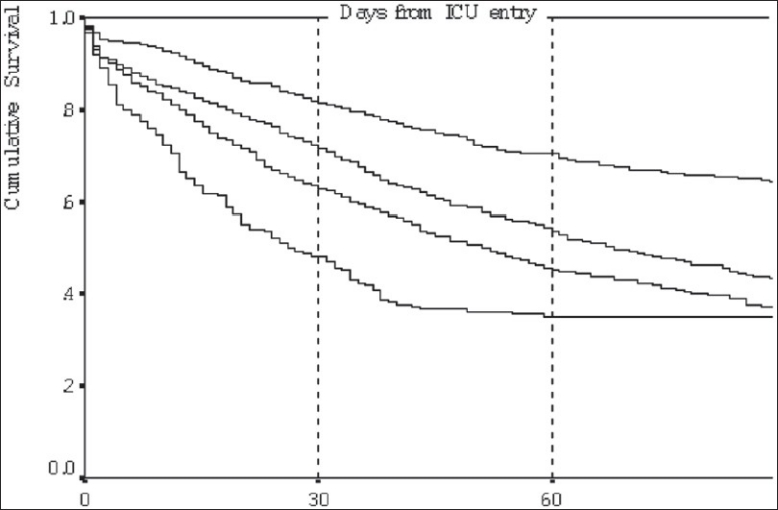
Administrative data acquired for 4196 severe septic cases of 75,069 cases entered in the ICU were used to assess patient outcomes. Cardiovascular dysfunction was identified as the most major organ dysfunction (73.0%), and the followings were respiratory dysfunction (69.4%) and renal dysfunction (39.0%), respectively. The ICU mortality and 28-day means 28-day from ICU entry. were 18.8% and 27.7%, respectively. After adjustment for age, gender, and severity of illness, the hazard ratio of 2, 3, and ≥4, the organ dysfunctions for one organ failure on ICU mortality was 1.6, 2.0, and 2.7, respectively.
We showed that the number of organ dysfunction was a useful indicator for ICU mortality on administrative data. The hepatic dysfunction was the highest mortality among organ dysfunctions. The hazard ratio of ICU death in severe septic patients with multiple organ dysfunctions was average 2.2 times higher than severe septic patients with single organ dysfunction.
严重脓毒症可导致器官衰竭并造成高死亡率。器官功能障碍是重症监护病房(ICU)死亡率的独立预后因素。本研究的目的是利用管理数据确定急性器官功能障碍对严重脓毒症患者ICU死亡率的影响。
2008年进行了一项多中心横断面研究。该研究在日本的112家教学医院开展。从管理数据中识别出ICU中所有严重脓毒症病例。
对ICU录入的75069例病例中的4196例严重脓毒症病例的管理数据进行分析,以评估患者预后。心血管功能障碍被确定为最主要的器官功能障碍(73.0%),其次分别是呼吸功能障碍(69.4%)和肾功能障碍(39.0%)。ICU死亡率和28天死亡率(从进入ICU起算28天)分别为18.8%和27.7%。在对年龄、性别和疾病严重程度进行校正后,2、3和≥4种器官功能障碍相对于一种器官功能衰竭导致ICU死亡的风险比分别为1.6、2.0和2.7。
我们发现,在管理数据中,器官功能障碍的数量是ICU死亡率的一个有用指标。肝功能障碍在器官功能障碍中死亡率最高。伴有多器官功能障碍的严重脓毒症患者的ICU死亡风险比伴有单器官功能障碍的严重脓毒症患者平均高2.2倍。