Department of Neurological Surgery, University of California Davis Davis, CA, USA.
Front Neurol. 2011 Jul 4;2:43. doi: 10.3389/fneur.2011.00043. eCollection 2011.
Moyamoya disease has been classically described by the Asian experience, yet clinical aspects of moyamoya phenomena in the United States remain vastly undefined. The multifocal occlusive arterial disorder may be linked with numerous conditions; however, later stages of this syndrome share common vascular pathophysiology. This study is aimed at characterizing inpatient moyamoya cases in the United States over a broad time span.
A comprehensive analysis of the Nationwide Inpatient Sample of the Healthcare Cost and Utilization Project (Releases 1-13, 1988-2004) based on ICD-9-CM code 437.5 was performed. Annual percentages and trends analyses were conducted for demographic variables, admission characteristics, co-morbidities, and procedures.
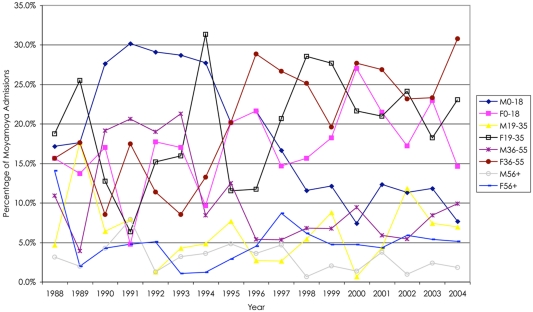
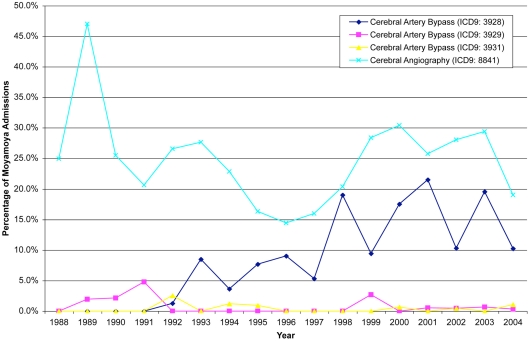
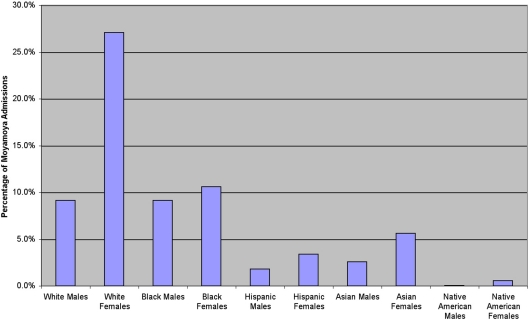
2247 admissions of moyamoya cases were analyzed from a wide geographic distribution throughout the United States between 1988 and 2004. Age at admission varied considerably (mean 29.6 ± 18.5 years), affecting women more frequently than men (61.9%). Various racial groups were identified (35.4% White, 19.7% African American, 5.6% Hispanic, 8.3% Asian or Pacific Islander, 1.4% Native American). Admissions were typically emergent (38.8%) or urgent (18.7%), although elective admissions occurred (24.4%). Aside from moyamoya, sickle cell disease was diagnosed in 13.6%, ischemic stroke in 20.7%, intracerebral hemorrhage in 7.4%, transient ischemic attack in 3.4%, and subarachnoid hemorrhage in 3.1%. Cerebral angiography was performed in 24.9% while extracranial-intracranial bypass was done in 8.4% of patients.
Moyamoya in the United States is a heterogeneous condition affecting individuals of all ages across a diverse racial spectrum and wide geographic distribution. Further recognition of moyamoya syndrome may facilitate ongoing research and future therapeutic approaches.
Moyamoya 病以前被认为是一种典型的亚洲疾病,然而,美国 Moyamoya 现象的临床方面仍未得到充分定义。这种多发性闭塞性动脉疾病可能与许多疾病有关;然而,这种综合征的晚期具有共同的血管病理生理学特征。本研究旨在对美国在广泛的时间跨度内的住院 Moyamoya 病例进行特征描述。
对医疗保健成本和利用项目的全国住院患者样本(发布 1-13 次,1988-2004 年)进行了基于 ICD-9-CM 代码 437.5 的全面分析。对人口统计学变量、入院特征、合并症和程序进行了年度百分比和趋势分析。
1988 年至 2004 年期间,从美国各地广泛的地理分布中分析了 2247 例 Moyamoya 病例。入院年龄差异很大(平均 29.6±18.5 岁),女性比男性更常见(61.9%)。确定了各种种族群体(35.4%为白人,19.7%为非裔美国人,5.6%为西班牙裔,8.3%为亚洲或太平洋岛民,1.4%为美国原住民)。入院情况通常为紧急(38.8%)或紧急(18.7%),尽管也有选择性入院(24.4%)。除了 Moyamoya 之外,13.6%的患者被诊断为镰状细胞病,20.7%的患者为缺血性脑卒中,7.4%的患者为颅内出血,3.4%的患者为短暂性脑缺血发作,3.1%的患者为蛛网膜下腔出血。24.9%的患者进行了脑血管造影检查,8.4%的患者进行了颅内外旁路手术。
美国的 Moyamoya 是一种异质性疾病,影响着不同年龄、不同种族和广泛地理分布的个体。对 Moyamoya 综合征的进一步认识可能有助于开展进一步的研究和未来的治疗方法。