The Department of Microbiology, The Ohio State University Columbus, OH, USA.
Front Microbiol. 2011 May 6;2:101. doi: 10.3389/fmicb.2011.00101. eCollection 2011.
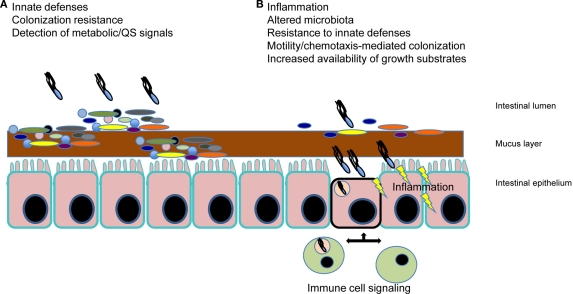
Salmonella spp. are major cause of human morbidity and mortality worldwide. Upon entry into the human host, Salmonella spp. must overcome the resistance to colonization mediated by the gut microbiota and the innate immune system. They successfully accomplish this by inducing inflammation and mechanisms of innate immune defense. Many models have been developed to study Salmonella spp. interaction with the microbiota that have helped to identify factors necessary to overcome colonization resistance and to mediate disease. Here we review the current state of studies into this important pathogen/microbiota/host interaction in the mammalian gastrointestinal tract.
沙门氏菌属是导致全球人类发病和死亡的主要原因。沙门氏菌属进入人体宿主后,必须克服肠道微生物群和先天免疫系统介导的定植抗性。它们通过诱导炎症和先天免疫防御机制成功地完成了这一过程。已经开发了许多模型来研究沙门氏菌属与微生物群的相互作用,这些模型有助于确定克服定植抗性和介导疾病所需的因素。在这里,我们综述了目前对哺乳动物胃肠道中这一重要病原体/微生物群/宿主相互作用的研究现状。