Jenny Marcel, Wondrak Angela, Zvetkova Elissaveta, Tram Nguyen Thi Ngoc, Phi Phan Thi Phi, Schennach Harald, Culig Zoran, Ueberall Florian, Fuchs Dietmar
Division of Biological Chemistry, Innsbruck Medical University, Fritz-Pregl-Str. 3, 6020 Innsbruck, Austria.
Sci Pharm. 2011 Apr-Jun;79(2):323-35. doi: 10.3797/scipharm.1011-13. Epub 2011 Apr 5.
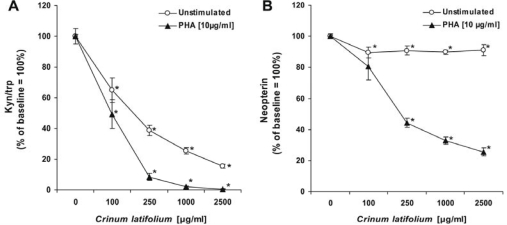
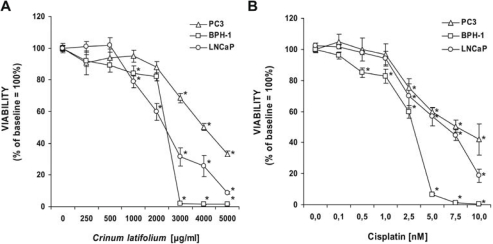
Plants of the genus Crinum (Amaryllidaceae) are widely used in folk medicine in different tropical and subtropical regions around the world. The Indian species Crinum latifolium (L.) was traditionally used to treat rheumatism, fistula, tumors, earaches, rubefacient, tubercle and whitlow. In Vietnamese and Chinese traditional medicine Crinum latifolium preparations are used until nowadays because of their antiviral and antitumor properties. In this study, we demonstrate potent in vitro antioxidant activity of an aqueous Crinum latifolium extract by an oxygen radical absorbance capacity (ORAC) value of 1610 ± 150 μmol Trolox equivalents/g. Furthermore, significant anti-inflammatory effects of this extract were shown by its potential to suppress indoleamine 2,3-dioxygenase (IDO) mediated tryptophan degradation in unstimulated- and mitogen-stimulated PBMC at IC(50) doses of 241 ± 57 μg/ml and 92 ± 20 μg/ml, respectively. Concentrations of the immune activation marker neopterin were slightly diminished in unstimulated PBMC, whereas a dose-dependent inhibition of neopterin formation was observed in mitogen-stimulated PBMC (IC(50) = 453 ± 86 μg/ml). Additionally, we measured also dose-dependent inhibitory effects of this aqueous Crinum latifolium extract on cell proliferation of highly metastatic human prostate carcinoma PC3 cells (IC(50) = 4.5 ± 0.8 mg/ml), androgen-sensitive prostate adenocarcinoma LNCaP cells (IC(50) =2.3 ± 0.1 mg/ml), and benign prostate hyperplasia BPH-1 cells (IC(50) = 2.1 ± 0.04 mg/ml). We conclude that both effects, inhibition of tumor cell growth and recovery of immune functions, are important for the antitumor properties of Crinum latifolium.
文殊兰属(石蒜科)植物在世界各地不同的热带和亚热带地区被广泛用于民间医学。印度物种阔叶文殊兰(L.)传统上用于治疗风湿病、瘘管、肿瘤、耳痛、发红剂、结核和甲沟炎。在越南和中国传统医学中,阔叶文殊兰制剂因其抗病毒和抗肿瘤特性至今仍被使用。在本研究中,我们通过氧自由基吸收能力(ORAC)值为1610±150μmol Trolox当量/g,证明了阔叶文殊兰水提取物具有强大的体外抗氧化活性。此外,该提取物在未刺激和丝裂原刺激的外周血单核细胞(PBMC)中,分别以241±57μg/ml和92±20μg/ml的半数抑制浓度(IC50)抑制吲哚胺2,3-双加氧酶(IDO)介导的色氨酸降解,显示出显著的抗炎作用。未刺激的PBMC中免疫激活标志物新蝶呤的浓度略有降低,而在丝裂原刺激的PBMC中观察到新蝶呤形成的剂量依赖性抑制(IC50 = 453±86μg/ml)。此外,我们还测量了该阔叶文殊兰水提取物对高转移性人前列腺癌PC3细胞(IC50 = 4.5±0.8mg/ml)、雄激素敏感前列腺腺癌LNCaP细胞(IC50 = 2.3±0.1mg/ml)和良性前列腺增生BPH-1细胞(IC50 = 2.1±0.04mg/ml)细胞增殖的剂量依赖性抑制作用。我们得出结论,抑制肿瘤细胞生长和恢复免疫功能这两种作用对于阔叶文殊兰的抗肿瘤特性都很重要。