Department of Medical Psychology 840, Radboud University Nijmegen Medical Centre, PO Box 9101, 6500 HB Nijmegen, The Netherlands.
Support Care Cancer. 2012 Jul;20(7):1441-7. doi: 10.1007/s00520-011-1227-4. Epub 2011 Jul 21.
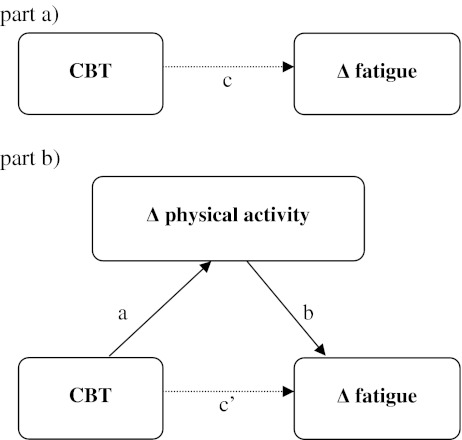
Persistent fatigue is a long-term adverse effect experienced in about a quarter of patients cured of cancer. It was shown that cognitive behavior therapy (CBT) especially designed for postcancer fatigue is highly effective in reducing severe fatigue. However, it is unclear by what mechanism the fatigue reduction is reached. In many fatigue reduction programs, an increase in physical activity is assumed to reduce fatigue. The purpose of the present study is to determine whether the effect of CBT on fatigue is mediated by an increase in physical activity.
Data of a previous randomized controlled trial on the efficacy of CBT for postcancer fatigue were reanalyzed (CBT, n = 41; waiting list condition, n = 42). Actigraphy was used to assess the level of objective physical activity. Cancer survivors were assessed prior as well as after the CBT and waiting list period. The mediation hypothesis was tested according to guidelines of Baron and Kenny. A non-parametric bootstrap approach was used to test statistical significance of the mediation effect.
Although CBT effectively reduced postcancer fatigue, no change in level of objective physical activity was found. The mean mediation effect was 1.4% of the total treatment effect. This effect was not significant.
The effect of CBT for postcancer fatigue is not mediated by a persistent increase in objective physical activity.
约四分之一癌症治愈患者会经历持续性疲劳这一长期不良反应。研究表明,专门针对癌症后疲劳设计的认知行为疗法(CBT)在减轻严重疲劳方面非常有效。然而,疲劳减轻的机制尚不清楚。在许多减轻疲劳的方案中,假设增加身体活动会减轻疲劳。本研究的目的是确定 CBT 对疲劳的影响是否通过增加身体活动来介导。
重新分析了先前关于 CBT 治疗癌症后疲劳疗效的随机对照试验的数据(CBT 组,n=41;等待名单组,n=42)。使用活动记录仪评估客观身体活动水平。癌症幸存者在接受 CBT 和等待名单治疗前后均接受了评估。根据 Baron 和 Kenny 的指南检验了中介假设。使用非参数自举法检验了中介效应的统计学意义。
尽管 CBT 能有效减轻癌症后疲劳,但未发现客观身体活动水平的变化。平均中介效应为总治疗效果的 1.4%。该效应不显著。
CBT 治疗癌症后疲劳的效果并非通过持续增加客观身体活动来介导。