Clinical Memory Research Unit, Department of Clinical Sciences, Malmö, Lund University, SE-205 02 Malmö, Sweden.
Alzheimers Res Ther. 2011 Jul 20;3(4):23. doi: 10.1186/alzrt85.
The objective of this study was to describe the longitudinal cognitive outcome in Alzheimer's disease (AD) and analyze factors that affect the outcome, including the impact of different cholinesterase inhibitors (ChEI).
In an open, three-year, nonrandomized, prospective, multicenter study, 843 patients were treated with donepezil, rivastigmine, or galantamine in a routine clinical setting. At baseline and every six months, patients were assessed using several rating scales, including the Mini-Mental State Examination (MMSE) and the Alzheimer's Disease Assessment Scale-cognitive subscale (ADAS-cog) and the dose of ChEI was recorded. Sociodemographic and clinical characteristics were investigated. The relationships of these predictors with longitudinal cognitive ability were analyzed using mixed-effects models.
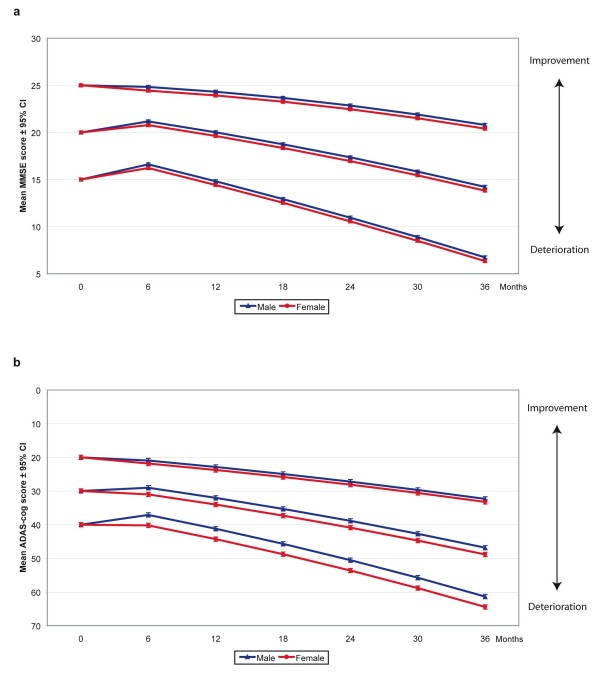
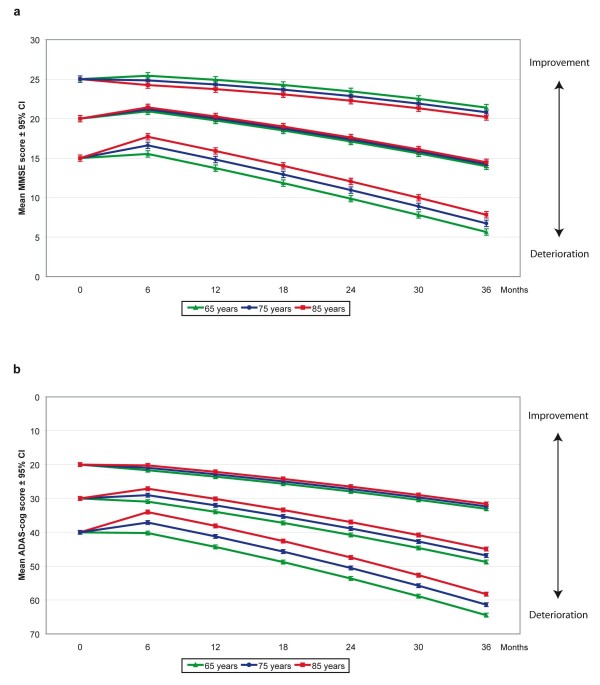
Slower long-term cognitive decline was associated with a higher cognitive ability at baseline or a lower level of education. The improvement in cognitive response after six months of ChEI therapy and a more positive longitudinal outcome were related to a higher mean dose of ChEI, nonsteroidal anti-inflammatory drug (NSAID)/acetylsalicylic acid usage, male gender, older age, and absence of the apolipoprotein E (APOE) ε4 allele. More severe cognitive impairment at baseline also predicted an improved response to ChEI treatment after six months. The type of ChEI agent did not influence the short-term response or the long-term outcome.
In this three-year AD study performed in a routine clinical practice, the response to ChEI treatment and longitudinal cognitive outcome were better in males, older individuals, non-carriers of the APOE ε4 allele, patients treated with NSAIDs/acetylsalicylic acid, and those receiving a higher dose of ChEI, regardless of the drug agent.
本研究旨在描述阿尔茨海默病(AD)的纵向认知结局,并分析影响结局的因素,包括不同胆碱酯酶抑制剂(ChEI)的影响。
在一项开放、三年、非随机、前瞻性、多中心研究中,843 例患者在常规临床环境中接受多奈哌齐、加兰他敏或利斯的明治疗。在基线和每 6 个月时,使用多种评分量表评估患者,包括简易精神状态检查(MMSE)和阿尔茨海默病评估量表认知分量表(ADAS-cog),并记录 ChEI 剂量。调查了社会人口统计学和临床特征。使用混合效应模型分析这些预测因素与纵向认知能力的关系。
长期认知能力下降较慢与基线时认知能力较高或受教育程度较低有关。ChEI 治疗 6 个月后的认知反应改善和更积极的纵向结局与 ChEI 的平均剂量较高、非甾体抗炎药(NSAID)/乙酰水杨酸使用、男性性别、年龄较大、载脂蛋白 E(APOE)ε4 等位基因缺失有关。基线时认知障碍越严重,对 ChEI 治疗 6 个月后的反应也越好。ChEI 药物类型不影响短期反应或长期结局。
在这项为期三年的 AD 常规临床实践研究中,男性、年龄较大、不携带 APOE ε4 等位基因、接受 NSAID/乙酰水杨酸治疗、以及接受较高剂量 ChEI 的患者对 ChEI 治疗的反应和纵向认知结局更好,无论药物类型如何。