Clinical Memory Research Unit, Department of Clinical Sciences, Malmö, Lund University, Malmö, Sweden.
Alzheimers Res Ther. 2013 Oct 7;5(5):44. doi: 10.1186/alzrt210. eCollection 2013.
Knowledge of longitudinal progression in mild Alzheimer's disease (AD) is required for the evaluation of disease-modifying therapies. Our aim was to observe the effects of long-term cholinesterase inhibitor (ChEI) therapy in mild AD patients in a routine clinical setting.
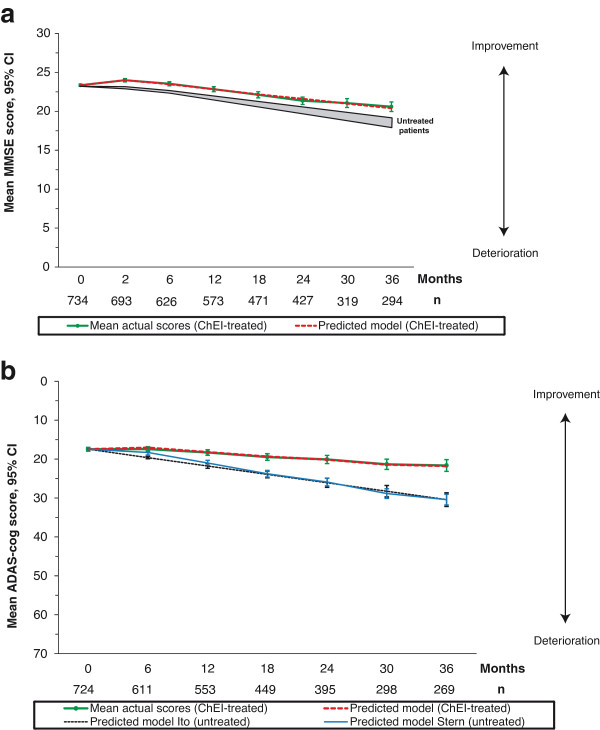
This was a prospective, open-label, non-randomized, multicenter study of ChEI treatment (donepezil, rivastigmine or galantamine) conducted during clinical practice. The 734 mild AD patients (Mini-Mental State Examination (MMSE) score 20 to 26) were assessed at baseline and then semi-annually over three years. Outcome measures included the MMSE, Alzheimer's Disease Assessment Scale-cognitive subscale (ADAS-cog), Clinician's Interview-Based Impression of Change (CIBIC) and Instrumental Activities of Daily Living (IADL) scale.
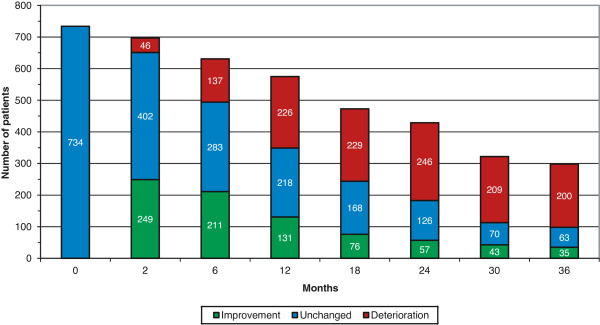
After three years of ChEI therapy, 31% (MMSE) and 33% (ADAS-cog) of the patients showed improved/unchanged cognitive ability, 33% showed improved/unchanged global performance and 14% showed improved/unchanged IADL capacity. Higher mean dose of ChEI and lower educational level were both predictors of more positive longitudinal cognitive and functional outcomes. Older participants and those with a better IADL score at baseline exhibited a slower rate of cognitive decline, whereas younger participants and those with higher cognitive status showed more preserved IADL ability over time. Gender and apolipoprotein E (APOE) genotype showed inconsistent results. Prediction models using the abovementioned scales are presented.
In naturalistic mild AD patients, a marked deterioration in IADL compared with cognitive and global long-term outcomes was observed, indicating the importance of functional assessments during the early stages of the disease. The participants' time on ChEI treatment before inclusion in studies of new therapies might affect their rate of decline and thus the comparisons of changes in scores between various studies. An increased understanding of expected disease progression in different domains and potential predictors of disease progression is essential for assessment of future therapies in AD.
了解轻度阿尔茨海默病(AD)的纵向进展对于评估疾病修饰疗法至关重要。我们的目的是在常规临床环境中观察长期胆碱酯酶抑制剂(ChEI)治疗对轻度 AD 患者的影响。
这是一项在临床实践中进行的、前瞻性的、开放标签的、非随机的、多中心的 ChEI 治疗(多奈哌齐、加兰他敏或利伐斯的明)研究。734 名轻度 AD 患者(简易精神状态检查(MMSE)评分 20-26)在基线时进行评估,然后在三年内每半年评估一次。主要终点包括 MMSE、阿尔茨海默病评估量表认知子量表(ADAS-cog)、临床医生基于访谈的变化印象量表(CIBIC)和日常生活活动量表(IADL)。
在接受 ChEI 治疗三年后,31%(MMSE)和 33%(ADAS-cog)的患者认知能力改善/无变化,33%的患者整体表现改善/无变化,14%的患者 IADL 能力改善/无变化。更高的 ChEI 平均剂量和更低的教育水平均是认知和功能结局更积极的纵向变化的预测因素。年龄较大的参与者和基线时 IADL 评分较高的参与者认知衰退速度较慢,而年龄较小的参与者和认知状态较高的参与者随时间推移 IADL 能力保存更好。性别和载脂蛋白 E(APOE)基因型的结果不一致。本文介绍了使用上述量表建立的预测模型。
在自然发生的轻度 AD 患者中,与认知和总体长期结局相比,IADL 明显恶化,表明在疾病早期进行功能评估的重要性。在纳入新疗法研究之前,参与者接受 ChEI 治疗的时间可能会影响他们的下降速度,从而影响不同研究之间评分变化的比较。深入了解不同领域的预期疾病进展和疾病进展的潜在预测因素对于评估 AD 的未来疗法至关重要。