• 文献检索
  • 文档翻译
  • 深度研究
  • 学术资讯
  • Suppr Zotero 插件Zotero 插件
  • 邀请有礼
  • 套餐&价格
  • 历史记录
应用&插件
Suppr Zotero 插件Zotero 插件浏览器插件Mac 客户端Windows 客户端微信小程序
定价
高级版会员购买积分包购买API积分包
服务
文献检索文档翻译深度研究API 文档MCP 服务
关于我们
关于 Suppr公司介绍联系我们用户协议隐私条款
关注我们

Suppr 超能文献

核心技术专利:CN118964589B侵权必究
粤ICP备2023148730 号-1Suppr @ 2026

文献检索

告别复杂PubMed语法,用中文像聊天一样搜索,搜遍4000万医学文献。AI智能推荐,让科研检索更轻松。

立即免费搜索

文件翻译

保留排版,准确专业,支持PDF/Word/PPT等文件格式,支持 12+语言互译。

免费翻译文档

深度研究

AI帮你快速写综述,25分钟生成高质量综述,智能提取关键信息,辅助科研写作。

立即免费体验

中风会损害儿童的学习能力吗?

Does stroke impair learning in children?

作者信息

Rodrigues Sonia das Dores, Ciasca Sylvia Maria, Guimarães Inês Elcione, da Freiria Elias Karla Maria Ibraim, Oliveira Carolina Camargo, de Moura-Ribeiro Maria Valeriana Leme

机构信息

Department of Neurology, Medical Sciences Faculty, State University of Campinas (Unicamp), 13081-970 Campinas, SP, Brazil.

出版信息

Stroke Res Treat. 2011;2011:369836. doi: 10.4061/2011/369836. Epub 2011 Jun 8.

DOI:10.4061/2011/369836
PMID:21776360
原文链接:https://pmc.ncbi.nlm.nih.gov/articles/PMC3138155/
Abstract

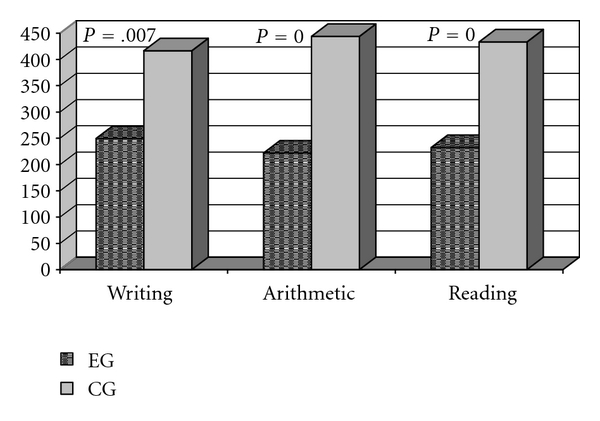
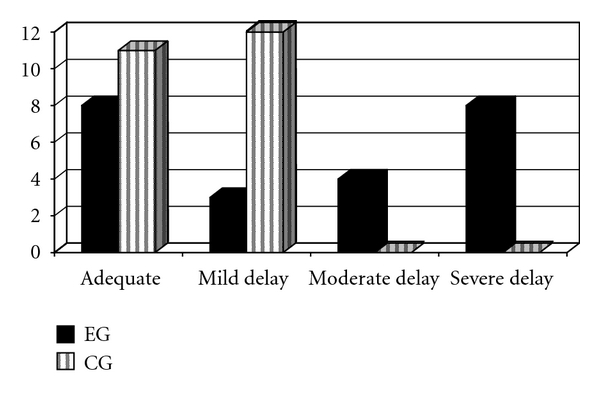
Objective. To assess cognitive development and learning in children who have had strokes. Method. Twenty-nine stroke patients and 18 children with no brain lesions and no learning impairments were evaluated. For the cognitive assessment, Piaget's clinical method was used. Writing, arithmetic, and reading abilities were assessed by the school performance test. Results. The mean age at evaluation was 9.6 years. Among the 29 children, 20 had early lesions (mean of 2.4 years old). The stroke was ischemic in 18 subjects; there were 7 cases of recurrence. Six children could not answer the tests. A high index of cognitive delay and low performance in writing, arithmetic, and reading were verified. Comparison with the control group revealed that the children who have had strokes had significantly lower performances. Conclusion. In this sample, strokes impaired cognitive development and learning. It is important that children have access to educational support and cognitive rehabilitation after injury. These approaches may minimise the effects of strokes on learning in children.

摘要

目的。评估患中风儿童的认知发展和学习情况。方法。对29名中风患者以及18名无脑部损伤且无学习障碍的儿童进行了评估。认知评估采用皮亚杰临床方法。通过学校成绩测试评估书写、算术和阅读能力。结果。评估时的平均年龄为9.6岁。在这29名儿童中,20名有早期损伤(平均年龄2.4岁)。18名受试者的中风为缺血性;有7例复发。6名儿童无法完成测试。证实存在较高的认知延迟指数以及书写、算术和阅读方面的低表现。与对照组比较显示,患中风的儿童表现明显更低。结论。在该样本中,中风损害了认知发展和学习。儿童受伤后获得教育支持和认知康复很重要。这些方法可能会将中风对儿童学习的影响降至最低。
https://cdn.ncbi.nlm.nih.gov/pmc/blobs/310b/3138155/57cdb80ea72a/SRT2011-369836.005.jpg
https://cdn.ncbi.nlm.nih.gov/pmc/blobs/310b/3138155/053024175318/SRT2011-369836.001.jpg
https://cdn.ncbi.nlm.nih.gov/pmc/blobs/310b/3138155/bd5031cf5d3e/SRT2011-369836.002.jpg
https://cdn.ncbi.nlm.nih.gov/pmc/blobs/310b/3138155/94b7f7f4c190/SRT2011-369836.003.jpg
https://cdn.ncbi.nlm.nih.gov/pmc/blobs/310b/3138155/02967bf27f88/SRT2011-369836.004.jpg
https://cdn.ncbi.nlm.nih.gov/pmc/blobs/310b/3138155/57cdb80ea72a/SRT2011-369836.005.jpg
https://cdn.ncbi.nlm.nih.gov/pmc/blobs/310b/3138155/053024175318/SRT2011-369836.001.jpg
https://cdn.ncbi.nlm.nih.gov/pmc/blobs/310b/3138155/bd5031cf5d3e/SRT2011-369836.002.jpg
https://cdn.ncbi.nlm.nih.gov/pmc/blobs/310b/3138155/94b7f7f4c190/SRT2011-369836.003.jpg
https://cdn.ncbi.nlm.nih.gov/pmc/blobs/310b/3138155/02967bf27f88/SRT2011-369836.004.jpg
https://cdn.ncbi.nlm.nih.gov/pmc/blobs/310b/3138155/57cdb80ea72a/SRT2011-369836.005.jpg

相似文献

1
Does stroke impair learning in children?中风会损害儿童的学习能力吗?
Stroke Res Treat. 2011;2011:369836. doi: 10.4061/2011/369836. Epub 2011 Jun 8.
2
[Alphabetization and rehabilitation of reading/writing disorders through a phonetic-visual-articulatory method].[通过语音-视觉-发音方法对阅读/书写障碍进行字母排序及康复训练]
Pro Fono. 2006 Jan-Apr;18(1):69-78. doi: 10.1590/s0104-56872006000100009.
3
Relationship between visual motor integration skill and academic performance in kindergarten through third grade.幼儿园至三年级学生视觉运动整合技能与学业成绩之间的关系。
Optom Vis Sci. 1999 Mar;76(3):159-63. doi: 10.1097/00006324-199903000-00015.
4
School attainments in children with congenital hypothyroidism detected by neonatal screening and treated early in life.
Eur J Endocrinol. 1999 May;140(5):407-13. doi: 10.1530/eje.0.1400407.
5
[Do children with cochlear implants read or write differently?: literacy acquisition after cochlear implantation].[接受人工耳蜗植入的儿童在阅读或写作方面是否有不同表现?:人工耳蜗植入后的读写能力获得]
HNO. 2010 Sep;58(9):934-46. doi: 10.1007/s00106-010-2088-8.
6
Neuropsychological significance of variations in patterns of academic performance: verbal and visual-spatial abilities.学业成绩模式变化的神经心理学意义:言语和视觉空间能力。
J Abnorm Child Psychol. 1978 Mar;6(1):121-33. doi: 10.1007/BF00915788.
7
Type of delivery and reading, writing, and arithmetic learning in twin births.分娩方式与双胞胎读写算术学习能力的关系。
Dev Psychobiol. 2020 May;62(4):484-495. doi: 10.1002/dev.21932. Epub 2019 Oct 31.
8
Effects of diabetes on learning in children.糖尿病对儿童学习的影响。
Pediatrics. 2002 Jan;109(1):E9. doi: 10.1542/peds.109.1.e9.
9
Spatial complexity of character-based writing systems and arithmetic in primary school: a longitudinal study.小学基于字符的书写系统和算术的空间复杂性:一项纵向研究。
Front Psychol. 2015 Mar 26;6:333. doi: 10.3389/fpsyg.2015.00333. eCollection 2015.
10
Learning disability in rural primary school children.农村小学儿童的学习障碍
Indian J Med Res. 1991 Apr;94:89-95.

引用本文的文献

1
Back to School: Academic Functioning and Educational Needs among Youth with Acquired Brain Injury.重返校园:获得性脑损伤青少年的学业表现与教育需求
Children (Basel). 2022 Aug 30;9(9):1321. doi: 10.3390/children9091321.
2
Academic skills after brain injury: A lifespan perspective.脑损伤后的学术技能:全生命周期视角。
Neuropsychology. 2022 Jul;36(5):419-432. doi: 10.1037/neu0000806. Epub 2022 Apr 14.
3
Functional outcomes in children related to self-care, mobility, and social function after stroke in early childhood: a cohort study.

本文引用的文献

1
Cognitive outcome following unilateral arterial ischaemic stroke in childhood: effects of age at stroke and lesion location.儿童单侧动脉缺血性卒中后的认知结局:卒中年龄和病变部位的影响。
Dev Med Child Neurol. 2010 Apr;52(4):386-93. doi: 10.1111/j.1469-8749.2009.03403.x. Epub 2009 Aug 20.
2
[Auditory processing in children with cerebrovascular disease].[脑血管疾病患儿的听觉处理]
Pro Fono. 2007 Oct-Dec;19(4):393-400. doi: 10.1590/s0104-56872007000400012.
3
Cerebrovascular disease in childhood: neuropsychological investigation of 14 cases.
儿童在幼儿期中风后在自理、移动和社会功能方面的功能结果:一项队列研究。
Arq Neuropsiquiatr. 2022 Jan;80(1):13-22. doi: 10.1590/0004-282X-ANP-2021-0019.
4
Experimental pediatric stroke shows age-specific recovery of cognition and role of hippocampal Nogo-A receptor signaling.实验性小儿脑卒中显示认知具有年龄特异性恢复,且海马 Nogo-A 受体信号起作用。
J Cereb Blood Flow Metab. 2020 Mar;40(3):588-599. doi: 10.1177/0271678X19828581. Epub 2019 Feb 14.
5
[Impact of a virtual reality-based intervention on motor performance and balance of a child with cerebral palsy: a case study].[基于虚拟现实的干预对一名脑瘫儿童运动表现和平衡能力的影响:一项案例研究]
Rev Paul Pediatr. 2014 Dec;32(4):389-94. doi: 10.1016/j.rpped.2014.04.005.
儿童脑血管疾病:14例神经心理学调查
Arq Neuropsiquiatr. 2007 Mar;65(1):41-7. doi: 10.1590/s0004-282x2007000100010.
4
Hemorrhagic stroke in children.儿童出血性中风
Pediatr Neurol. 2007 Feb;36(2):73-80. doi: 10.1016/j.pediatrneurol.2006.09.017.
5
Neuropsychological problems after paediatric stroke: two year follow-up of Swiss children.儿童中风后的神经心理学问题:瑞士儿童的两年随访
Neuropediatrics. 2006 Feb;37(1):13-9. doi: 10.1055/s-2006-923932.
6
Is it time for a large, collaborative study of pediatric stroke?是时候开展一项关于儿童中风的大型合作研究了吗?
Stroke. 2005 Sep;36(9):1825-9. doi: 10.1161/01.STR.0000177882.08802.3c. Epub 2005 Aug 11.
7
The first three years of the Swiss Neuropaediatric Stroke Registry (SNPSR): a population-based study of incidence, symptoms and risk factors.瑞士儿童神经病学卒中登记处(SNPSR)的头三年:一项基于人群的发病率、症状及风险因素研究。
Neuropediatrics. 2005 Apr;36(2):90-7. doi: 10.1055/s-2005-837658.
8
Ischemic cerebrovascular disease in childhood: cognitive assessment of 15 patients.儿童缺血性脑血管疾病:15例患者的认知评估
Arq Neuropsiquiatr. 2004 Sep;62(3B):802-7. doi: 10.1590/s0004-282x2004000500012. Epub 2004 Oct 5.
9
The clinical outcomes of neonatal and childhood stroke: review of the literature and implications for future research.
Eur J Neurol. 2004 Jul;11(7):431-8. doi: 10.1111/j.1468-1331.2004.00861.x.
10
Long-term functional outcome of pediatric stroke survivors.
Top Stroke Rehabil. 2004 Spring;11(2):51-9. doi: 10.1310/CL09-U2QA-9M5A-ANG2.