Department of Molecular Oncology, Centre de Recherche en Cancérologie de Marseille, UMR891 Inserm, Institut Paoli-Calmettes, 27 bd Leï Roure, 13009 Marseille, France.
Mol Cancer. 2011 Jul 21;10:86. doi: 10.1186/1476-4598-10-86.
Basal breast cancers (BCs) represent ~15% of BCs. Although overall poor, prognosis is heterogeneous. Identification of good- versus poor-prognosis patients is difficult or impossible using the standard histoclinical features and the recently defined prognostic gene expression signatures (GES). Kinases are often activated or overexpressed in cancers, and constitute targets for successful therapies. We sought to define a prognostic model of basal BCs based on kinome expression profiling.
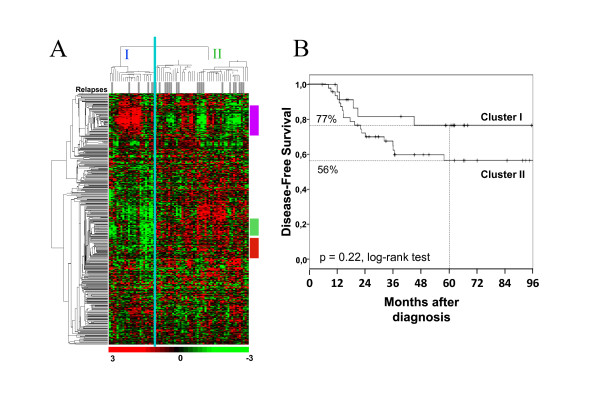
DNA microarray-based gene expression and histoclinical data of 2515 early BCs from thirteen datasets were collected. We searched for a kinome-based GES associated with disease-free survival (DFS) in basal BCs of the learning set using a metagene-based approach. The signature was then tested in basal tumors of the independent validation set.
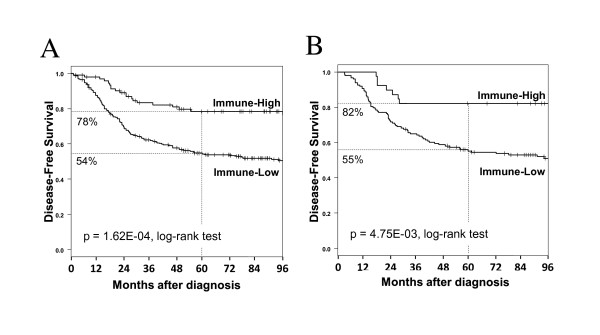
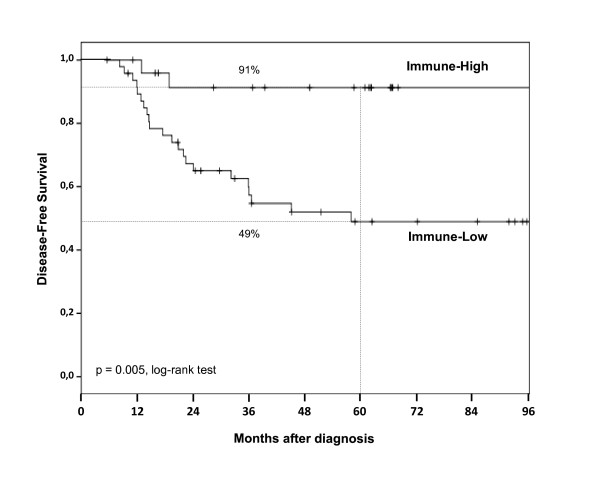
A total of 591 samples were basal. We identified a 28-kinase metagene associated with DFS in the learning set (N = 73). This metagene was associated with immune response and particularly cytotoxic T-cell response. On multivariate analysis, a metagene-based predictor outperformed the classical prognostic factors, both in the learning and the validation (N = 518) sets, independently of the lymphocyte infiltrate. In the validation set, patients whose tumors overexpressed the metagene had a 78% 5-year DFS versus 54% for other patients (p = 1.62E-4, log-rank test).
Based on kinome expression, we identified a predictor that separated basal BCs into two subgroups of different prognosis. Tumors associated with higher activation of cytotoxic tumor-infiltrative lymphocytes harbored a better prognosis. Such classification should help tailor the treatment and develop new therapies based on immune response manipulation.
基底样乳腺癌(BC)约占 BC 的 15%。尽管总体预后较差,但预后存在异质性。使用标准的组织临床特征和最近定义的预后基因表达谱(GES),难以或不可能识别预后良好和预后不良的患者。在癌症中,激酶经常被激活或过度表达,并且是成功治疗的靶点。我们试图根据激酶组表达谱定义基底样 BC 的预后模型。
收集了来自 13 个数据集的 2515 例早期 BC 的基于 DNA 微阵列的基因表达和组织临床数据。我们使用基于元基因的方法,在学习集中搜索与基底样 BC 的无病生存(DFS)相关的激酶 GES。然后在独立验证集中的基底肿瘤中测试该签名。
共有 591 例样本为基底样。我们在学习集中鉴定了与 DFS 相关的 28-激酶元基因(N = 73)。该元基因与免疫反应有关,特别是与细胞毒性 T 细胞反应有关。在多变量分析中,元基因预测器在学习和验证(N = 518)集中均优于经典预后因素,独立于淋巴细胞浸润。在验证集中,肿瘤过度表达元基因的患者 5 年 DFS 率为 78%,而其他患者为 54%(p = 1.62E-4,对数秩检验)。
基于激酶组表达,我们确定了一个可以将基底样 BC 分为两个不同预后亚组的预测因子。与细胞毒性肿瘤浸润淋巴细胞更高激活相关的肿瘤具有更好的预后。这种分类应该有助于根据免疫反应的改变来调整治疗并开发新的治疗方法。