MRC Centre for Causal Analyses in Translational Epidemiology, School of Social and Community Medicine, University of Bristol, Bristol, United Kingdom.
PLoS One. 2011;6(7):e22115. doi: 10.1371/journal.pone.0022115. Epub 2011 Jul 18.
Isolated gestational proteinuria may be part of the pre-eclampsia disease spectrum. Confirmation of its association with established pre-eclampsia risk factors and higher blood pressure in uncomplicated pregnancies would support this concept.
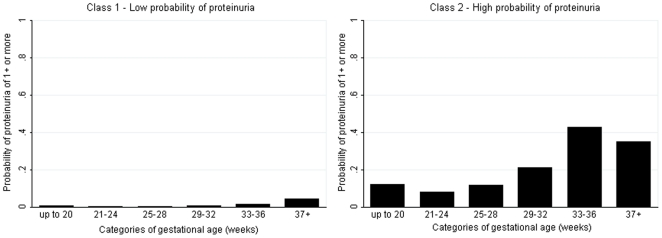
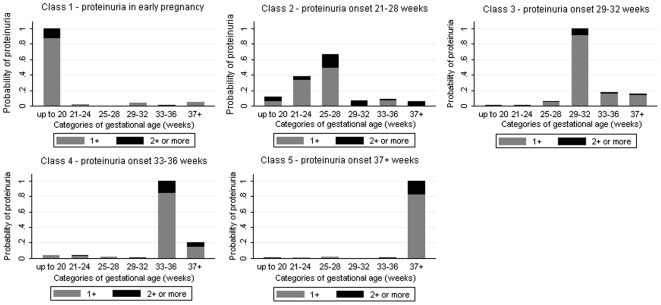
Data from 11,651 women from the Avon Longitudinal Study of Parents and Children who had a term live birth but did not have pre-existing hypertension or diabetes or develop gestational diabetes or preeclampsia were used. Proteinuria was assessed repeatedly (median 12 measurements per woman) by dipstick and latent class analysis was used to identify subgroups of the population with different patterns of proteinuria in pregnancy.
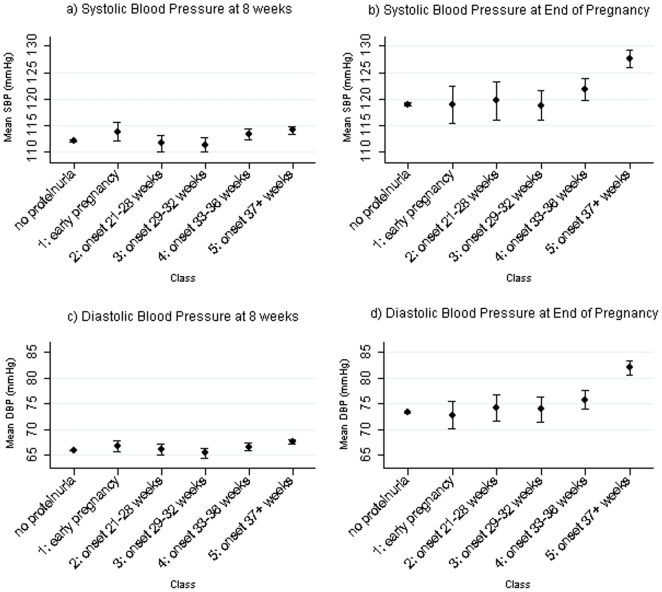
Higher maternal pre-pregnancy body mass index (BMI), younger age, nulliparity and twin pregnancy were independently associated with increased odds of any proteinuria in pregnancy. Women who experienced proteinuria showed five patterns: proteinuria in early pregnancy only (≤ 20 weeks gestation), and onset at 21-28 weeks, 29-32 weeks, 33-36 weeks and ≥ 37 weeks gestation. There were higher odds of proteinuria onset after 33 weeks in obese women and after 37 weeks in nulliparous women compared with normal weight and multiparous women respectively. Smoking in pregnancy was weakly negatively associated with odds of proteinuria onset after 37 weeks. Twin pregnancies had higher odds of proteinuria onset from 29 weeks. In women with proteinuria onset after 33 weeks blood pressure was higher in early pregnancy and at the end of pregnancy.
Established pre-eclampsia risk factors were related to proteinuria occurrence in late gestation in healthy term pregnancies, supporting the hypothesis that isolated gestational proteinuria may represent an early manifestation of pre-eclampsia.
孤立性妊娠蛋白尿可能是子痫前期疾病谱的一部分。如果孤立性妊娠蛋白尿与已确立的子痫前期危险因素相关,并与复杂妊娠中更高的血压相关,那么这一概念将得到支持。
该研究使用了来自阿冯纵向研究父母和儿童的 11651 名足月活产但无既往高血压或糖尿病或妊娠糖尿病或子痫前期的女性的数据。蛋白尿通过尿试纸进行了多次评估(每位女性的中位数为 12 次测量),并使用潜在类别分析来识别妊娠期间具有不同蛋白尿模式的人群亚组。
较高的母体孕前体重指数(BMI)、较年轻、未产和双胎妊娠与妊娠期间任何蛋白尿的发生几率增加独立相关。经历蛋白尿的女性表现出五种模式:仅在孕早期出现蛋白尿(≤20 周妊娠),以及在 21-28 周、29-32 周、33-36 周和≥37 周时出现蛋白尿。与正常体重和多产妇相比,肥胖妇女在 33 周后和未产妇在 37 周后出现蛋白尿的几率更高。妊娠期间吸烟与 37 周后蛋白尿发生几率呈弱负相关。双胎妊娠从 29 周开始出现蛋白尿的几率更高。在 33 周后出现蛋白尿的女性中,妊娠早期和妊娠末期血压更高。
已确立的子痫前期危险因素与健康足月妊娠中晚期蛋白尿的发生相关,支持孤立性妊娠蛋白尿可能代表子痫前期的早期表现这一假说。