Department of Cell Research and Immunology, George S. Wise Faculty of Life Sciences, Tel Aviv University, Tel Aviv 69978, Israel.
Nucleic Acids Res. 2011 Oct;39(19):e129. doi: 10.1093/nar/gkr601. Epub 2011 Jul 27.
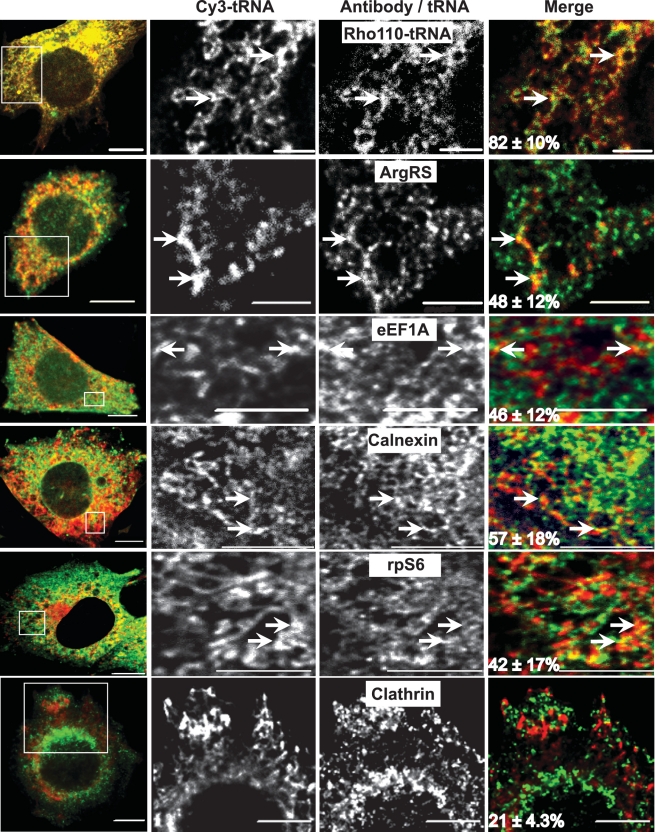
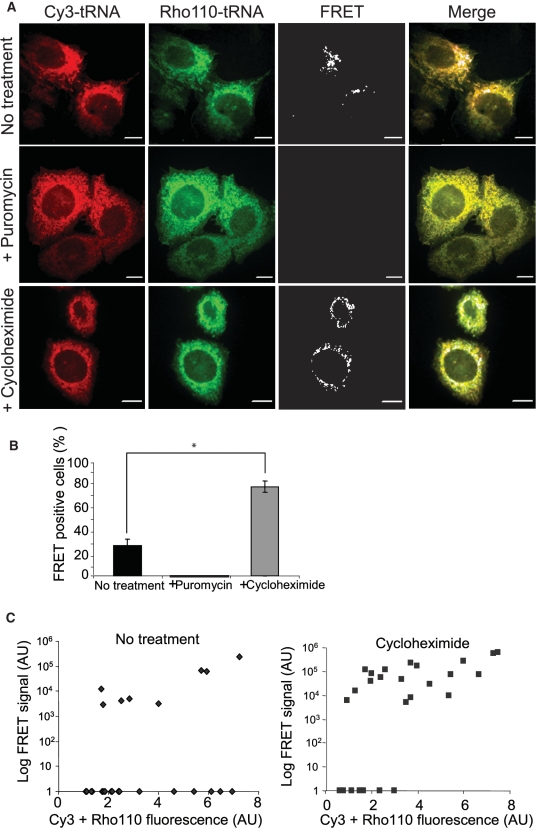
We have developed a novel technique of using fluorescent tRNA for translation monitoring (FtTM). FtTM enables the identification and monitoring of active protein synthesis sites within live cells at submicron resolution through quantitative microscopy of transfected bulk uncharged tRNA, fluorescently labeled in the D-loop (fl-tRNA). The localization of fl-tRNA to active translation sites was confirmed through its co-localization with cellular factors and its dynamic alterations upon inhibition of protein synthesis. Moreover, fluorescence resonance energy transfer (FRET) signals, generated when fl-tRNAs, separately labeled as a FRET pair occupy adjacent sites on the ribosome, quantitatively reflect levels of protein synthesis in defined cellular regions. In addition, FRET signals enable detection of intra-populational variability in protein synthesis activity. We demonstrate that FtTM allows quantitative comparison of protein synthesis between different cell types, monitoring effects of antibiotics and stress agents, and characterization of changes in spatial compartmentalization of protein synthesis upon viral infection.
我们开发了一种使用荧光 tRNA 进行翻译监测的新技术(FtTM)。FtTM 通过定量显微镜观察转染的未带电荷的 bulk tRNA(在 D 环处进行荧光标记的 fl-tRNA),能够以亚微米分辨率在活细胞内识别和监测活跃的蛋白质合成位点。通过 fl-tRNA 与细胞因子的共定位及其在蛋白质合成抑制时的动态变化,证实了 fl-tRNA 定位于活跃的翻译位点。此外,当分别标记为 FRET 对的 fl-tRNAs 占据核糖体上相邻的位置时,产生的荧光共振能量转移(FRET)信号定量反映了特定细胞区域的蛋白质合成水平。此外,FRET 信号可检测蛋白质合成活性的群体内变异性。我们证明 FtTM 允许在不同细胞类型之间进行蛋白质合成的定量比较,监测抗生素和应激剂的作用,并描述病毒感染时蛋白质合成空间区室化的变化。