Department of Public Health and Clinical Medicine, Division of Epidemiology and Global Health, Umeå University, Umeå, Sweden.
Glob Health Action. 2011;4:6347. doi: 10.3402/gha.v4i0.6347. Epub 2011 Jul 21.
Physical activity is identified as one important protective factor for chronic diseases. Physical activity surveillance is important in assessing healthy population behaviour over time. Many countries lack population trends on physical activity.
To present trends in physical activity levels in Västerbotten County, Sweden and to evaluate physical activity among women and men with various educational levels.
Population-based cross-sectional and panel data from the Västerbotten Intervention Programme (VIP) during 1990-2007 were used. All individuals in Västerbotten County who turned 40, 50, or 60 years old were invited to their local primary health care for a health screening. Physical activity during commuting, recreational activities, physical exercise, and socio-demographic data were collected using a self-administered questionnaire. Respondents were categorised as sedentary, moderate physically active, or physically active.
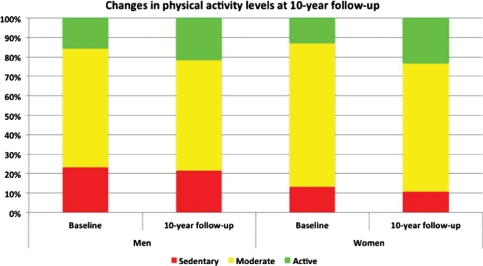
The prevalences of physically active behaviours increased from 16 to 24.2% among men and from 12.6 to 30.4% among women. Increases are observed in all educational groups, but gaps between educational groups widened recently. The level of sedentary behaviour was stable over the time period studied. The 10-year follow-up data show that the prevalences of physically active behaviours increased from 15.8 to 21.4% among men and 12.7 to 23.3% among women. However, 10.2% of men and 3.8% of women remained sedentary.
Despite the promising evidence of increasing physical activity levels among the population in Västerbotten County, challenges remain for how to reduce the stable levels of sedentary behaviours in some subgroups. Persisting social gaps in physical activity levels should be addressed further. An exploration of people's views on engaging in physical activity and barriers to doing so will allow better formulation of targeted interventions within this population.
身体活动被认为是预防慢性病的一个重要保护因素。身体活动监测对于评估人群的健康行为随时间的变化趋势非常重要。许多国家缺乏关于身体活动的人群趋势数据。
报告瑞典韦斯特博滕县身体活动水平的变化趋势,并评估不同教育水平的女性和男性的身体活动情况。
使用 1990-2007 年韦斯特博滕干预项目(VIP)的基于人群的横断面和面板数据。邀请韦斯特博滕县所有年满 40、50 或 60 岁的人到当地的初级保健中心进行健康检查。使用自我管理问卷收集了通勤、娱乐活动、体育锻炼和社会人口统计学数据。根据身体活动的多少将受访者分为久坐不动、适度活跃和活跃三个类别。
男性活跃行为的比例从 16%增加到 24.2%,女性从 12.6%增加到 30.4%。所有教育群体都有所增加,但教育群体之间的差距最近有所扩大。久坐行为的水平在研究期间保持稳定。10 年随访数据显示,男性活跃行为的比例从 15.8%增加到 21.4%,女性从 12.7%增加到 23.3%。然而,仍有 10.2%的男性和 3.8%的女性保持久坐不动。
尽管瑞典韦斯特博滕县人群的身体活动水平呈上升趋势,但在某些亚组中减少久坐行为的稳定水平仍面临挑战。需要进一步解决身体活动水平方面持续存在的社会差距问题。探索人们对参与身体活动的看法和阻碍因素,将有助于在该人群中制定有针对性的干预措施。