Department of Psychology, National University of Singapore, Singapore, Singapore.
PLoS One. 2011;6(7):e21829. doi: 10.1371/journal.pone.0021829. Epub 2011 Jul 20.
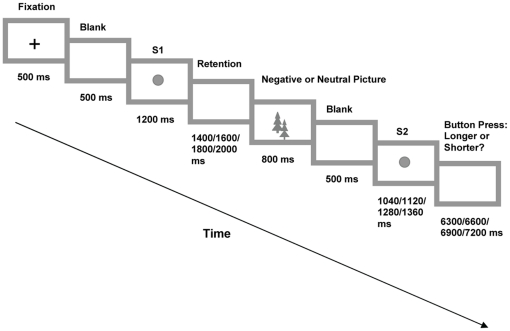
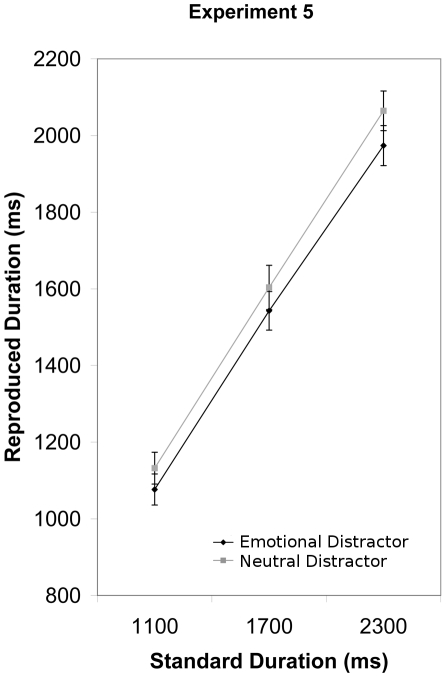
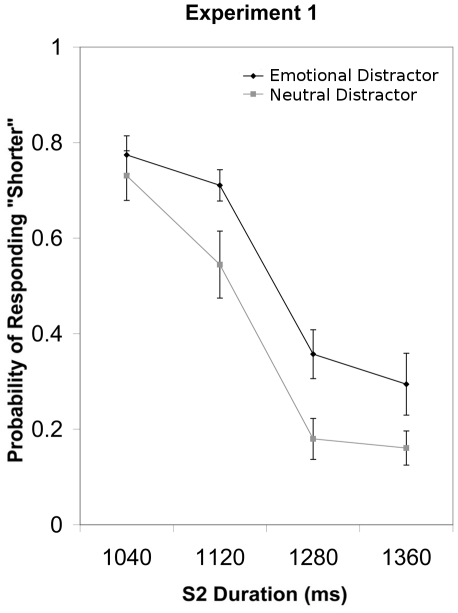
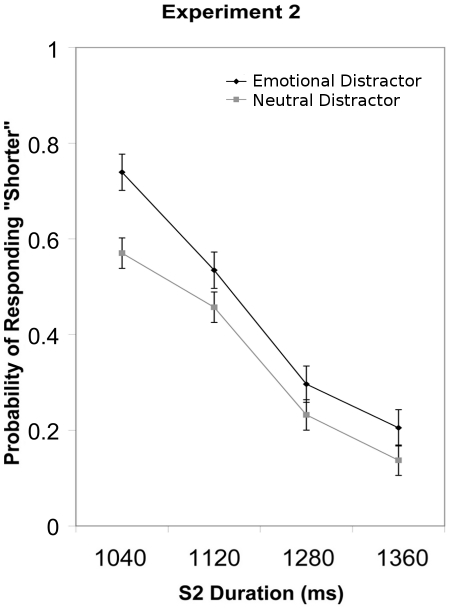
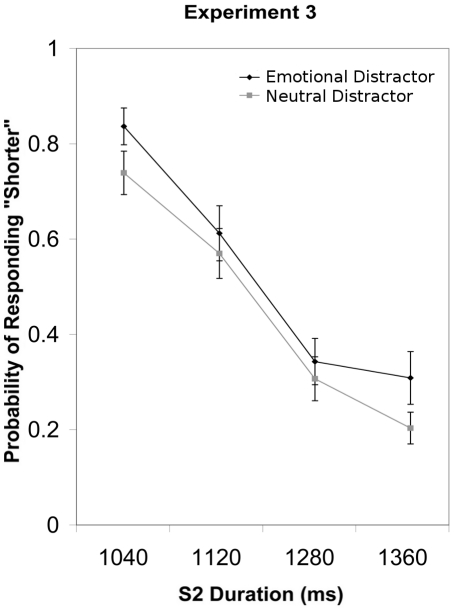
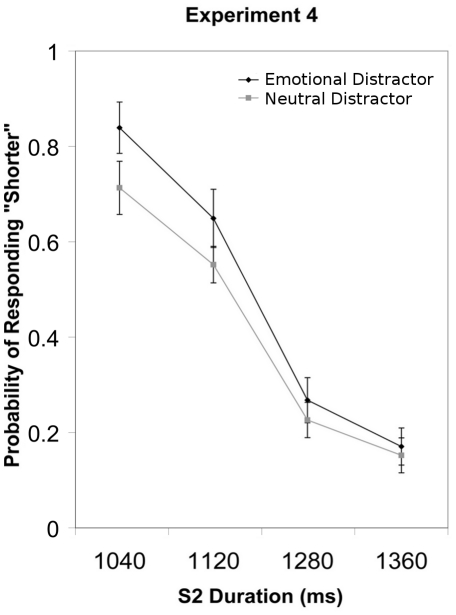
Emotions change our perception of time. In the past, this has been attributed primarily to emotions speeding up an "internal clock" thereby increasing subjective time estimates. Here we probed this account using an S1/S2 temporal discrimination paradigm. Participants were presented with a stimulus (S1) followed by a brief delay and then a second stimulus (S2) and indicated whether S2 was shorter or longer in duration than S1. We manipulated participants' emotions by presenting a task-irrelevant picture following S1 and preceding S2. Participants were more likely to judge S2 as shorter than S1 when the intervening picture was emotional as compared to neutral. This effect held independent of S1 and S2 modality (Visual: Exps. 1, 2, & 3; Auditory: Exp. 4) and intervening picture valence (Negative: Exps. 1, 2 & 4; Positive: Exp. 3). Moreover, it was replicated in a temporal reproduction paradigm (Exp. 5) where a timing stimulus was preceded by an emotional or neutral picture and participants were asked to reproduce the duration of the timing stimulus. Taken together, these findings indicate that emotional experiences may decrease temporal estimates and thus raise questions about the suitability of internal clock speed explanations of emotion effects on timing. Moreover, they highlight attentional mechanisms as a viable alternative.
情绪会改变我们对时间的感知。过去,这主要归因于情绪加速了“内部时钟”,从而增加了主观时间估计。在这里,我们使用 S1/S2 时间辨别范式来探究这一说法。参与者首先看到一个刺激(S1),然后是一个短暂的延迟,然后是第二个刺激(S2),并判断 S2 的持续时间是否比 S1 短。我们通过在 S1 之后和 S2 之前呈现一个与任务无关的图片来操纵参与者的情绪。与中性图片相比,当介入的图片是情绪化的时,参与者更有可能将 S2 判断为比 S1 短。这种效应独立于 S1 和 S2 模式(视觉:实验 1、2 和 3;听觉:实验 4)和介入图片的效价(负性:实验 1、2 和 4;正性:实验 3)。此外,它在时间复制范式(实验 5)中得到了复制,在该范式中,一个定时刺激之前是一个情绪化或中性的图片,参与者被要求复制定时刺激的持续时间。综上所述,这些发现表明,情绪体验可能会降低时间估计,从而对内部时钟速度解释情绪对时间的影响的适用性提出质疑。此外,它们还强调了注意力机制是一种可行的替代方案。