Qian Yiming, Jiang Shan, Jing Xiaolu, Shi Yusheng, Qin Haibo, Xin Bingmu, Chi Lizhong, Wu Bin
School of Psychology, Beijing Sport University, Beijing, China.
China Astronaut Research and Training Center, Beijing, China.
Front Psychol. 2021 Dec 22;12:732362. doi: 10.3389/fpsyg.2021.732362. eCollection 2021.
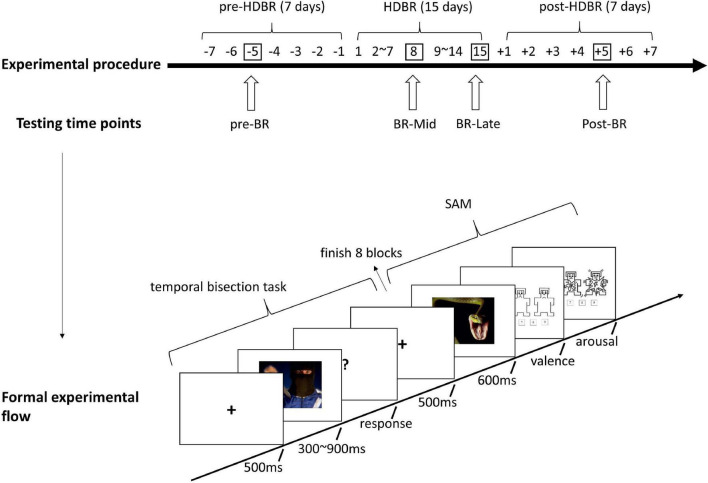
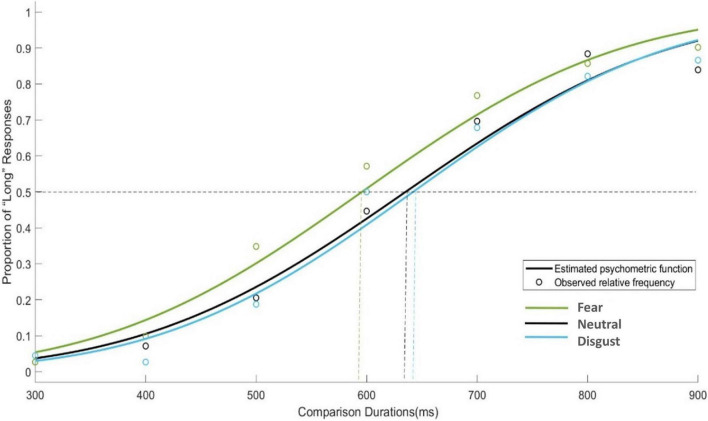
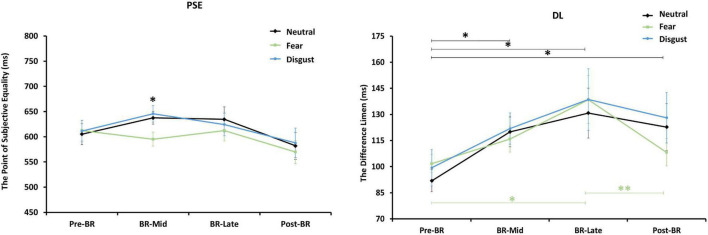
Accurate time perception is clearly essential for the successful implementation of space missions. To elucidate the effect of microgravity on time perception, we used three emotional picture stimuli: neutral, fear, and disgust, in combination with a temporal bisection task to measure 16 male participants' time perception in 15 days of -6° head-down bed rest, which is a reliable simulation model for most physiological effects of spaceflight. We found that: (1) participants showed temporal overestimation of the fear stimuli in the middle phase (day 8), suggesting that when participants' behavioral simulations were consistent with the action implications of the emotional stimuli, they could still elicit an overestimation of time even if the subjective arousal of the emotional stimuli was not high. (2) Participants' temporal sensitivity tends to get worse in the bed rest phase (days 8 and 15) and better in the post-bed rest phase, especially for neutral and fear stimuli, suggesting that multiple presentations of short-term emotional stimuli may also lead to a lack of affective effects. This reduced the pacemaker rate and affected temporal perceptual sensitivity. Also, this may be related to changes in physiological factors in participants in the bed rest state, such as reduced vagal excitability. These results provide new evidence to support the theory of embodied cognition in the context of time perception in head-down bed rest and suggest important perspectives for future perception science research in special environments such as microgravity.
准确的时间感知对于太空任务的成功实施显然至关重要。为了阐明微重力对时间感知的影响,我们使用了三种情绪图片刺激:中性、恐惧和厌恶,并结合时间二分任务,来测量16名男性参与者在为期15天的 -6°头低位卧床休息期间的时间感知,这是一种对太空飞行的大多数生理效应都可靠的模拟模型。我们发现:(1)参与者在中期(第8天)对恐惧刺激表现出时间高估,这表明当参与者的行为模拟与情绪刺激的行动暗示一致时,即使情绪刺激的主观唤醒程度不高,他们仍然可能引发时间高估。(2)参与者的时间敏感性在卧床休息阶段(第8天和第15天)趋于变差,而在卧床休息后阶段变好,尤其是对于中性和恐惧刺激,这表明短期情绪刺激的多次呈现也可能导致情感效应缺失。这降低了起搏器速率并影响了时间感知敏感性。此外,这可能与处于卧床休息状态的参与者的生理因素变化有关,比如迷走神经兴奋性降低。这些结果为头低位卧床休息的时间感知背景下的具身认知理论提供了新证据,并为未来在微重力等特殊环境下的感知科学研究提出了重要观点。