Division of Biology, California Institute of Technology, Pasadena, California, United States of America.
PLoS One. 2011;6(7):e22201. doi: 10.1371/journal.pone.0022201. Epub 2011 Jul 20.
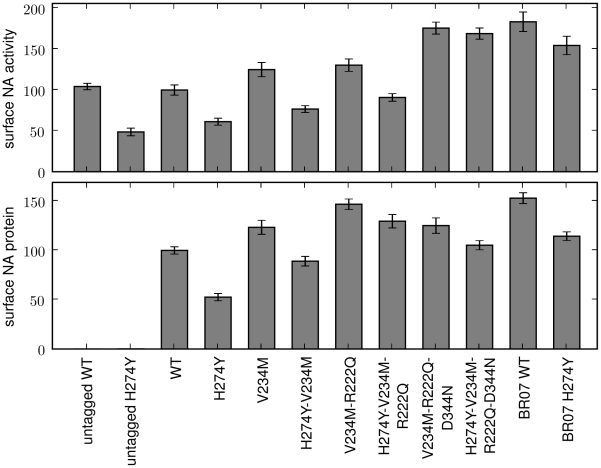
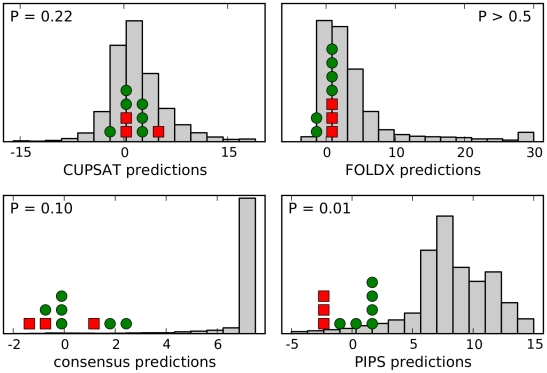
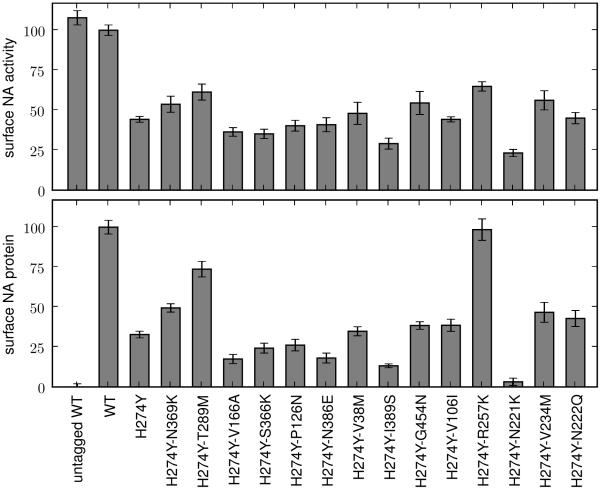
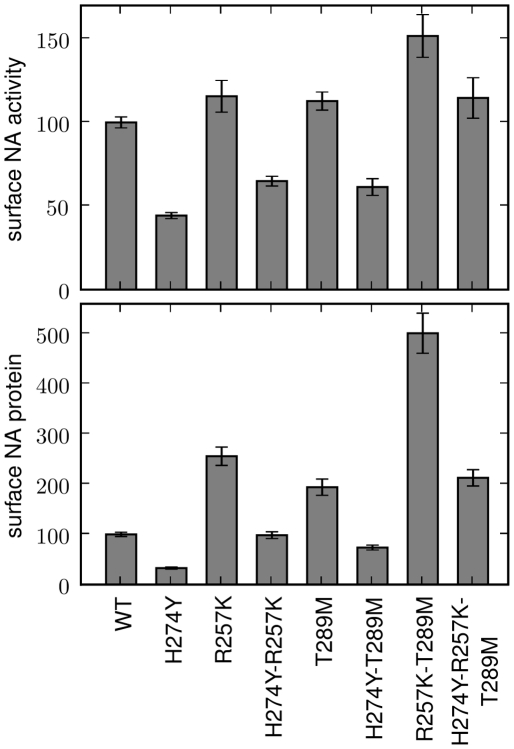
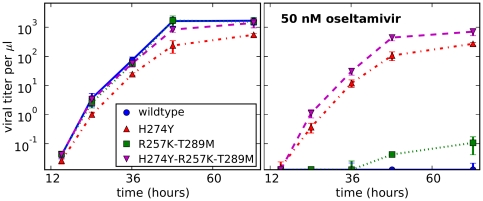
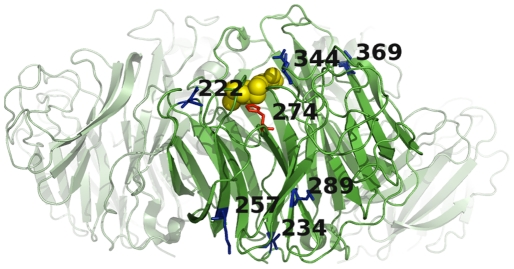
The His274→Tyr (H274Y) oseltamivir (Tamiflu) resistance mutation causes a substantial decrease in the total levels of surface-expressed neuraminidase protein and activity in early isolates of human seasonal H1N1 influenza, and in the swine-origin pandemic H1N1. In seasonal H1N1, H274Y only became widespread after the occurrence of secondary mutations that counteracted this decrease. H274Y is currently rare in pandemic H1N1, and it remains unclear whether secondary mutations exist that might similarly counteract the decreased neuraminidase surface expression associated with this resistance mutation in pandemic H1N1. Here we investigate the possibility of predicting such secondary mutations. We first test the ability of several computational approaches to retrospectively identify the secondary mutations that enhanced levels of surface-expressed neuraminidase protein and activity in seasonal H1N1 shortly before the emergence of oseltamivir resistance. We then use the most successful computational approach to predict a set of candidate secondary mutations to the pandemic H1N1 neuraminidase. We experimentally screen these mutations, and find that several of them do indeed partially counteract the decrease in neuraminidase surface expression caused by H274Y. Two of the secondary mutations together restore surface-expressed neuraminidase activity to wildtype levels, and also eliminate the very slight decrease in viral growth in tissue-culture caused by H274Y. Our work therefore demonstrates a combined computational-experimental approach for identifying mutations that enhance neuraminidase surface expression, and describes several specific mutations with the potential to be of relevance to the spread of oseltamivir resistance in pandemic H1N1.
His274→Tyr(H274Y)奥司他韦(达菲)耐药突变导致人类季节性 H1N1 流感和猪源大流行性 H1N1 流感早期分离株表面表达的神经氨酸酶蛋白和活性总量显著降低。在季节性 H1N1 中,只有在发生抵消这种减少的二次突变后,H274Y 才广泛传播。H274Y 目前在大流行性 H1N1 中罕见,目前尚不清楚是否存在类似的二次突变,可能会抵消与大流行性 H1N1 中这种耐药突变相关的神经氨酸酶表面表达降低。在这里,我们研究了预测这种二次突变的可能性。我们首先测试了几种计算方法的能力,以回顾性地识别在奥司他韦耐药出现前不久增强季节性 H1N1 表面表达神经氨酸酶蛋白和活性的二次突变。然后,我们使用最成功的计算方法来预测一组大流行性 H1N1 神经氨酸酶的候选二次突变。我们对这些突变进行了实验筛选,发现其中几个确实部分抵消了 H274Y 引起的神经氨酸酶表面表达减少。两种二次突变一起将神经氨酸酶表面表达活性恢复到野生型水平,并且还消除了 H274Y 引起的组织培养中病毒生长的轻微降低。因此,我们的工作展示了一种结合计算实验的方法来识别增强神经氨酸酶表面表达的突变,并描述了几种具有潜在相关性的特定突变可能会影响大流行性 H1N1 中奥司他韦耐药的传播。