Department of Psychiatry, Lund University Hospital SE - 221 85 Lund, Sweden.
BMC Psychiatry. 2011 Jul 30;11:122. doi: 10.1186/1471-244X-11-122.
Few longitudinal cohort studies have focused on the impact of substances abused and psychiatric disorders on premature mortality. The aim of the present study was to identify predictors of increased risk of drug related death and non drug related death in substance abusers of opiates, stimulants, cannabis, sedatives/hypnotics, hallucinogens and alcohol over several decades.
Follow-up study of a consecutive cohort of 561 substance abusers, admitted to a detoxification unit January 1970 to February 1978 in southern Sweden, and followed up in 2006. Demographic and clinical data, substance diagnoses and three groups of psychiatric diagnoses were identified at first admission. Causes of death were coded according to ICD-10 and classified as drug related deaths or non drug related deaths. To identify the incidence of some probable risk factors of drug related premature death, the data were subjected to a competing risks Cox regression analysis.
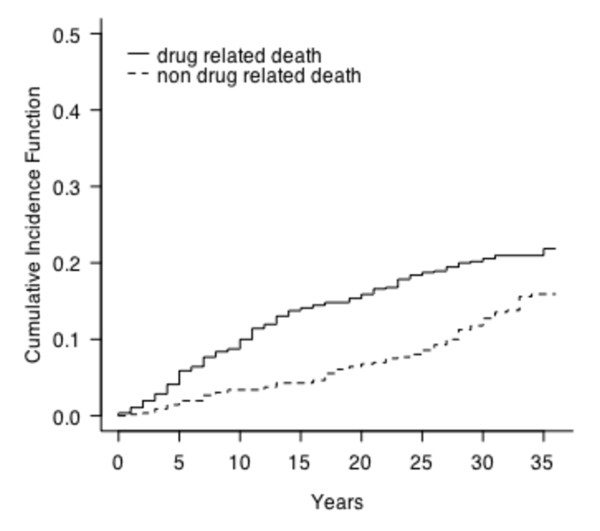
Of 561 patients in the cohort, 11 individuals had either emigrated or could not be located, and 204/561 patients (36.4%) were deceased by 2006. The cumulative risk of drug related death increased more in the first 15 years and leveled out later on when non drug related causes of death had a similar incidence. In the final model, male gender, regular use of opiates or barbiturates at first admission, and neurosis were associated with an increased risk of drug related premature death, while cannabis use and psychosis were associated with a decreased risk. Neurosis, mainly depression and/or anxiety disorders, predicted drug related premature death while chronic psychosis and personality disorders did not. Chronic alcohol addiction was associated with increased risk of non drug related death.
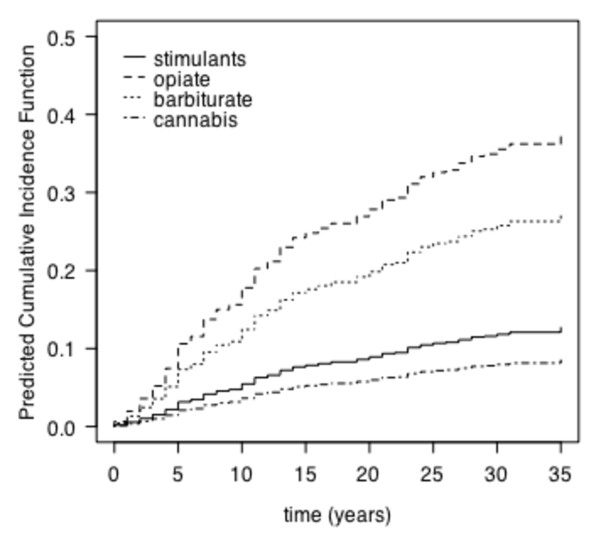
The cohort of drug abusers had an increased risk of premature death to the age of 69. Drug related premature death was predicted by male gender, the use of opiates or barbiturates and depression and anxiety disorders at first admission. The predicted cumulative incidence of drug related death was significantly higher in opiate and barbiturate abusers over the observed period of 37 years, while stimulant abuse did not have any impact. Alcohol contributed to non drug related death.
鲜有纵向队列研究关注滥用物质和精神障碍对早逝的影响。本研究旨在确定数十年间阿片类物质、兴奋剂、大麻、镇静催眠药/催眠药、致幻剂和酒精滥用者中与药物相关的死亡和非药物相关的死亡风险增加的预测因素。
对瑞典南部一家戒毒单位 1970 年 1 月至 1978 年 2 月连续收治的 561 名物质滥用者进行随访研究,并于 2006 年进行随访。首次入院时确定人口统计学和临床数据、物质诊断和三组精神诊断。根据 ICD-10 对死亡原因进行编码,并分为与药物相关的死亡或非药物相关的死亡。为了确定与药物相关的过早死亡的一些可能的危险因素的发生率,对数据进行了竞争风险 Cox 回归分析。
队列中的 561 名患者中,有 11 名已经移民或无法找到,到 2006 年,204/561 名患者(36.4%)死亡。在最初的 15 年内,与药物相关的死亡风险增加更为明显,而后来非药物相关的死亡原因的发生率相似。在最终模型中,男性、首次入院时经常使用阿片类药物或巴比妥类药物、神经症与与药物相关的过早死亡风险增加相关,而大麻使用和精神病与风险降低相关。神经症,主要是抑郁和/或焦虑障碍,预测与药物相关的过早死亡,而慢性精神病和人格障碍则不会。慢性酒精成瘾与非药物相关的死亡风险增加有关。
该吸毒者队列的预期寿命为 69 岁。首次入院时的性别、使用阿片类药物或巴比妥类药物以及抑郁和焦虑障碍与与药物相关的过早死亡相关。在 37 年的观察期间,阿片类药物和巴比妥类药物滥用者的与药物相关的死亡预测累积发生率显著更高,而兴奋剂滥用则没有任何影响。酒精导致非药物相关的死亡。