Al-Metwalli Roshdi R, Al-Ghamdi Abdulmohsen A, Mowafi Hany A, Sadek Sayed, Abdulshafi Mohammed, Mousa Wesam F
Department of Anesthesia, University of Dammam, Kingdom of Saudi Arabia.
Saudi J Anaesth. 2011 Apr;5(2):185-9. doi: 10.4103/1658-354X.82795.
To compare the three common methods of endotracheal tube cuff inflation (sealing pressure, precise standard pressure or finger estimation) regarding the effective tracheal seal and the incidence of post-intubation airway complications.
Seventy-five adult patients scheduled for N(2) O free general anesthesia were enrolled in this study. After induction of anesthesia, endotracheal tubes size 7.5 mm for female and 8.0 mm for male were used. Patients were randomly assigned into one of three groups. Control group (n=25), the cuff was inflated to a pressure of 25 cm H(2)O; sealing group (n=25), the cuff was inflated to prevent air leaks at airway pressure of 20 cm H(2)O and finger group (n=25), the cuff was inflated using finger estimation. Tracheal leaks, incidence of sore throat, hoarseness and dysphagia were tested.
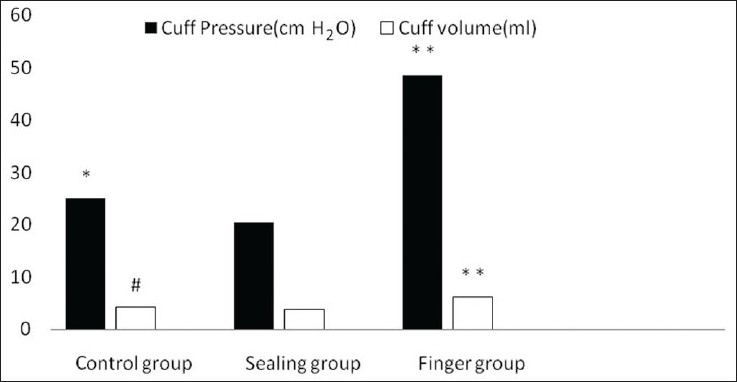
Although cuff pressure was significantly low in the sealing group compared to the control group (P<0.001), the incidence of sore throat was similar in both groups. On the other hand, cuff pressure as well as the incidence of sore throat were significantly higher in the finger group compared to both the control and the sealing group (P<0.001 and P=0.008). The incidence of dysphagia and hoarseness were similar in the three groups. None of the patients in the three groups developed air leak around the endotracheal tube cuff..
In N(2)O, free anesthesia sealing cuff pressure is an easy, undemanding and safe alternative to the standard technique, regarding effective sealing and low incidence of sore throat.
比较气管导管套囊充气的三种常用方法(密封压力、精确标准压力或手指估算)在有效气管密封及插管后气道并发症发生率方面的差异。
本研究纳入75例计划行无氧化亚氮全身麻醉的成年患者。麻醉诱导后,使用女性为7.5mm、男性为8.0mm的气管导管。患者被随机分为三组。对照组(n = 25),套囊充气至25cm H₂O的压力;密封组(n = 25),套囊充气至气道压力为20cm H₂O时防止漏气;手指组(n = 25),通过手指估算进行套囊充气。检测气管漏气情况、咽痛、声音嘶哑和吞咽困难的发生率。
尽管密封组的套囊压力显著低于对照组(P < 0.001),但两组咽痛的发生率相似。另一方面,手指组的套囊压力和咽痛发生率均显著高于对照组和密封组(P < 0.001和P = 0.008)。三组吞咽困难和声音嘶哑的发生率相似。三组患者均未出现气管导管套囊周围漏气。
在无氧化亚氮麻醉中,就有效密封和低咽痛发生率而言,密封套囊压力是一种简便、无需苛求且安全的标准技术替代方法。