UMR Diversité, Adaptation et Développement des Plantes Cultivées (DIADE), Institut de Recherche pour le Développement (IRD), Montpellier, France.
BMC Evol Biol. 2011 Aug 1;11:229. doi: 10.1186/1471-2148-11-229.
We studied patterns of molecular adaptation in the wild Mediterranean legume Medicago truncatula. We focused on two phenotypic traits that are not functionally linked: flowering time and perception of symbiotic microbes. Phenology is an important fitness component, especially for annual plants, and many instances of molecular adaptation have been reported for genes involved in flowering pathways. While perception of symbiotic microbes is also integral to adaptation in many plant species, very few reports of molecular adaptation exist for symbiotic genes. Here we used data from 57 individuals and 53 gene fragments to quantify the overall strength of both positive and purifying selection in M. truncatula and asked if footprints of positive selection can be detected at key genes of rhizobia recognition pathways.
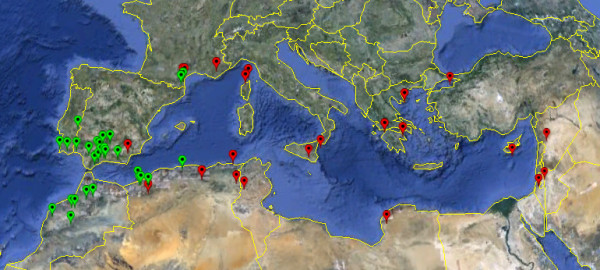
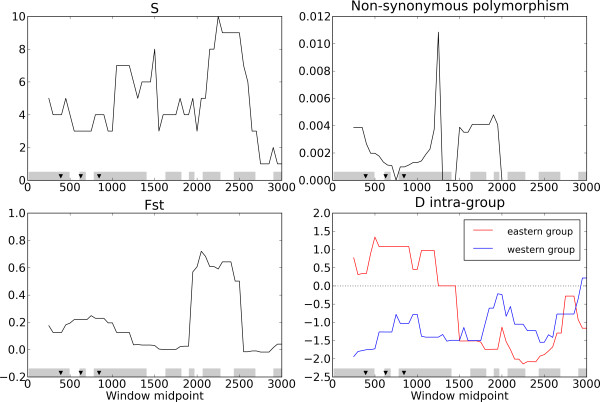
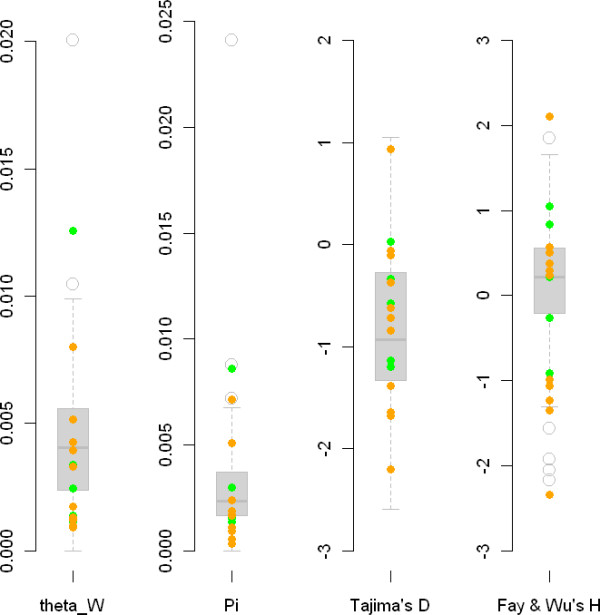
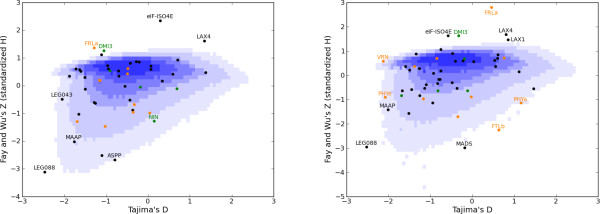
We examined nucleotide variation among 57 accessions from natural populations in 53 gene fragments: 5 genes involved in nitrogen-fixing bacteria recognition, 11 genes involved in flowering, and 37 genes used as control loci. We detected 1757 polymorphic sites yielding an average nucleotide diversity (pi) of 0.003 per site. Non-synonymous variation is under sizable purifying selection with 90% of amino-acid changing mutations being strongly selected against. Accessions were structured in two groups consistent with geographical origins. Each of these two groups harboured an excess of rare alleles, relative to expectations of a constant-sized population, suggesting recent population expansion. Using coalescent simulations and an approximate Bayesian computation framework we detected several instances of genes departing from selective neutrality within each group and showed that the polymorphism of two nodulation and four flowering genes has probably been shaped by recent positive selection.
We quantify the intensity of purifying selection in the M. truncatula genome and show that putative footprints of natural selection can be detected at different time scales in both flowering and symbiotic pathways.
我们研究了野生地中海豆科植物紫花苜蓿中分子适应的模式。我们专注于两个没有功能联系的表型特征:开花时间和共生微生物的感知。物候是一个重要的适应组成部分,特别是对于一年生植物,许多与开花途径相关的基因已经报道了分子适应的实例。虽然共生微生物的感知也是许多植物物种适应的重要组成部分,但共生基因的分子适应的报道非常少。在这里,我们使用来自 57 个个体和 53 个基因片段的数据,量化了紫花苜蓿中正负选择的整体强度,并询问在根瘤菌识别途径的关键基因中是否可以检测到正选择的痕迹。
我们检查了来自 53 个基因片段的 57 个自然种群个体中的核苷酸变异:涉及固氮细菌识别的 5 个基因、涉及开花的 11 个基因和作为对照基因的 37 个基因。我们检测到 1757 个多态性位点,平均每个位点的核苷酸多样性(pi)为 0.003。非 synonymous变异受到大量纯化选择的影响,90%的氨基酸改变突变受到强烈选择。个体按照地理起源分为两组。这两组都存在稀有等位基因的过剩,相对于一个恒定大小的群体的预期,表明最近的种群扩张。使用合并模拟和近似贝叶斯计算框架,我们在每组内检测到几个基因偏离选择中性的实例,并表明两个结瘤和四个开花基因的多态性可能是由最近的正选择塑造的。
我们量化了紫花苜蓿基因组中纯化选择的强度,并表明在开花和共生途径中,可以在不同的时间尺度上检测到自然选择的潜在痕迹。