The Mind Research Network Albuquerque, NM, USA.
Front Syst Neurosci. 2011 Jul 14;5:59. doi: 10.3389/fnsys.2011.00059. eCollection 2011.
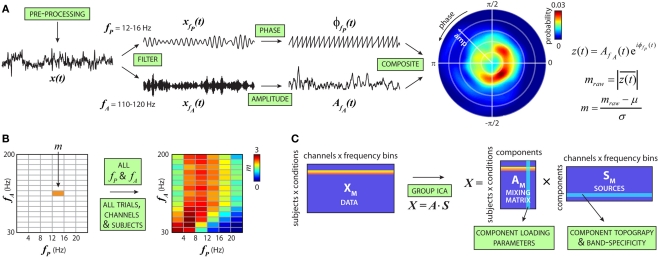
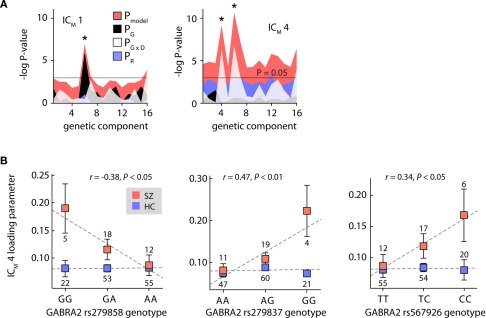
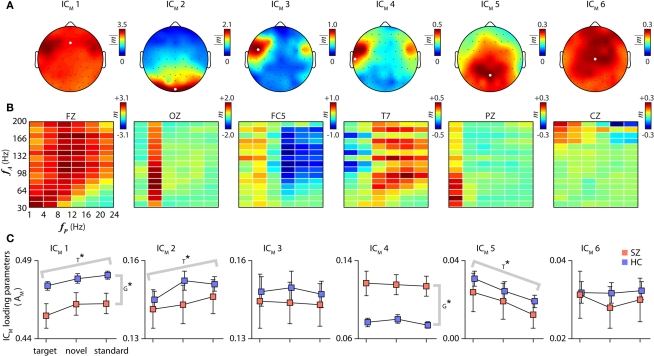
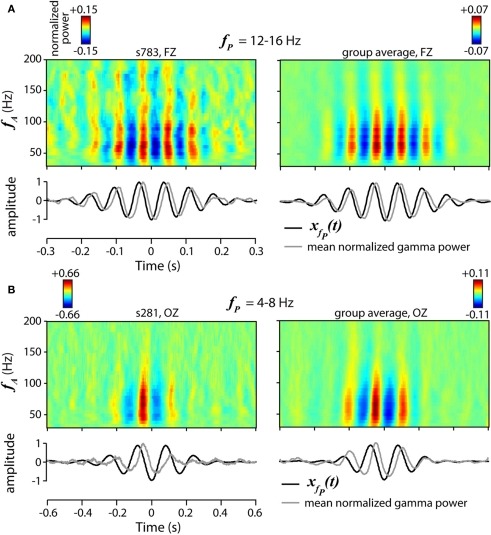
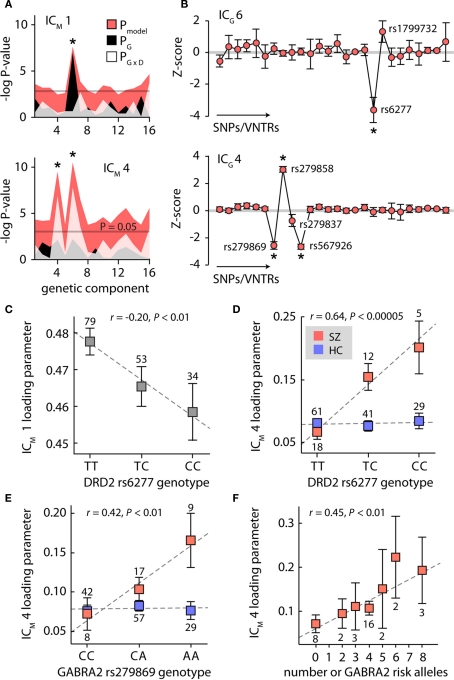
The cognitive deficits associated with schizophrenia are commonly believed to arise from the abnormal temporal integration of information, however a quantitative approach to assess network coordination is lacking. Here, we propose to use cross-frequency modulation (cfM), the dependence of local high-frequency activity on the phase of widespread low-frequency oscillations, as an indicator of network coordination and functional integration. In an exploratory analysis based on pre-existing data, we measured cfM from multi-channel EEG recordings acquired while schizophrenia patients (n = 47) and healthy controls (n = 130) performed an auditory oddball task. Novel application of independent component analysis (ICA) to modulation data delineated components with specific spatial and spectral profiles, the weights of which showed covariation with diagnosis. Global cfM was significantly greater in healthy controls (F(1,175) = 9.25, P < 0.005), while modulation at fronto-temporal electrodes was greater in patients (F(1,175) = 17.5, P < 0.0001). We further found that the weights of schizophrenia-relevant components were associated with genetic polymorphisms at previously identified risk loci. Global cfM decreased with copies of 957C allele in the gene for the dopamine D2 receptor (r = -0.20, P < 0.01) across all subjects. Additionally, greater "aberrant" fronto-temporal modulation in schizophrenia patients was correlated with several polymorphisms in the gene for the α2-subunit of the GABA(A) receptor (GABRA2) as well as the total number of risk alleles in GABRA2 (r = 0.45, P < 0.01). Overall, our results indicate great promise for this approach in establishing patterns of cfM in health and disease and elucidating the roles of oscillatory interactions in functional connectivity.
精神分裂症相关的认知缺陷通常被认为是由于信息的异常时间整合引起的,但是缺乏评估网络协调的定量方法。在这里,我们提出使用跨频调制(cfM)作为网络协调和功能整合的指标,cfM 是指局部高频活动对广泛低频振荡相位的依赖性。在基于现有数据的探索性分析中,我们测量了精神分裂症患者(n=47)和健康对照者(n=130)在执行听觉Oddball 任务时多通道 EEG 记录的 cfM。对调制数据的独立成分分析(ICA)的新应用描绘了具有特定空间和频谱特征的成分,其权重与诊断相关。健康对照组的全局 cfM 显著更高(F(1,175)=9.25,P<0.005),而患者的额颞电极调制更高(F(1,175)=17.5,P<0.0001)。我们进一步发现,与精神分裂症相关的成分权重与先前确定的风险位点的遗传多态性有关。在所有受试者中,多巴胺 D2 受体基因 957C 等位基因的拷贝数与全局 cfM 呈负相关(r=-0.20,P<0.01)。此外,精神分裂症患者异常的额颞调制与 GABA(A)受体的α2 亚单位基因(GABRA2)中的几个多态性以及 GABRA2 中的风险等位基因总数(r=0.45,P<0.01)相关。总体而言,我们的结果表明,该方法在确定健康和疾病中的 cfM 模式以及阐明振荡相互作用在功能连接中的作用方面具有很大的应用前景。