Ziskoven Christoph, Jäger Marcus, Zilkens Christoph, Bloch Wilhelm, Brixius Klara, Krauspe Rüdiger
Orthopedic Department, Heinrich-Heine University Medical School, Düsseldorf, Germany.
Orthop Rev (Pavia). 2010 Sep 23;2(2):e23. doi: 10.4081/or.2010.e23.
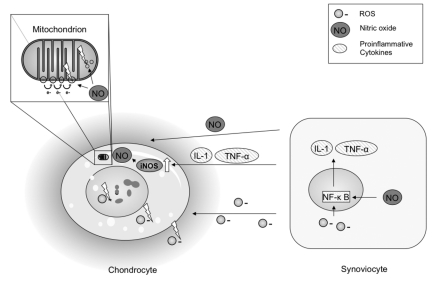
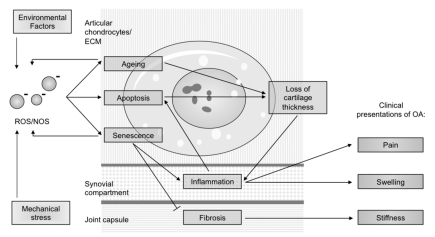
Due to an increasing life expectance, osteoarthritis (OA) is one of the most common chronic diseases. Although strong efforts have been made to regenerate degenerated joint cartilage, OA is a progressive and irreversible disease up to date. Among other factors the dysbalance between free radical burden and cellular scavenging mechanisms defined as oxidative stress is a relevant part of OA pathogenesis. Here, only little data are available about the mediation and interaction between different joint compartments. The article provides a review of the current literature regarding the influence of oxidative stress on cellular aging, senescence and apoptosis in different joint compartments (cartilage, synovial tissue and subchondral bone). Free radical exposure is known to promote cellular senescence and apoptosis. Radical oxygen species (ROS) involvement in inflammation, fibrosis control and pain nociception has been proven. The data from literature indicates a link between free radical burden and OA pathogenesis mediating local tissue reactions between the joint compartments. Hence, oxidative stress is likely not only to promote cartilage destruction but also to be involved in inflammative transformation, promoting the transition from clinically silent cartilage destruction to apparent OA. ROS induced by exogenous factors such as overload, trauma, local intraarticular lesion and consecutive synovial inflammation cause cartilage degradation. In the affected joint, free radicals mediate disease progression. The interrelationship between oxidative stress and OA etiology might provide a novel approach to the comprehension and therefore modification of disease progression and symptom control.
由于预期寿命的增加,骨关节炎(OA)是最常见的慢性疾病之一。尽管人们为再生退化的关节软骨付出了巨大努力,但迄今为止,OA仍是一种进行性且不可逆的疾病。在其他因素中,自由基负荷与细胞清除机制之间的失衡(定义为氧化应激)是OA发病机制的一个相关部分。在此,关于不同关节腔室之间的介导和相互作用的数据很少。本文综述了当前关于氧化应激对不同关节腔室(软骨、滑膜组织和软骨下骨)细胞衰老、衰老和凋亡影响的文献。已知自由基暴露会促进细胞衰老和凋亡。活性氧(ROS)参与炎症、纤维化控制和疼痛伤害感受已得到证实。文献数据表明自由基负荷与OA发病机制之间存在联系,介导关节腔室之间的局部组织反应。因此,氧化应激可能不仅会促进软骨破坏,还会参与炎症转化,促进从临床上无症状的软骨破坏向明显的OA转变。由过载、创伤、局部关节内病变和连续的滑膜炎等外源性因素诱导的ROS会导致软骨降解。在受影响的关节中,自由基介导疾病进展。氧化应激与OA病因之间的相互关系可能为理解并因此改变疾病进展和症状控制提供一种新方法。