Caphri, Department of Health, Ethics and Society, Maastricht University, Universiteitssingel 40, P.O. Box 616, 6200 MD Maastricht, The Netherlands.
Health Care Anal. 2012 Sep;20(3):250-67. doi: 10.1007/s10728-011-0185-9.
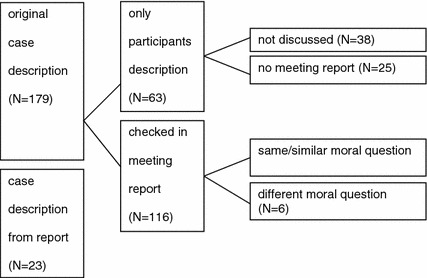
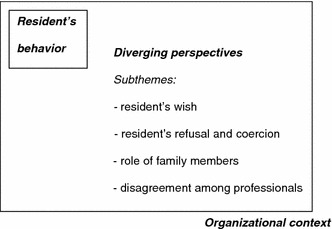
Our study presents an overview of the issues that were brought forward by participants of a moral case deliberation (MCD) project in two elderly care organizations. The overview was inductively derived from all case descriptions (N = 202) provided by participants of seven mixed MCD groups, consisting of care providers from various professional backgrounds, from nursing assistant to physician. The MCD groups were part of a larger MCD project within two care institutions (residential homes and nursing homes). Care providers are confronted with a wide variety of largely everyday ethical issues. We distinguished three main categories: 'resident's behavior', 'divergent perspectives on good care' and 'organizational context'. The overview can be used for agendasetting when institutions wish to stimulate reflection and deliberation. It is important that an agenda is constructed from the bottom-up and open to a variety of issues. In addition, organizing reflection and deliberation requires effort to identify moral questions in practice whilst at the same time maintaining the connection with the organizational context and existing communication structures. Once care providers are used to dealing with divergent perspectives, inviting different perspectives (e.g. family members) to take part in the deliberation, might help to identify and address ethical 'blind spots'.
本研究概述了两个老年护理机构的道德案例审议(MCD)项目参与者提出的问题。该概述是从来自不同专业背景的护理人员(从护士助理到医生)的七个混合 MCD 小组的所有案例描述(N=202)中归纳得出的。MCD 小组是两个护理机构(养老院和疗养院)内更大的 MCD 项目的一部分。护理人员面临着各种各样的、很大程度上是日常的伦理问题。我们区分了三个主要类别:“居民的行为”、“对良好护理的不同看法”和“组织背景”。该概述可用于机构希望激发反思和审议时的议程设置。重要的是,从下至上构建议程,并对各种问题持开放态度。此外,组织反思和审议需要努力在实践中识别道德问题,同时保持与组织背景和现有沟通结构的联系。一旦护理人员习惯于处理不同的观点,邀请不同的观点(例如家庭成员)参与审议,可能有助于识别和解决道德“盲点”。