INSERM U1048, Institute of Metabolic and Cardiovascular Diseases, Rangueil, Université Paul-Sabatier, Toulouse, France.
Diabetes. 2011 Sep;60(9):2245-56. doi: 10.2337/db11-0464. Epub 2011 Aug 1.
Glucagon-like peptide 1 (GLP-1) is a gut-brain hormone that regulates food intake, energy metabolism, and cardiovascular functions. In the brain, through a currently unknown molecular mechanism, it simultaneously reduces femoral artery blood flow and muscle glucose uptake. By analogy to pancreatic β-cells where GLP-1 activates protein kinase C (PKC) to stimulate insulin secretion, we postulated that PKC enzymes would be molecular targets of brain GLP-1 signaling that regulate metabolic and vascular function.
We used both genetic and pharmacological approaches to investigate the role of PKC isoforms in brain GLP-1 signaling in the conscious, free-moving mouse simultaneous with metabolic and vascular measurements.
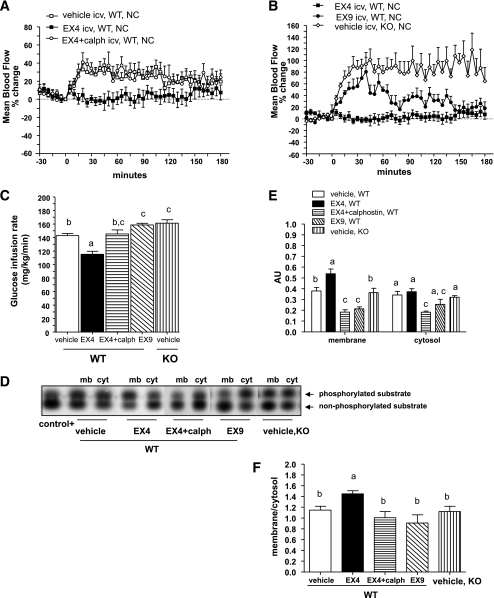
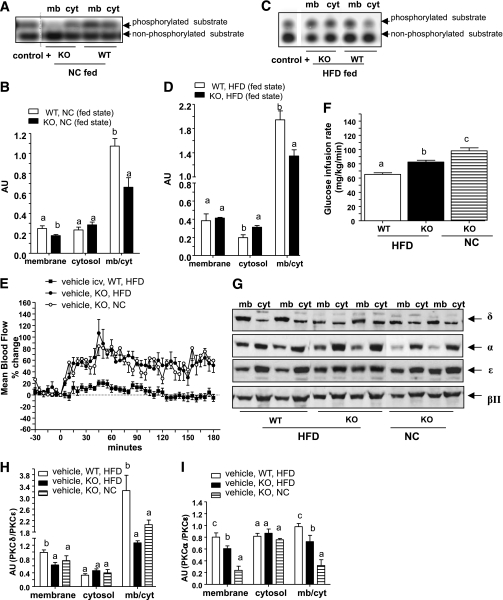
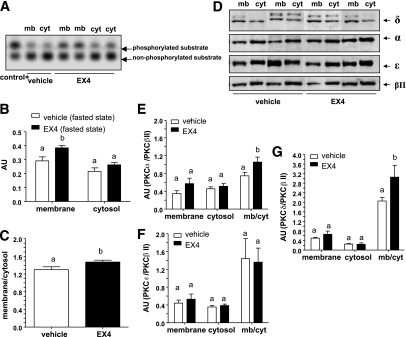
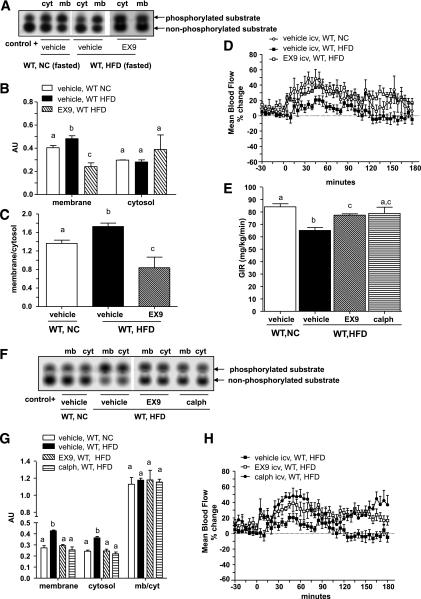
In normal wild-type (WT) mouse brain, the GLP-1 receptor (GLP-1R) agonist exendin-4 selectively promotes translocation of PKC-δ (but not -βII, -α, or -ε) to the plasma membrane. This translocation is blocked in Glp1r(-/-) mice and in WT mice infused in the brain with exendin-9, an antagonist of the GLP-1R. This mechanism coordinates both blood flow in the femoral artery and whole-body insulin sensitivity. Consequently, in hyperglycemic, high-fat diet-fed diabetic mice, hypothalamic PKC-δ activity was increased and its pharmacological inhibition improved both insulin-sensitive metabolic and vascular phenotypes.
Our studies show that brain GLP-1 signaling activates hypothalamic glucose-dependent PKC-δ to regulate femoral artery blood flow and insulin sensitivity. This mechanism is attenuated during the development of experimental hyperglycemia and may contribute to the pathophysiology of type 2 diabetes.
胰高血糖素样肽 1(GLP-1)是一种调节食物摄入、能量代谢和心血管功能的肠-脑激素。在大脑中,通过一种目前未知的分子机制,它同时降低股动脉血流和肌肉葡萄糖摄取。类比于胰腺β细胞中 GLP-1 通过激活蛋白激酶 C(PKC)刺激胰岛素分泌,我们推测 PKC 酶将是调节代谢和血管功能的脑 GLP-1 信号转导的分子靶点。
我们使用遗传和药理学方法,在清醒、自由活动的小鼠中同时进行代谢和血管测量,研究 PKC 同工型在脑 GLP-1 信号转导中的作用。
在正常野生型(WT)小鼠大脑中,GLP-1 受体(GLP-1R)激动剂 exendin-4 选择性促进 PKC-δ(而非 -βII、-α 或 -ε)向质膜易位。这种易位在 Glp1r(-/-) 小鼠和在大脑中输注 GLP-1R 拮抗剂 exendin-9 的 WT 小鼠中被阻断。这种机制协调股动脉血流和全身胰岛素敏感性。因此,在高血糖、高脂肪饮食喂养的糖尿病小鼠中,下丘脑 PKC-δ 活性增加,其药理学抑制改善了胰岛素敏感的代谢和血管表型。
我们的研究表明,脑 GLP-1 信号转导激活下丘脑葡萄糖依赖性 PKC-δ 以调节股动脉血流和胰岛素敏感性。这种机制在实验性高血糖的发展过程中减弱,可能有助于 2 型糖尿病的病理生理学。