Post Graduate Program in Rehabilitation Sciences, Nove de Julho University (UNINOVE), Rua Vergueiro, 235, 01504-001, São Paulo, SP, Brazil.
Lasers Med Sci. 2012 Mar;27(2):453-8. doi: 10.1007/s10103-011-0957-3. Epub 2011 Jul 22.
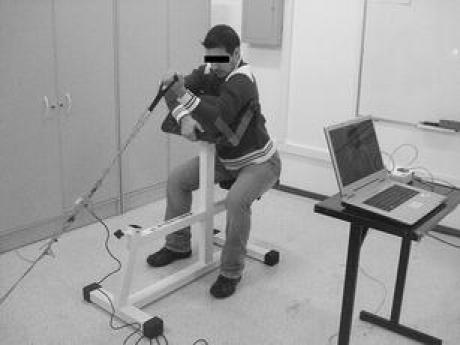
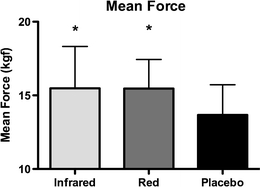
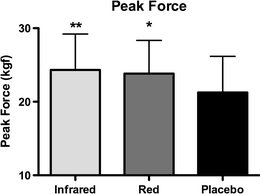
In animal and clinical trials low-level laser therapy (LLLT) using red, infrared and mixed wavelengths has been shown to delay the development of skeletal muscle fatigue. However, the parameters employed in these studies do not allow a conclusion as to which wavelength range is better in delaying the development of skeletal muscle fatigue. With this perspective in mind, we compared the effects of red and infrared LLLT on skeletal muscle fatigue. A randomized double-blind placebo-controlled crossover trial was performed in ten healthy male volunteers. They were treated with active red LLLT, active infrared LLLT (660 or 830 nm, 50 mW, 17.85 W/cm(2), 100 s irradiation per point, 5 J, 1,785 J/cm(2) at each point irradiated, total 20 J irradiated per muscle) or an identical placebo LLLT at four points of the biceps brachii muscle for 3 min before exercise (voluntary isometric elbow flexion for 60 s). The mean peak force was significantly greater (p < 0.05) following red (12.14%) and infrared LLLT (14.49%) than following placebo LLLT, and the mean average force was also significantly greater (p < 0.05) following red (13.09%) and infrared LLLT (13.24%) than following placebo LLLT. There were no significant differences in mean average force or mean peak force between red and infrared LLLT. We conclude that both red than infrared LLLT are effective in delaying the development skeletal muscle fatigue and in enhancement of skeletal muscle performance. Further studies are needed to identify the specific mechanisms through which each wavelength acts.
在动物和临床试验中,使用红色、红外线和混合波长的低水平激光疗法(LLLT)已被证明可以延迟骨骼肌疲劳的发展。然而,这些研究中使用的参数并不能得出哪种波长范围更能延迟骨骼肌疲劳发展的结论。基于这一观点,我们比较了红色和红外线 LLLT 对骨骼肌疲劳的影响。在十名健康男性志愿者中进行了一项随机、双盲、安慰剂对照的交叉试验。他们接受了主动红色 LLLT、主动红外线 LLLT(660 或 830nm,50mW,17.85W/cm²,每个点照射 100s,5J,每个照射点 1,785J/cm²,每个肌肉共照射 20J)或相同的安慰剂 LLLT,在运动前在肱二头肌的四个点照射 3 分钟(自愿等长肘屈 60s)。与安慰剂 LLLT 相比,红色(12.14%)和红外线 LLLT(14.49%)的平均峰值力显著更大(p<0.05),红色(13.09%)和红外线 LLLT(13.24%)的平均平均力也显著更大(p<0.05)与安慰剂 LLLT 相比。红色和红外线 LLLT 之间的平均平均力或平均峰值力没有显著差异。我们得出结论,红色和红外线 LLLT 都能有效延迟骨骼肌疲劳的发展,并增强骨骼肌的性能。需要进一步研究以确定每种波长作用的具体机制。