Department of Microbiology, Mount Sinai School of Medicine, New York, NY 10029, USA.
Rev Med Virol. 2011 Nov;21(6):358-69. doi: 10.1002/rmv.703. Epub 2011 Aug 8.
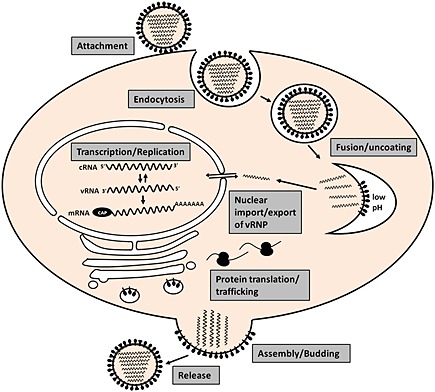
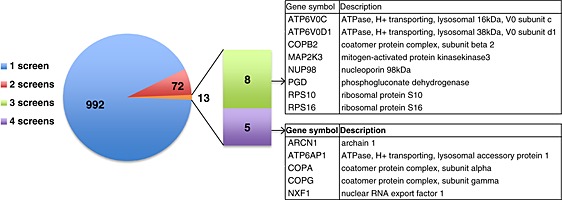
Increasing antiviral drug resistance is a major concern for treating influenza, especially in a pandemic setting when the availability of a protective vaccine is uncertain. Resistance is often an issue with drugs directed at viral proteins and for small RNA viruses; there are also a limited number of viral proteins that are amenable to inhibition by a small molecule. A new approach that is gaining support is that cellular proteins, which facilitate virus replication, may be used as alternative targets. Whereas drugs directed at viral proteins tend to be virus-specific, drugs directed at host targets have the potential to have broad-spectrum antiviral activity as many viruses may share a dependency on that host function. For influenza virus, we have very limited knowledge of which cellular factors are involved in virus replication, let alone which of these have suitable properties to serve as drug targets. Through the use of high-throughput RNA interference screens, several studies have addressed this gap in our knowledge. The resulting datasets provide new insight into host pathways that are involved in the influenza virus replication cycle and identify specific host factors in these pathways that may serve as potential targets for future antiviral drug development.
抗病毒药物耐药性的增加是治疗流感的主要关注点,尤其是在大流行期间,保护疫苗的供应不确定时。耐药性通常是针对病毒蛋白的药物的一个问题,对于小 RNA 病毒也是如此;也有少数病毒蛋白可以被小分子抑制。一种新的方法越来越受到支持,即促进病毒复制的细胞蛋白可以用作替代靶标。针对病毒蛋白的药物往往具有病毒特异性,而针对宿主靶标的药物有可能具有广谱抗病毒活性,因为许多病毒可能依赖于该宿主功能。对于流感病毒,我们对参与病毒复制的细胞因子知之甚少,更不用说这些因子中有哪些具有适合作为药物靶点的特性。通过使用高通量 RNA 干扰筛选,几项研究解决了我们知识中的这一空白。由此产生的数据集为参与流感病毒复制周期的宿主途径提供了新的见解,并确定了这些途径中可能作为未来抗病毒药物开发潜在靶点的特定宿主因素。