Division of Respiratory Medicine, Department of Paediatrics, Inselspital, University of Bern, Bern, Switzerland.
PLoS One. 2011;6(8):e23130. doi: 10.1371/journal.pone.0023130. Epub 2011 Aug 3.
BACKGROUND/OBJECTIVES: Ambient air pollution can alter cytokine concentrations as shown in vitro and following short-term exposure to high air pollution levels in vivo. Exposure to pollution during late pregnancy has been shown to affect fetal lymphocytic immunophenotypes. However, effects of prenatal exposure to moderate levels of air pollutants on cytokine regulation in cord blood of healthy infants are unknown.
In a birth cohort of 265 healthy term-born neonates, we assessed maternal exposure to particles with an aerodynamic diameter of 10 µm or less (PM₁₀), as well as to indoor air pollution during the last trimester, specifically the last 21, 14, 7, 3 and 1 days of pregnancy. As a proxy for traffic-related air pollution, we determined the distance of mothers' homes to major roads. We measured cytokine and chemokine levels (MCP-1, IL-6, IL-10, IL-1ß, TNF-α and GM-CSF) in cord blood serum using LUMINEX technology. Their association with pollution levels was assessed using regression analysis, adjusted for possible confounders.
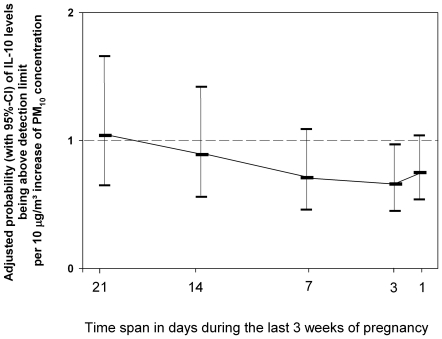
Mean (95%-CI) PM₁₀ exposure for the last 7 days of pregnancy was 18.3 (10.3-38.4 µg/m³). PM₁₀ exposure during the last 3 days of pregnancy was significantly associated with reduced IL-10 and during the last 3 months of pregnancy with increased IL-1ß levels in cord blood after adjustment for relevant confounders. Maternal smoking was associated with reduced IL-6 levels. For the other cytokines no association was found.
Our results suggest that even naturally occurring prenatal exposure to moderate amounts of indoor and outdoor air pollution may lead to changes in cord blood cytokine levels in a population based cohort.
背景/目的:环境空气污染可以改变细胞因子浓度,这在体外和短期暴露于高水平空气污染的体内实验中已经得到证实。研究表明,妊娠晚期接触污染会影响胎儿淋巴细胞免疫表型。然而,产前暴露于中水平空气污染物对健康婴儿脐带血细胞因子调节的影响尚不清楚。
在一个 265 名健康足月新生儿的出生队列中,我们评估了母亲在妊娠晚期(最后 21、14、7、3 和 1 天)暴露于直径 10 微米或以下的颗粒物(PM₁₀)以及室内空气污染的情况。作为与交通相关的空气污染的替代指标,我们确定了母亲住所与主要道路的距离。我们使用 LUMINEX 技术测量脐带血血清中的细胞因子和趋化因子水平(MCP-1、IL-6、IL-10、IL-1β、TNF-α和 GM-CSF)。使用回归分析评估它们与污染水平的关联,并根据可能的混杂因素进行调整。
妊娠最后 7 天的平均(95%CI)PM₁₀ 暴露为 18.3(10.3-38.4 µg/m³)。调整相关混杂因素后,妊娠最后 3 天的 PM₁₀ 暴露与脐带血中 IL-10 降低有关,妊娠最后 3 个月的 PM₁₀ 暴露与 IL-1β水平升高有关。母亲吸烟与 IL-6 水平降低有关。对于其他细胞因子,没有发现关联。
我们的结果表明,即使是自然发生的中水平的产前室内和室外空气污染暴露,也可能导致基于人群的队列中脐带血细胞因子水平发生变化。