Graduate Program in Structural and Computational Biology and Molecular Biophysics, Baylor College of Medicine, Houston, TX, USA.
EMBO J. 2011 Aug 9;30(18):3854-63. doi: 10.1038/emboj.2011.261.
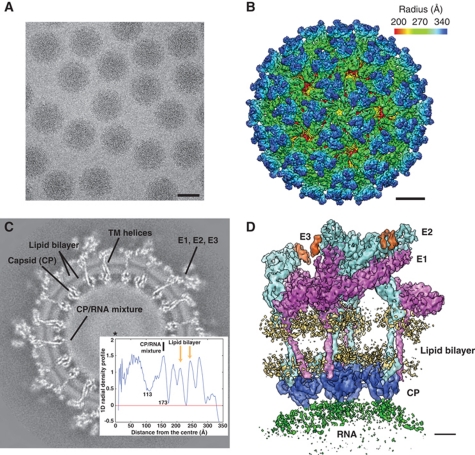
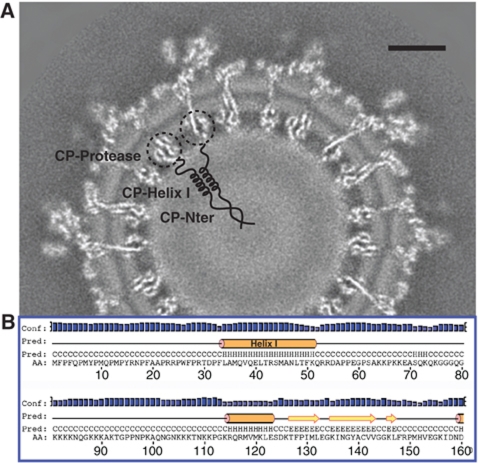
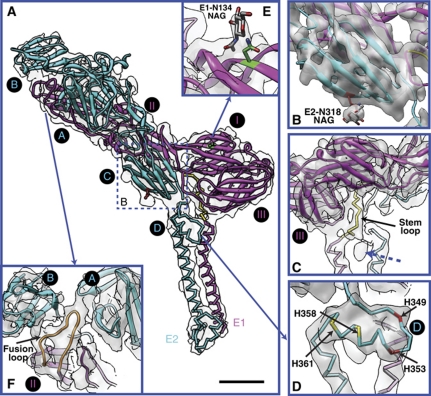
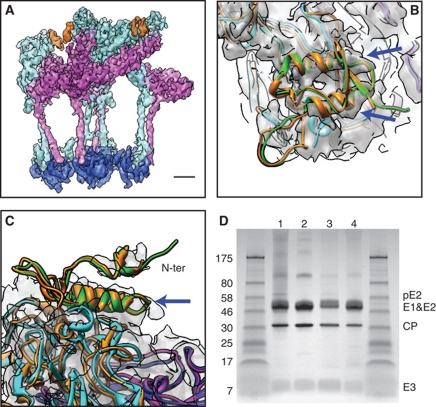
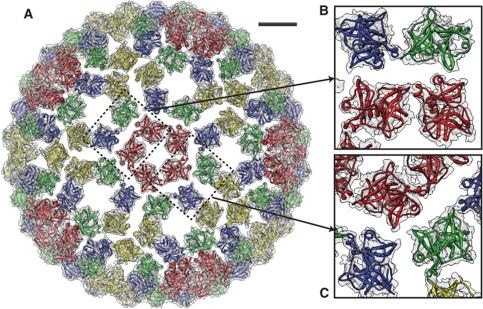
Venezuelan equine encephalitis virus (VEEV), a member of the membrane-containing Alphavirus genus, is a human and equine pathogen, and has been developed as a biological weapon. Using electron cryo-microscopy (cryo-EM), we determined the structure of an attenuated vaccine strain, TC-83, of VEEV to 4.4 Å resolution. Our density map clearly resolves regions (including E1, E2 transmembrane helices and cytoplasmic tails) that were missing in the crystal structures of domains of alphavirus subunits. These new features are implicated in the fusion, assembly and budding processes of alphaviruses. Furthermore, our map reveals the unexpected E3 protein, which is cleaved and generally thought to be absent in the mature VEEV. Our structural results suggest a mechanism for the initial stage of nucleocapsid core formation, and shed light on the virulence attenuation, host recognition and neutralizing activities of VEEV and other alphavirus pathogens.
委内瑞拉马脑炎病毒(VEEV)是一种膜结合的甲病毒属成员,可感染人和马,曾被开发为生物武器。我们使用电子冷冻显微镜(cryo-EM)将 VEEV 的减毒疫苗株 TC-83 的结构解析至 4.4 Å 分辨率。我们的密度图清晰地解析了在甲病毒亚基结构域晶体结构中缺失的区域(包括 E1、E2 跨膜螺旋和细胞质尾巴)。这些新特征与甲病毒的融合、组装和出芽过程有关。此外,我们的图谱还揭示了出乎意料的 E3 蛋白,该蛋白被切割,通常认为在成熟的 VEEV 中不存在。我们的结构结果提出了核衣壳核心形成初始阶段的机制,并阐明了 VEEV 和其他甲病毒病原体的毒力减弱、宿主识别和中和活性的机制。