Ludwig Institute for Cancer Research and Department of Cellular and Molecular Medicine, University of California San Diego, La Jolla, California, United States of America.
PLoS One. 2011;6(8):e22969. doi: 10.1371/journal.pone.0022969. Epub 2011 Aug 2.
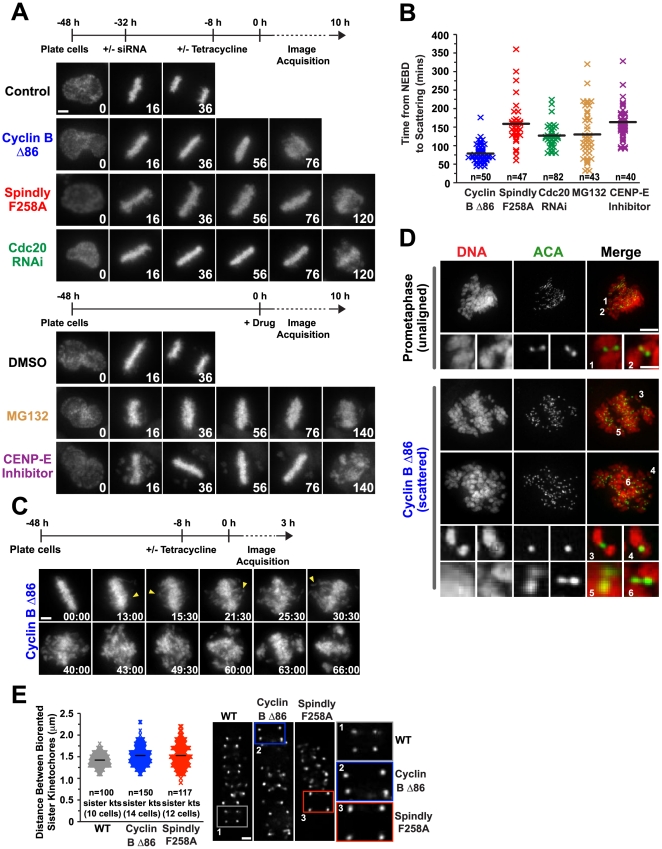
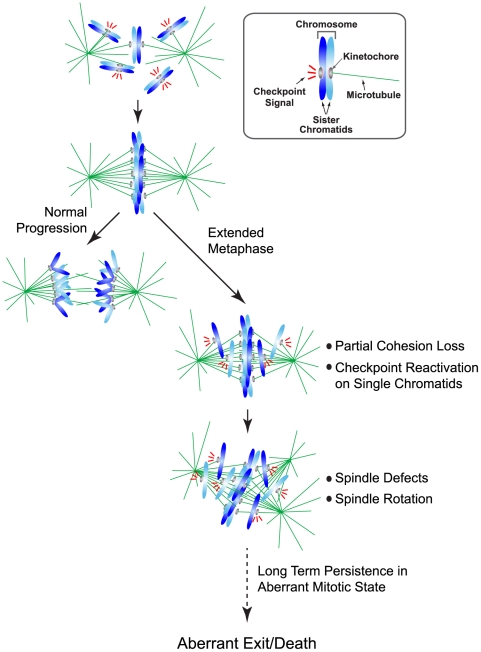
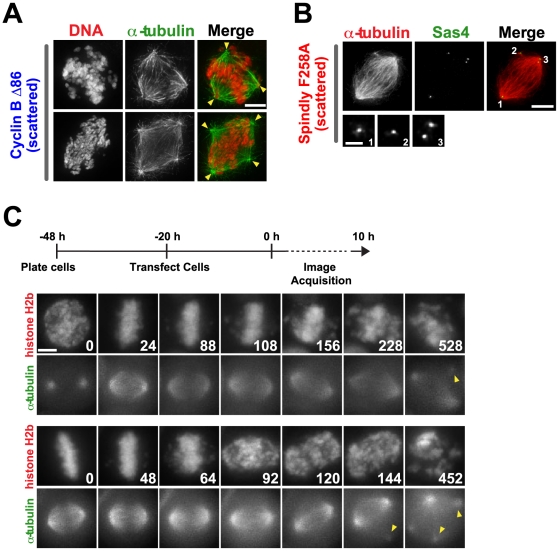
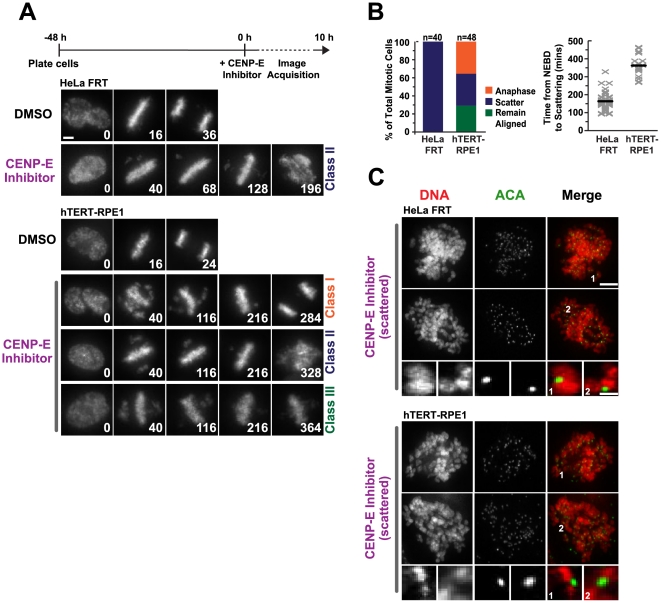
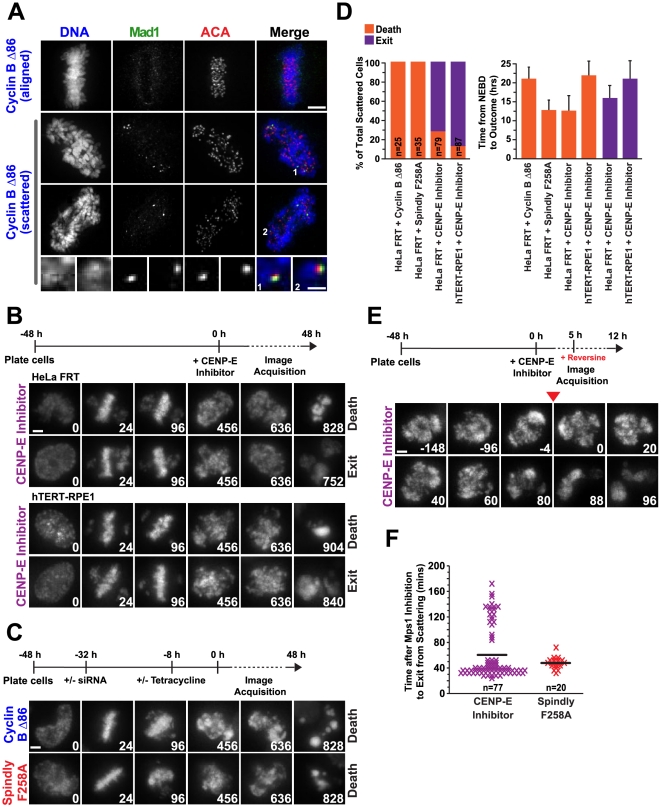
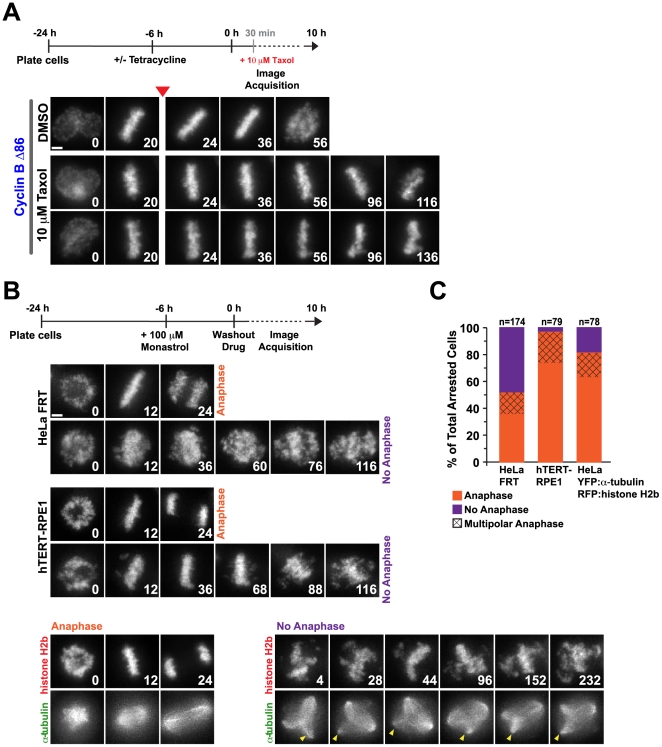
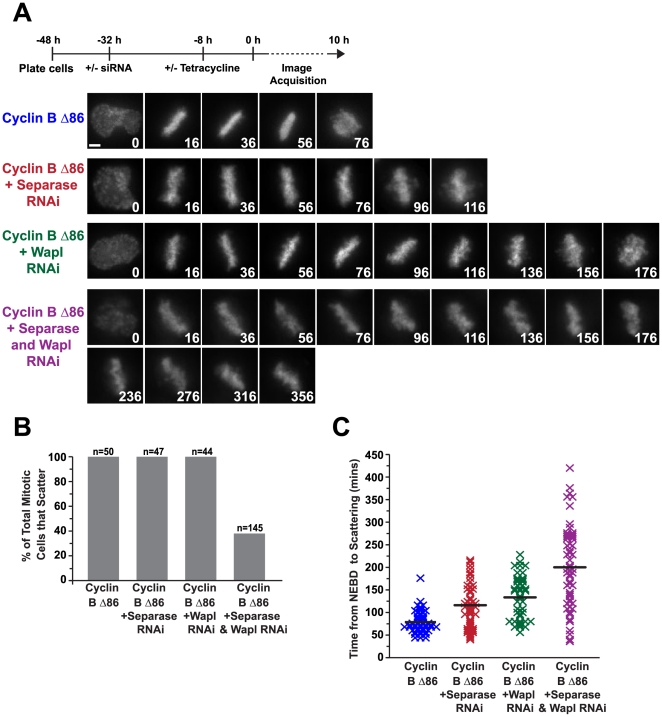
Chromosome segregation requires coordinated separation of sister chromatids following biorientation of all chromosomes on the mitotic spindle. Chromatid separation at the metaphase-to-anaphase transition is accomplished by cleavage of the cohesin complex that holds chromatids together. Here we show using live-cell imaging that extending the metaphase bioriented state using five independent perturbations (expression of non-degradable Cyclin B, expression of a Spindly point mutant that prevents spindle checkpoint silencing, depletion of the anaphase inducer Cdc20, treatment with a proteasome inhibitor, or treatment with an inhibitor of the mitotic kinesin CENP-E) leads to eventual scattering of chromosomes on the spindle. This scattering phenotype is characterized by uncoordinated loss of cohesion between some, but not all sister chromatids and subsequent spindle defects that include centriole separation. Cells with scattered chromosomes persist long-term in a mitotic state and eventually die or exit. Partial cohesion loss-associated scattering is observed in both transformed cells and in karyotypically normal human cells, albeit at lower penetrance. Suppressing microtubule dynamics reduces scattering, suggesting that cohesion at centromeres is unable to resist dynamic microtubule-dependent pulling forces on the kinetochores. Consistent with this view, strengthening cohesion by inhibiting the two pathways responsible for its removal significantly inhibits scattering. These results establish that chromosome scattering due to uncoordinated partial loss of chromatid cohesion is a common outcome following extended arrest with bioriented chromosomes in human cells. These findings have important implications for analysis of mitotic phenotypes in human cells and for development of anti-mitotic chemotherapeutic approaches in the treatment of cancer.
染色体分离需要在有丝分裂纺锤体上所有染色体的双取向之后协调分离姐妹染色单体。在中期到后期的转变过程中,通过切割将染色单体结合在一起的黏连复合物来完成染色单体的分离。在这里,我们使用活细胞成像显示,通过使用五种独立的扰动(表达不可降解的细胞周期蛋白 B、表达阻止纺锤体检查点沉默的 Spindly 点突变体、耗尽后期诱导因子 Cdc20、用蛋白酶体抑制剂处理或用有丝分裂驱动蛋白 CENP-E 的抑制剂处理)来延长中期双取向状态,最终导致染色体在纺锤体上散射。这种散射表型的特征是一些姐妹染色单体之间的协调性丧失,但不是所有的,随后出现包括中心粒分离在内的纺锤体缺陷。具有散射染色体的细胞在有丝分裂状态下长期存在,并最终死亡或退出。在转化细胞和核型正常的人类细胞中都观察到部分黏连丢失相关的散射,尽管其渗透率较低。抑制微管动力学可减少散射,表明着丝粒处的黏连无法抵抗动粒上依赖微管的拉力。这一观点与以下事实一致:通过抑制负责其去除的两条途径来增强黏连,可显著抑制散射。这些结果表明,由于姐妹染色单体黏连的不协调部分丧失导致染色体散射,是人类细胞中双取向染色体延长阻滞后常见的结果。这些发现对人类细胞有丝分裂表型的分析以及开发用于癌症治疗的抗有丝分裂化学治疗方法具有重要意义。