Epidemiology and Public Health, Peninsula College of Medicine and Dentistry, University of Exeter, Exeter, United Kingdom.
Environ Health Perspect. 2011 Dec;119(12):1788-93. doi: 10.1289/ehp.1103809. Epub 2011 Aug 10.
Bisphenol A (BPA) is a synthetic estrogen commonly used in polycarbonate plastic and resin-lined food and beverage containers. Exposure of animal and cell models to doses of BPA below the recommended tolerable daily intake (TDI) of 50 μg/kg/day have been shown to alter specific estrogen-responsive gene expression, but this has not previously been shown in humans.
We investigated associations between BPA exposure and in vivo estrogenic gene expression in humans.
We studied 96 adult men from the InCHIANTI population study and examined in vivo expression of six estrogen receptor, estrogen-related receptor, and androgen receptor genes in peripheral blood leukocytes.
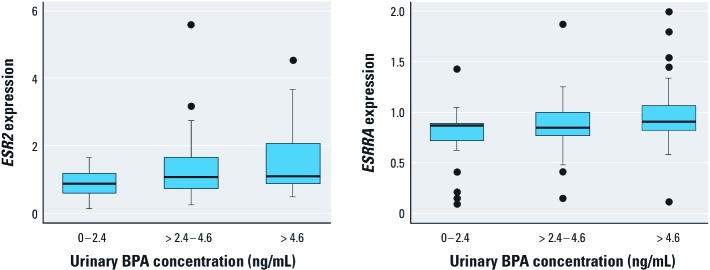
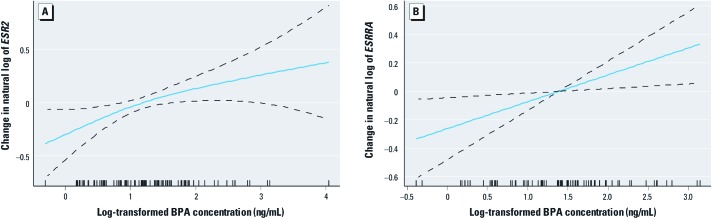
The geometric mean urinary BPA concentration was 3.65 ng/mL [95% confidence interval (CI): 3.13, 4.28], giving an estimated mean excretion of 5.84 μg/day (95% CI: 5.00, 6.85), significantly below the current TDI. In age-adjusted models, there were positive associations between higher BPA concentrations and higher ESR2 [estrogen receptor 2 (ER beta)] expression (unstandardized linear regression coefficient = 0.1804; 95% CI: 0.0388, 0.3221; p = 0.013) and ESRRA (estrogen related receptor alpha) expression (coefficient = 0.1718; 95% CI: 0.0213, 0.3223; p = 0.026): These associations were little changed after adjusting for potential confounders, including obesity, serum lipid concentrations, and white cell subtype percentages. Upper-tertile BPA excretors (urinary BPA > 4.6 ng/mL) had 65% higher mean ESR2 expression than did lower-tertile BPA excretors (0-2.4 ng/mL).
Because activation of nuclear-receptor-mediated pathways by BPA is consistently found in laboratory studies, such activation in humans provides evidence that BPA is likely to function as a xenoestrogen in this sample of adults.
双酚 A(BPA)是一种常用于聚碳酸酯塑料和树脂衬里的食品和饮料容器的合成雌激素。动物和细胞模型暴露于低于推荐的可耐受每日摄入量(TDI)50μg/kg/天的 BPA 剂量下,已被证明会改变特定的雌激素反应基因表达,但这在人类中尚未得到证实。
我们研究了 BPA 暴露与人类体内雌激素基因表达之间的关系。
我们研究了来自 InCHIANTI 人群研究的 96 名成年男性,并检查了外周血白细胞中六种雌激素受体、雌激素相关受体和雄激素受体基因的体内表达。
尿中 BPA 浓度的几何平均值为 3.65ng/ml[95%置信区间(CI):3.13,4.28],估计平均日排泄量为 5.84μg[95%CI:5.00,6.85],明显低于目前的 TDI。在年龄调整模型中,较高的 BPA 浓度与更高的 ESR2[雌激素受体 2(ER beta)]表达呈正相关(未标准化线性回归系数=0.1804;95%CI:0.0388,0.3221;p=0.013)和 ESRRA(雌激素相关受体 alpha)表达(系数=0.1718;95%CI:0.0213,0.3223;p=0.026):这些关联在调整潜在混杂因素后变化不大,包括肥胖、血清脂质浓度和白细胞亚型百分比。上三分位 BPA 排泄者(尿中 BPA>4.6ng/ml)的 ESR2 表达平均比下三分位 BPA 排泄者(0-2.4ng/ml)高 65%。
由于 BPA 对核受体介导途径的激活在实验室研究中始终存在,因此在该成年人样本中,BPA 的这种激活提供了证据表明 BPA 可能作为一种外源性雌激素发挥作用。