Department of Plant Biology and Pathology, Rutgers University, New Brunswick, NJ 08901, USA.
J Exp Bot. 2011 Nov;62(15):5311-33. doi: 10.1093/jxb/err166. Epub 2011 Aug 9.
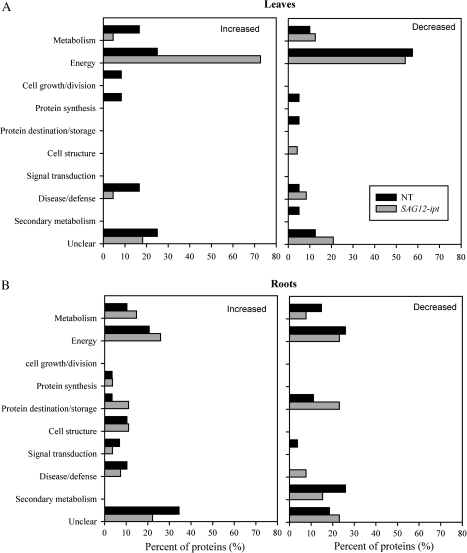
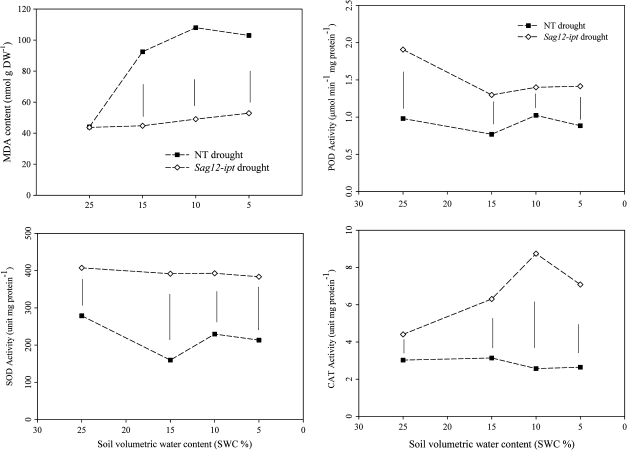
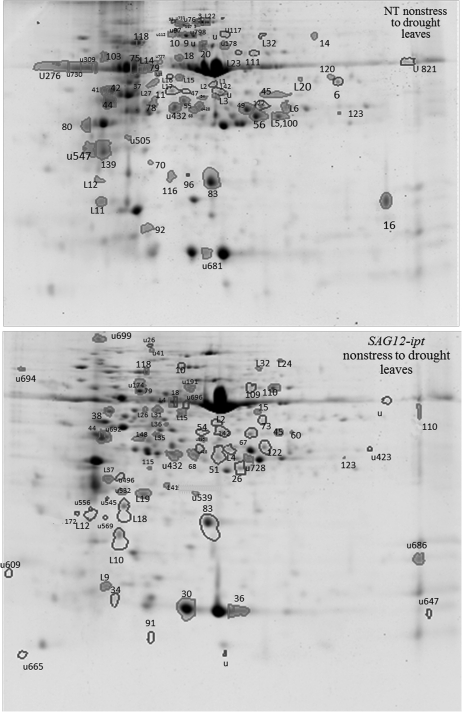
Cytokinins (CKs) may be involved in the regulation of plant adaptation to drought stress. The objectives of the study were to identify proteomic changes in leaves and roots in relation to improved drought tolerance in transgenic creeping bentgrass (Agrostis stolonifera) containing a senescence-activated promoter (SAG12) and the isopentyl transferase (ipt) transgene that increases endogenous CK content. Leaves of SAG12-ipt bentgrass exhibited less severe senescence under water stress, as demonstrated by maintaining lower electrolyte leakage and lipid peroxidation, and higher photochemical efficiency (F(v)/F(m)), compared with the null transformant (NT) plants. SAG12-ipt plants had higher root/shoot ratios and lower lipid peroxidation in leaves under water stress than the NT plants. The suppression of drought-induced leaf senescence and root dieback in the transgenic plants was associated with the maintenance of greater antioxidant enzyme activities (superoxide dismutase, peroxidase, and catalase). The SAG12-ipt and NT plants exhibited differential protein expression patterns under well-watered and drought conditions in both leaves and roots. Under equivalent leaf water deficit (47% relative water content), SAG12-ipt plants maintained higher abundance of proteins involved in (i) energy production within both photosynthesis and respiration [ribulose 1,5-bisphosphate carboxylase (RuBisCO) and glyceraldehyde phosphate dehydrogenase (GAPDH)]; (ii) amino acid synthesis (methionine and glutamine); (iii) protein synthesis and destination [chloroplastic elongation factor (EF-Tu) and protein disulphide isomerases (PDIs)]; and (iv) antioxidant defence system (catalase and peroxidase) than the NT plants. These results suggest that increased endogenous CKs under drought stress may directly or indirectly regulate protein abundance and enzymatic activities involved in the above-mentioned metabolic processes, thereby enhancing plant drought tolerance.
细胞分裂素(CKs)可能参与了植物适应干旱胁迫的调节。本研究的目的是鉴定与提高含有衰老激活启动子(SAG12)和异戊烯基转移酶(ipt)转基因匍匐翦股颖(Agrostis stolonifera)耐旱性相关的叶片和根系的蛋白质组变化,ipt 转基因增加了内源性 CK 含量。在水分胁迫下,SAG12-ipt 匍匐翦股颖叶片的衰老程度较轻,表现为电解质泄漏和脂质过氧化程度较低,而光化学效率(Fv/Fm)较高,与对照转化体(NT)植株相比。在水分胁迫下,SAG12-ipt 植株的根/茎比更高,叶片脂质过氧化程度更低。与 NT 植株相比,转基因植株在干旱诱导的叶片衰老和根死亡中表现出更强的抗氧化酶活性(超氧化物歧化酶、过氧化物酶和过氧化氢酶)。在水分充足和干旱条件下,SAG12-ipt 和 NT 植株在叶片和根系中表现出不同的蛋白质表达模式。在等效叶片水分亏缺(相对含水量 47%)下,SAG12-ipt 植株维持较高丰度的参与以下过程的蛋白质:(i)光合作用和呼吸作用中的能量产生[核酮糖 1,5-二磷酸羧化酶(RuBisCO)和 3-磷酸甘油醛脱氢酶(GAPDH)];(ii)氨基酸合成(甲硫氨酸和谷氨酰胺);(iii)蛋白质合成和定位[叶绿体延伸因子(EF-Tu)和蛋白质二硫键异构酶(PDIs)];和(iv)抗氧化防御系统(过氧化氢酶和过氧化物酶),而 NT 植株则较低。这些结果表明,干旱胁迫下内源 CKs 的增加可能直接或间接调节与上述代谢过程相关的蛋白质丰度和酶活性,从而提高植物的耐旱性。