Thoracic Oncology Service, Division of Solid Tumor Oncology, Department of Medicine, Memorial Sloan-Kettering Cancer Center, Weill Cornell Medical College, New York, New York, USA.
Clin Cancer Res. 2011 Oct 1;17(19):6322-8. doi: 10.1158/1078-0432.CCR-11-1080. Epub 2011 Aug 10.
Given the unprecedented efficacy of EGFR tyrosine kinase inhibitors (TKI) in advanced EGFR-mutant lung cancer, adjuvant TKI therapy is an appealing strategy. However, there are conflicting findings regarding the potential benefit of adjuvant EGFR-TKI in patients with lung cancer harboring EGFR mutations. To better understand these results, we studied the natural history of lung cancers which recurred despite adjuvant TKI.
Patients with recurrent EGFR-mutant lung cancer following adjuvant TKI were identified using an Institutional Review Board-approved mechanism. Recurrent cancer specimens were tested for resistance mutations. Sensitivity to retreatment with EGFR-TKI was evaluated.
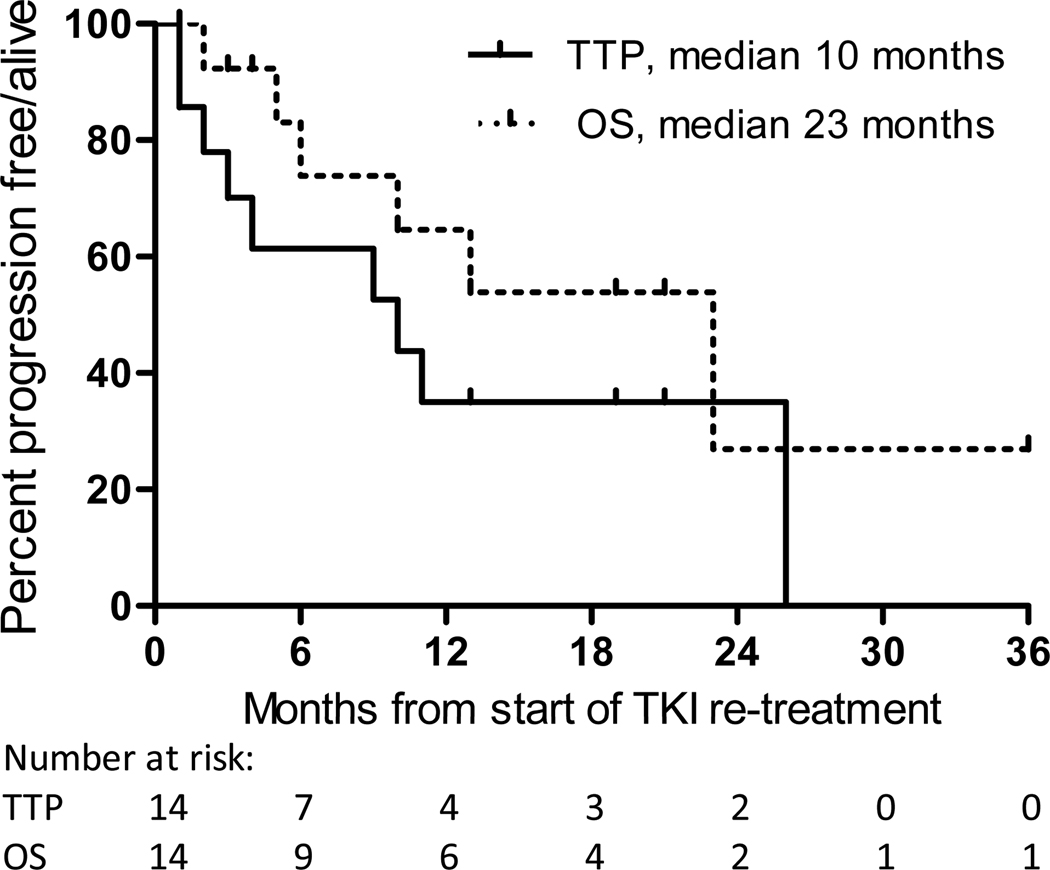
Twenty-two patients with cancers harboring an EGFR sensitizing mutation received adjuvant erlotinib or gefitinib for a median of 17 months (range 1-37 months). T790M was more common in cancers which recurred while receiving TKI than in those which recurred after stopping TKI (67% vs. 0%, P = 0.011). Fourteen patients who developed recurrence after stopping EGFR-TKI were retreated, with a median time to progression of 10 months and radiographic response seen in 8 of 11 patients with evaluable disease (73%).
Recurrence of EGFR-mutant lung cancer after stopping adjuvant TKI should not preclude a trial of TKI retreatment; a phase II trial of erlotinib in this setting is underway. Studies of adjuvant EGFR-TKI will underestimate the potential survival benefit of adjuvant TKI for patients with EGFR-mutant lung cancers if retreatment at recurrence is not given.
鉴于表皮生长因子受体酪氨酸激酶抑制剂(EGFR-TKI)在晚期 EGFR 突变型肺癌中的空前疗效,辅助 TKI 治疗是一种有吸引力的策略。然而,对于携带 EGFR 突变的肺癌患者,辅助 EGFR-TKI 是否具有潜在获益存在相互矛盾的研究结果。为了更好地理解这些结果,我们研究了尽管接受辅助 TKI 治疗但仍复发的肺癌的自然史。
通过机构审查委员会批准的机制,确定了接受辅助 TKI 治疗后出现 EGFR 突变型肺癌复发的患者。对复发性癌症标本进行耐药突变检测。评估对 EGFR-TKI 再治疗的敏感性。
22 例携带 EGFR 敏感突变的患者接受了辅助厄洛替尼或吉非替尼治疗,中位时间为 17 个月(范围 1-37 个月)。在接受 TKI 治疗时复发的癌症中 T790M 更为常见,而在停止 TKI 治疗后复发的癌症中则更为罕见(67% vs. 0%,P = 0.011)。14 例在停止 EGFR-TKI 后出现复发的患者接受了再治疗,中位无进展生存期为 10 个月,在可评估疾病的 11 例患者中,有 8 例(73%)出现了影像学反应。
停止辅助 TKI 后 EGFR 突变型肺癌的复发不应排除 TKI 再治疗的尝试;正在进行这项研究中厄洛替尼的 II 期试验。如果在复发时不给予再治疗,那么研究辅助 EGFR-TKI 将低估辅助 TKI 对携带 EGFR 突变的肺癌患者的潜在生存获益。