Department of Psychology, University of Milano-Bicocca Milan, Italy.
Front Psychol. 2010 Oct 18;1:169. doi: 10.3389/fpsyg.2010.00169. eCollection 2010.
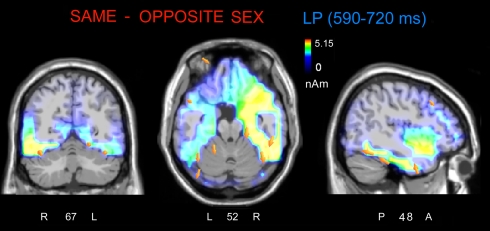
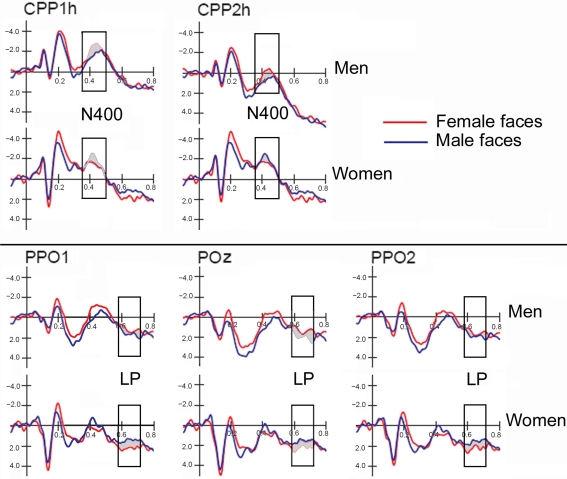
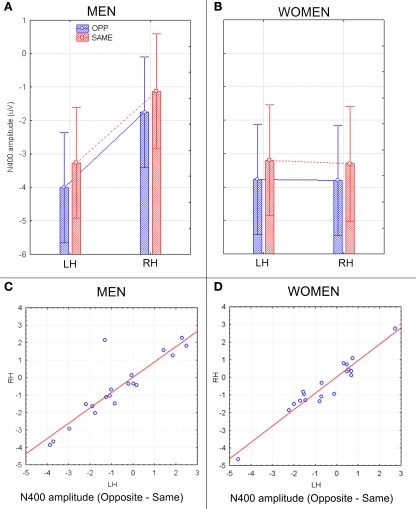
Some behavioral and neuroimaging studies suggest that adults prefer to view attractive faces of the opposite sex more than attractive faces of the same sex. However, unlike the other-race face effect (Caldara et al., 2004), little is known regarding the existence of an opposite-/same-sex bias in face processing. In this study, the faces of 130 attractive male and female adults were foveally presented to 40 heterosexual university students (20 men and 20 women) who were engaged in a secondary perceptual task (landscape detection). The automatic processing of face gender was investigated by recording ERPs from 128 scalp sites. Neural markers of opposite- vs. same-sex bias in face processing included larger and earlier centro-parietal N400s in response to faces of the opposite sex and a larger late positivity (LP) to same-sex faces. Analysis of intra-cortical neural generators (swLORETA) showed that facial processing-related (FG, BA37, BA20/21) and emotion-related brain areas (the right parahippocampal gyrus, BA35; uncus, BA36/38; and the cingulate gyrus, BA24) had higher activations in response to opposite- than same-sex faces. The results of this analysis, along with data obtained from ERP recordings, support the hypothesis that both genders process opposite-sex faces differently than same-sex faces. The data also suggest a hemispheric asymmetry in the processing of opposite-/same-sex faces, with the right hemisphere involved in processing same-sex faces and the left hemisphere involved in processing faces of the opposite sex. The data support previous literature suggesting a right lateralization for the representation of self-image and body awareness.
一些行为和神经影像学研究表明,成年人更喜欢观看异性的有吸引力的面孔,而不是同性的有吸引力的面孔。然而,与异族面孔效应(Caldara 等人,2004)不同,对于在面孔处理中是否存在异性/同性偏见,人们知之甚少。在这项研究中,130 名有吸引力的成年男性和女性的面孔被聚焦呈现给 40 名异性恋大学生(20 名男性和 20 名女性),他们正在进行次要的感知任务(景观检测)。通过记录来自 128 个头皮部位的 ERP 来研究面孔性别的自动处理。对面孔异性/同性偏见的神经标记包括对异性面孔的更大和更早的中央-顶叶 N400 以及对同性面孔的更大的晚期正波(LP)。对皮质内神经发生器(swLORETA)的分析表明,与面部处理相关的(FG,BA37,BA20/21)和与情绪相关的大脑区域(右侧海马旁回,BA35;穹窿,BA36/38;和扣带回,BA24)对面孔的反应有更高的激活。该分析的数据以及从 ERP 记录获得的数据支持了这样一种假设,即两性对面孔的处理方式与同性面孔不同。数据还表明,对面孔的处理存在半球不对称性,右侧半球参与处理同性面孔,左侧半球参与处理异性面孔。该数据支持了先前的文献,表明自我形象和身体意识的表示存在右侧偏侧化。